Showing posts with label ceramics. Show all posts

Sunday, June 25, 2017

Matière Grise @ Galerie Max Hetzler, Paris

Raymond Hains, Untitled, 1990
Albert Oehlen’s Untitled, 2017, commissioned for this exhibition, dispels all doubt about the ambiguity of grey. The colour chart that moves from what we might call grey to blue to brown to white showing that, in fact, any colour might be grey if seen in the right light. And vice versa, grey can become any other colour if seen from a given perspective, by a particular culture, in a specific historical moment. As Wittgenstein reminds us, we call grey, like all other colours, is always at the mercy of language, the words that we give to that peculiar cast of light on the surface before our eyes. I have no idea if it is Oehlen’s intention to cast the definition of grey into question, but this is what came to mind as I stood before this work that seems unrelated to everything he has done until now. While the form of the colour chart is nothing new—and visitors will be reminded of Gerhard Richter’s works of the same genre—its placement here at the entrance to Matière Grise as a claim about grey, is innovative.
Albert Oehlen, Untitled, 2017
The exhibition confirms all my convictions that grey is the most exciting colour. While each work on exhibition has some kind of value, the curation is what makes this show fascinating. Matière Grise brings together all of the materials in our world that are grey: steel, clay, oil, spray paint on cars, aluminium, charcoal and of course, paint. The exhibition consists of pieces ranging from Raymond Hains, Untitled (1990) made up of posters torn from the streets stuck on stainless steel, through Edmund de Waal’s still life of a pot, a book with a gold leaf leaning against it inside a small box, to a rock by Navid Nuur, enamelled and with indentations in which iron shavings are nestled. All of this matter is grey, and together, they remind us that grey matters.
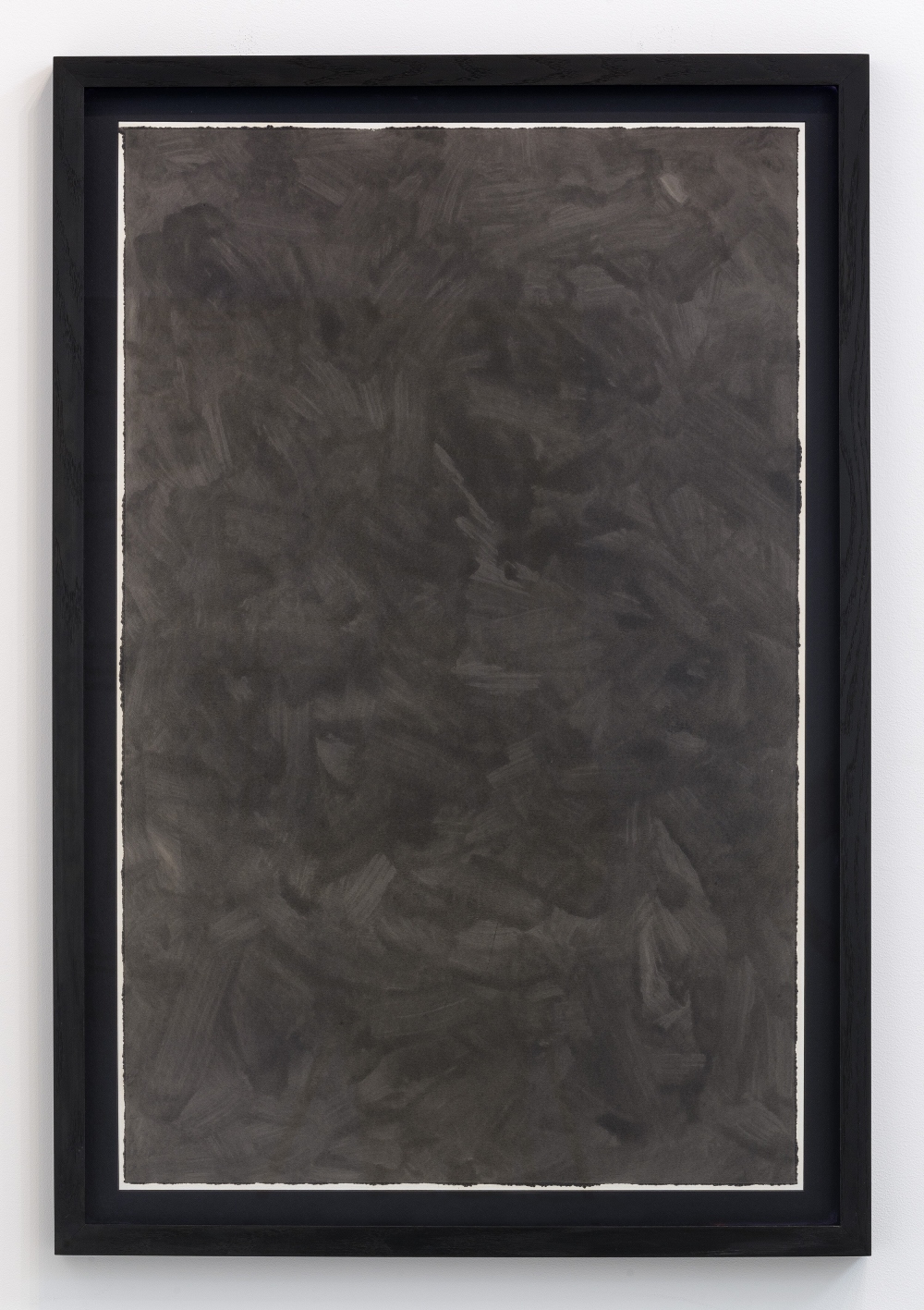
 
Loris Gréaud, Trajectories, 2017
My favourite of the individual pieces is Loris Gréaud’s Trajectories, 2017.  Car waste oil has been smeared across absorbent paper, mounted and framed in black oak. The bevelled edges of the paper which is mounted on board and then made precious through a frame. The unevenness of the paper on which the oil is smeared thus becomes foregrounded and similarly makes the oil as medium poetic. The oil raises many associations; the cars from which it has been wasted, the environment from which it has robbed, the economy it turns around, remind us that oil is such a politically and economically potent substance. And here, in Trajectories, oil makes paper sensuous and aesthetically pleasing, and in turn, delicate.
Jérémy Demester, Vin d'Anjou IX, 2017
It is interesting to note that all the pieces are abstract, and all are tactile, material and or sumptuous surfaces. And like Trajectories they all engage some form of transformation, either of the material or the grey. Each piece therefore reflects back on the colour grey. The shiny reflective surface of Jérémy Demester’s, Vin d’Anjoy IX, 2017 is hung opposite Gréaud’s Trajectories and looks blue by comparison, across the other side of the room. The two are in conversation, reflecting on their differences—reflective opposite absorbent—and through juxtaposition, their own materiality. In this example, we see how grey has the capacity to make ethereal substances material—oil, water, air, and of course, paint are made into things, distinct, but dependent on each other for definition. We see this transformation, literally, in the fourth panel of Hains’ Untitled. A horizontal blue line about 1/3 of the way down the panel turns blu paint into water, a substance. Materiality is also the conversation had by the objects of de Waal’s Tobias and his angel (2017): the objects in the box are ceramic, graphite, glass, aluminium, plexiglass, and all come together to transcend their individual identity and significance.
Günter Förg, Untitled, 2001
The question I came away with: why is it that grey is always rendered through abstraction? I don’t know the definitive answer, but I am convinced that artists turn to grey to pose the questions and problems that preoccupy, but cannot be examined through representation. Grey is a stripping back of the concerns of the aesthetic, and therefore, questions are resolved in grey where other colours have no idea. Thus, Günther Förg’s ribbons of dark grey on a lighter grey background ask questions about background and foreground, the difference between line and ground, between chaos and order, labyrinthine possibilities.

My commitment to grey stems from the fact that grey has to work with other colours, in different materials in order for its brilliance to shine through. Grey doesn’t have an easy life. And this exhibition is memorable because it is only in the coming together of the different works that all of this magic happens in the Max Hetzler gallery.


All images copyright Max Hetzler Gallery

Sunday, June 18, 2017

Lucio Fontana Crosses @ Galerie Karsten Greve


In yet another stunning exhibition at Karsten Greve’s corner gallery in the Marais, Lucio Fontana’s ceramic Crosses are strangely sublime. In keeping with my commitment to a modernist aesthetic, I have always been more interested in Fontana’s renowned defacement of the painted canvas than his ceramics. However, at the 2014 exhibition at the Musée d’Art Moderne de la Ville de Paris I realized that painting was more than it appeared thanks to the emphasis on the three dimensionality of the “cut canvases.” Even though the ceramic crosses appear very different from the cut canvases, this dimensionality and spatial articulation is clearly consistent between the two forms.


Here at the Karsten Greve exhibition, I discovered a delicate desecration of a different kind. The ceramics of Christ on the cross, in some cases Christ without a cross, and in others, crosses without Christ are beautiful and, of course, because they represent the sacrificial, they are painful. The contorted body of Christ is, like the misshapen cross with which he merges, hand moulded and fired such that the two verge into abstract form and emotional expression. The coming together of these two incompatible modes makes the pieces unusual and simultaneously exciting.

 
The surface of each piece is sumptuous, and the colour is surprising; where green turns into gold which turns into red and blue, the forms become ethereal, like fabric blowing in the wind rather than handmade ceramic sculptures. The materiality of the pieces is smooth so that it’s difficult to resist the temptation to run our fingers across the smooth, delicate surface, to feel this complex object that leaves behind a shadow as it seems to fly off the wall. We can see and want to trace the curves left by Fontana as he has moulded the clay, and left the edges as if suspended in midair. We can feel the indentations left by his fingers, the piece of clay stretched out to become a hand begging for mercy, a torso writhing in pain, a head bowed exhaustion. Even though the form is abstract, we have no difficulty finding the body and emotions of Christ.


One of the most curious aspects of the ceramic sculptures is their size; on the clean white walls of the gallery they appeared tiny. Their size makes them delicate, and somehow contributes to the pain as the expression given to the murdered Christ. As I walked around, I wondered if they could be religious? They are, after all, crucifixions. But, I am not sure they are any more sacred than Pasolini’s The Gospel According to Saint Matthew (1964)a film more interested in the social and ideological ramifications of power and sacrifice than it is in the biblical story. However, unlike Pasolini, Fontana doesn’t seem to be criticizing the church and its want to hang people on crosses. Rather, it’s as though Fontana uses the subject matter of the bible and its history as a vehicle for his concern with the use of art and colour to express the inexpressible. These fine works are perhaps best understood as artistic expressions of extreme emotion.  


Saturday, July 12, 2014

Lucio Fontana @ Musée d'art moderne de la ville de paris

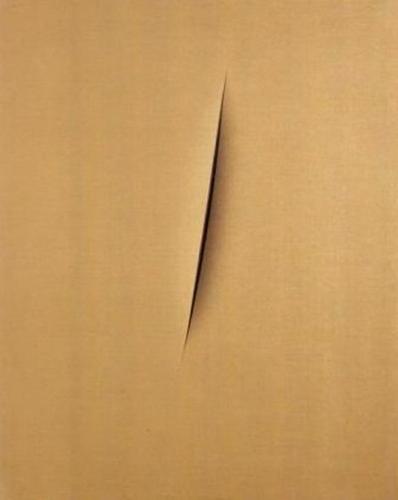
Image result for Lucio Fontana, Concetto Spaziale, Attesa, 1960
Lucio Fontana, Concetto Spaziale, Attesa, 1960
I had heard not very good things about the Lucio Fontana exhibition at the Musée d’Art Moderne de la Ville de Paris. At dinner last week, a friend looked appalled as she announced that over half the exhibition is taken up with ceramics and sculpture. It’s true: it took Fontana a long time to find his unique contribution to the history of art. In fact, it wasn’t until the 1950s, that is, halfway through the exhibition, that he starts putting holes in his canvases, and slicing them open. Up until this point his work is derivative and not very interesting. Even the early cut works are not so exciting, appearing as little more than thinly painted canvases with holes in them. It’s not until the 1960s, when he does nothing but cut and making holes in the canvas —  the final rooms of the exhibition — that the works come to be anything more than mediocre works with theoretical or historical rigour.
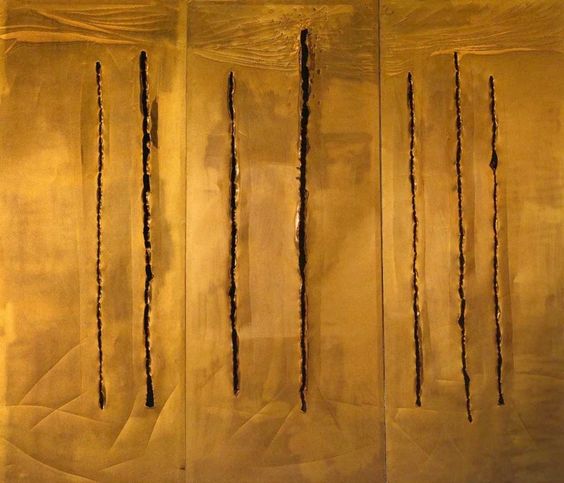
Lucio Fontana, Concetto Spaziale, Attese, 1966
One thing that surprised me (once I got to the final rooms of the exhibition) was that even though I always knew Fontana’s cuts are the ultimate iconoclastic gesture, I didn’t realize how little they have to do with painting. At times, the canvas is not even painted, but a piece of thin, almost transparent fabric covers the canvas and so the canvas is not even cut. The works are almost all entitled Concetto spaziale (Spatial Concept) thereby indicating the three-dimensional, articulation of an object in and as space, rather than as two dimensional images. And yet, while they are not about painting, the works are about the history of art. Fontana’s slicing open of the canvas speak a violence, disrespect, defacement, denigration of all that can be imagined by such a gesture. The act of cutting the face of the canvas, even when there is nothing on the canvas, is perhaps the most definitive act of iconoclasm.

Lucio Fontana, Concetto Spaziale, New York 10, 1962
Along with the displacement of the canvas as image, there is nothing to look at, even though the visual appearance of the canvas is always different from image to image. Visually, each spatial concept is like a repetition of those on either side of it. Whether there is one cut or a series of cuts, it doesn’t seem to make a difference, and we seem to be looking at a single concept being reiterated over and over again. And then, in the last few rooms — the 1960s — everything comes together a matter of years before Fontana dies. In the end, the works are about the sense of touch, they are erotic, they are gendered, imaginative, and somehow transport us to another level of experience. The cuts become a moment that we sense, an anterior moment, because it is as though we are looking at that moment of cutting itself. We get to feel the curve of the gesture of slitting – it’s incredibly sensuous. The cuts as the trace of the artist, are sensuous, physical, and they are no longer revealing violation, but some kind of spiritual belief, a calling. As Fontana approaches the end of his life, the cut is a creation, not a violation. But of course, it is still a violation because it slices the canvas open, however lovingly. And there is no mistaking that these are the gestures of a powerful male artist, making incisions that remind of female genitalia. Around the edges of the holes the paint is coagulated, where it has dried up, it is thick, we want to touch it, it is so tempting it arouses desire.
Lucio Fontana, Concetto Spaziale, 1962
In the final room of paintings, the holes on the canvas become bigger, they become gorgeous until there are more of the holes than the canvas. Finally, we realize, Fontana is an artist exploring the void. What in the early years was about making painting into sculptural, expressing the materiality of the canvas through its incision, by the late 1960s, Fontana is building sculptures that are constantly cutting away the material and all materiality, to find the nothingness. While the museum blurbs kept emphasizing Fontana’s interest in space and spatial organization, the works also strive towards its opposite, a non-space, absence.

Lucio Fontana, Concetto Spaziale. la Fine di Dio, 1966

It’s a spiritual practice – he’s actually a kind of romantic artist, not as modern as I have always assumed. At least, where the work might be modern in its material challenge to the identity and status of representation, especially painting, the most interesting dimension is the spiritual. Fontana strives for some kind of transcendence himself and we get to sense that journey. 


Images courtesy Musée d'Art Moderne de la Ville de Paris