Monday, September 23, 2013

Janet Cardiff, The Forty Part Motet, The Cloisters


Janet Cardiff’s eerie sound installation, The Forty Part Motet (2001) in the FuentidueƱa Chapel in the Cloisters is one of those New York events that is drawing immense crowds, and is worth every minute of the trek up to the top of Manhattan, and the long line to enter. The Forty Part Motet is the performance of Tudor composer Thomas Tallis’ (ca. 1505–1585) Spem in alium numquam habui (1556?/1573?) by the choir at Salisbury Cathedral. Cardiff placed a microphone on each individual chorister, recording his voice as an individual. She then places 42 speakers in a circle around the acoustically magnificent Chapel, inviting visitors to wander around from speaker to speaker (placed at ear level) or sit on a bench in the middle of the circle over the course of the 14 minute installation.

Despite the sacredness of the space and the music, and the spiritual nature of the experience, this nevertheless felt like a sound installation in a museum space. The crowds, respectful of the sacred music and the space it created were, as always in New York, dense. This translated into an interruption of the resonance, as the fullness and movement of music was interspersed with the sound of shuffling, whispers, coughing and the odd sneeze. I am certain that I experienced a different installation from the one at PS1 in 2012. For at heart, Cardiff’s piece is about the movement of music – as it shifts and changes across registers and voices, around, across, in and out of the circle formed by the speakers. And, The Forty Part Motet is about how the movement of music creates the space of the chapel. For this reason, the same installation would sound completely different if the chapel was empty, without people.
 
The Twelfth Century Apse
Nevertheless, or perhaps because of this, the meaning of Cardiff’s installation lies in the particularity of the visitor’s experience. This is made clear when we stand before different speakers, from one hearing a deep bass voice, from another the delicate treble of a young choir boy. In the distance, we might hear a tenor or a baritone, but then as we move to the next speaker, that voice in the distance recedes, is out of ear shot, not only because the music has progressed. The piece takes on different forms and shapes as we move to the middle of the circle, and the voices are heard in concert. The Forty Part Motet thus becomes defined by the listener, just as the music defines the space of the chapel, and our perspective of the twelfth-century apse which is on loan from San MartĆ­n at FuentidueƱa, near Segovia in Spain. Indeed, the apse is wholly altered by the music as it interacts with the sunlight that beams through the window.  

There were moments, no more than glimpses, when a voice usually a few feet, a few speakers away sounded off. Is this an illusion? Is this something created through the separation of the voices, each with its own speaker, and then the alternate coming together, in tune, as the voices reach our ears? Or is it that the voices sing different parts of the anthem and that juxtaposition at post-production makes them sound off? Or perhaps the explanation is more simple, perhaps the choristers are amateurs who hit a wrong note? It’s unclear why the odd note is off, but to be sure, I was not the only one to hear it.  

Lastly, my other question for Cardiff was why this particular piece? Is there something about it that lends itself to the concepts of movement of music, creating space, in its interaction with a medieval chapel? Of course, the piece was not made specifically for this space, but it was chosen by someone as the first modern artist to be invited to exhibit in the cloisters.


Monday, September 9, 2013

Ethan Murrow, American Ego @ la galerie particuliĆØre


Ethan Murrow, The Old Aristocratic Colours Breaking Through, 2013
On my way past the La Galerie ParticuliĆØre the other night on my bike, I glanced through the crowd to glimpse Ethan Murrow’s images. I thought, from a distance I was looking at photographs. When I went back for a closer look, I was pleasantly surprised to find huge graphite on paper drawings, huge because this is a medium usually used for more intimate scale pictures. Murrow depicts a strange, archaic America inspired by, and at times, depicting well known American literary myths and legends, paintings and historical events. As a lady from the gallery walked around the exhibition identifying the references and influences in each work for me, I wondered if most viewers would have even heard of the names and narratives, let alone recognize them in Murrow’s drawings.

Ethan Murrow, The Boast of Clotilde, 2013
Nevertheless, when standing before an image such as Moby Dick, 2013, the ambiguities are not in the subject matter of the image. If only thanks to the title we are immediately made aware of the grand narrative of adventure and discovery that is woven through the exhibition. In spite of the realist detail of the image, there is always something surreal in Murrow’s drawings. The title Moby Dick, does not sit well with four wheel drive vehicles, in a canyon, on the shores of a lake that has no depth, tiny figures holding umbrellas or wearing hard hats, with no rain and no reason for protective headwear. And when an elephant falls into the water in The Old Aristocratic Colours Breaking though, he falls off a raft that could never have held him. We know we are in the world of magic and miracles with this image. And yet, the title of this drawing is taken from Alexis de Tocqueville’s Democracy in America: “The surface of American society is covered with a layer of democratic paint, but from time to time one can see the old aristocratic colours breaking through”.  Thus, we become alerted to the multiple layers of works that are all at once political, playful, art historical and technically precise.

Ethan Murrow, Early Warning System, 2013
Many of the images contain antiquated and clearly malfunctioning machines: helicopters, cars, or in Early Warning System, a chimpanzee sits on a raft surrounded by an infinite stretch of water, accompanied by an unwieldy machine that could not possibly get him to where he is going. This is espite the face that his raft is named “ABLE.” When technology is introduced, the historical becomes the arcane, in narratives that are made unreal, and filled with the promise of failure. The narratives that Murrow references, revises, critiques and makes fun of are always about the discovery and colonization of America. They are about the formation of the American identity, its flaws and foibles, built as it is on conspiracies, whale sightings, UFOs, supernatural and animal life.

Ethan Murrow, Kingdom, 2013
What I loved most about Murrow’s drawings was their complex layers, as I say, not all of which I had access to. These images discourse through narratives of discovery, the movies, the Colonization of the American West, in cutting and simultaneously, highly entertaining depictions. Similarly, Murrow’s drawings are technically superb: painstakingly detailed in their reach for photographic realism in the form of graphite drawings. 


All images courtesy the artist and La galerie particuliĆØre

Wednesday, September 4, 2013

Bad Timing, dir. Nicolas Roeg, 1980


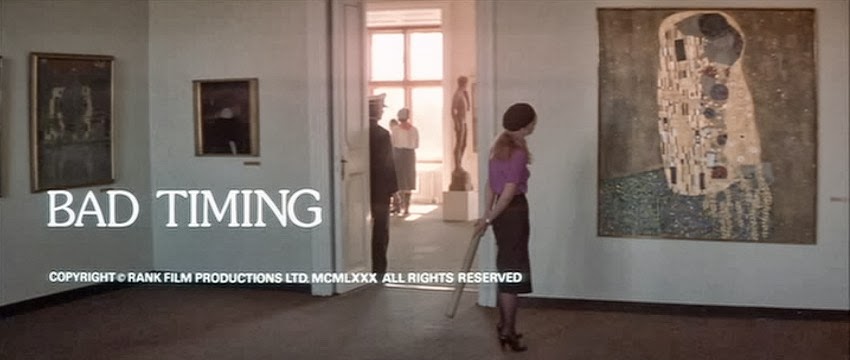
Even though it is supposed to be my mĆ©tier, I rarely have much to say about film these days. Least of all do I have much of an opinion on contemporary releases. But every now and then an old film will have a new print made and enjoy an extended run at one of the repertory cinemas in the 5th. Whatever we think of the film, its content, the apparently transgressive scenes of rape, Nicolas Roeg’s Bad Timing is a film that looks gorgeous. With its provocative – and kind of 1980s – use of montage, its lyrical, drifting narrative of closely cropped images, explicit sex and some extremely painful obsessions engaged in by the incognisant, Alex Lindon played by Art Garfunkel, the 35mm technovision image is glorious. I was left reciting the warn out refrain, bemoaning that they stopped making films that look like this.

On the Czechoslavakian-Austrian border: Art Garfunkel and Teresa Russell in Bad Timing, 1980
Even beyond the way it looks, Bad Timing has some lovely gestures that make it completely a film of its time. For example, the use of the border between Czechoslavakia and Austria as Milena crosses for never fully explained reasons, is very much of its time. Shot in 1979, the film assumes all of the chill of the border crossing accompanied by the strains of Pachabel’s Canon that pervaded divided Europe during the Cold War. And then when the film cuts to an austere Vienna, Milena infuses verve and colour to an otherwise stiff, colourless world. The most daring Vienna can offer is the seduction of the Gustav Klimt paintings, surrounded by which we first see Milena and Lindon sharing their wisdom on sex and love as they move through the Secessionist museum.


It’s not a perfect film by any means. The Harvey Keitel character of the Austrian investigator of the “crime”, Milena’s mysterious death, is tentatively placed as a mirror to Garfunkel’s Lindon, but the mirroring isn’t developed. As Linden, the professor of psychoanalysis (an appropriate profession for a film set in Vienna) becomes more and more disturbed, in what is a textbook obsession for Milena, the vivacious woman he can never fully own and dominate, Keitel’s character walks around looking very handsome, but not doing an awful lot. How he reaches his genius insights that prove Lindon’s rape and ultimate guilt in causing the death, is assumed, never explained by the film. The only insight into Keitel’s character is so unexplained that it seems irrelevant to the narrative when he comes home one night and we see the photos of his wife on he dresser.

Similarly, why Milena has left her husband in Hungary is never made clear – his role seems to be simply to tantalize Alex and to ensure he has reason to distrust her, to confirm his reasons for obsession.

The narrative of Bad Timing does not collapse in the same way that Performance ‘s does, both at the level of the gender collapsing and the narrative’s imitation of that collapse. However, in Bad Timing the narrative has a very meandering, lazy forward motion. While we never know where it is going, its unhurried wanderings are forgive because the look of the film is so enticing, as is the conviction with which a masterful depiction of sexual obsession that is only just on the other side of the line that separates us from Alex Lindon. Bad Timing, with its radical storytelling techniques and its images of sexuality at its most violent and irrevocable still puts a chill in the air. Especially when the other films on offer here in Paris are the likes of Wolverine, Star Trek, and Spiderman.