Tuesday, February 11, 2014

Harun Farocki, Parallel I-IV @ Thaddaeus Ropac


Harun Farocki, Parallel I-IV, 2012
Photo: Philippe Servent
Courtesy Galerie Thaddaeus Ropac Paris-Salzburg
In familiar Farocki fashion, Parallel I-IV exposes the mechanisms and the ideology that motivates computer-animated images, specifically those used in video games and war reconnaissance. And in typical Farocki style, a voiceover narration describes what we see in the image, telling us what we see, but more likely, what to look at. The merging of text, image, and voiceover is, consistent with his oeuvre since its beginnings in the 1970s, all about the control and manipulation of images, and as a result, how this leads to the control and manipulation of the way we think about reality.
Harun Farocki, Parallel I, 2012
Copyright Harun Farocki
Courtesy Galerie Thaddaeus Ropac Paris-Salzburg
When we walk into the downstairs gallery at Thadaeus Ropac, we enter a world in which we are surrounded by the four installations of Parallel. Each installation comprises two screens and before the coupled images, a bench. A speaker above each bench offers a narration of what we see in the image. While for the most part the narration —a familiar device in Farocki’s essay films — tells us what we are looking at, it is also a performance of the kind of manipulation that is discoursed about in the narration. As a virtual figure attempts and fails repeatedly to break through a road block, apparently an innocent attempt to escape the police, the narration explains that even though the road block is non-existent, being no more than an (invisible) surface appearance, its intransigence defies forward motion. Of course, the “explanation” is also a metaphorical warning. The focus on borders in Parallel II is perhaps the strongest of the four pieces. In addition to the animated figures attempting to break through barriers, we see a man on a horse in a recreated Western attempting to scale a cliff. In Parallel III nothing is a barrier: men walk through hedges and behind them no leaf is out of place. The borders are both invisible and virtual, and yet, they are always impenetrable.

Harun Farocki, Parallel II, 2012
Copyright Harun Farocki
Courtesy Galerie Thaddaeus Ropac Paris-Salzburg

The series also muses on —predictably—the disillusion of reality into an extreme illusion in the video images. In contrast to the virtual world, photographs are real, they are objects in the world and the voiceover convinces us that they are also representing something. Even if there is nothing behind the image, at least in the photograph, there is a piece of paper. Farocki reveals what we already know: that the virtual image is one step further away from reality because underneath the surface of water in the virtual world, there is a computer screen, which is itself an illusion. 
Harun Farocki, Parallel IV, 2012
Copyright Harun Farocki
Courtesy Galerie Thaddaeus Ropac Paris-Salzburg
Typical Farocki, there is not a lot to see on the four double screens, the image is cheap, not aestheticized. Because these are thinking images, they are images that ask us to think about what we see, rather than to be caught up in what we see. And yet, again characteristically Farocki, the content of what we see is vitally important, even though he exposes the manipulation that enables the images. The screens, especially Parallel III and Parallel IV are overwhelmed by fighting, confrontation, and devastation. Video games are one with representations of war, where the goal of both is to destroy the enemy which is usually a person.

Harun Farocki, Parallel II, 2012
Copyright Harun Farocki
Courtesy Galerie Thaddaeus Ropac Paris-Salzburg

I also enjoyed the history offered in Parallel I in which Farocki places the computer images in their own history from vertical and horizontal lines in the 1970s onwards to the emergence of the virtual image as it has developed from out of the filmic. In cinema there are two types of wind, the wind that blows and the wind of a wind machine – the real and the filmically manipulated. In the computer images, there is only one type of wind, and its constructed. Water in motion is made from dashes and dots, and it is simply that they are closer resemblances to reality, not that they are any more real. There is no connection beyond the visual resemblance to the original object. As the narration tells us, there is no longer any form of mystery to the image in its virtual manifestation; it, like the body that appears and disappears in the same moment, no longer exists. 
Harun Farocki, Parallel IV, 2012
Copyright Harun Farocki
Courtesy Galerie Thaddaeus Ropac Paris-Salzburg
This exhibition coincides with the single artist exhibition of Farocki’s oeuvre in the Hamburger Bahnhof, Berlin, and is both predictably Farocki and unpredictably new. Perhaps most refreshing about Parallel (2012) is the audience: I sat in the blue chip Thaddaeus Ropac gallery in the Marais, surrounded by freshfaced, bright-eyed young men with backpacks, clutching skateboards. It was lovely to enjoy esoteric art with this audience, but I kept wondering about their responses to Farocki’s installation. Those who stayed longer than ten minutes, that is, to see the narrative of each part of Parellel in its entirety, seemed captivated enough, but did they anticipate an installation on video games would be this discursive? And I wondered if the exhibition showed them anything they didn’t already know, and haven’t already seen in a more sophisticated form in their own video gaming lives?


Tuesday, January 28, 2014

Donation Florence and Daniel Guerlain

Marlene Dumas, THe Army is Looking for the Enemy, 1985

There’s no secret to where the money comes from for this vast collection of drawings, watercolours, ink and washes, collages, gouaches that Daniel and Florence Gerlain have recently donated to the Centre Pompidou. But what makes the Guerlain donation of “drawings” stand out is the collectors’ voracious appetite for works beyond personal and peculiar taste. The collection, or at least, that part of it currently on display at the Pompidou Centre is not only vast, but varied, international and fascinating.

Eduardo Arroya, Coiffeur, 1993
This said, I do find these kinds of exhibitions difficult to approach. Because the Guerlain’s seem to acquire such a range of contemporary drawings, there’s not a consistent or thematic logic to the collection. And because only one work, or at best, one series, by each artist is exhibited here, it’s difficult to give context to the works as we wander through. Which is to say, the collection itself is not focused enough to create internal logical that would, in turn, offer context. So my comments here are more general and more impressionistic than I would like them to be.


If there is one quality that binds all the works on display here is their intimacy. As Daniel Guerlain says in the accompanying text, what makes  “drawings” so special is their immediacy. They reveal the most direct image of the artists brain, without reworking, without the temporal narrative of rethinking. In the delicate, sometimes barely perceptible flourishes of the pencil, pen, brush or charcoal, we see thinking in motion.
 
Javier Perez, Metamorfosis, 2004
There’s also an immense sensuousness to many of the works displayed. At times, the paper and its undulations, knots and flaws become a part of the work itself. And at other times the ink, watercolours, the media of representation are always uneven and in motion that we can feel them, smell them in a way that we cannot when standing before the very polished images of old masters, in completion. When the paint buckles the paper, and again, when the watercolour becomes transparent on the end of a brushstroke, the materials almost become erotic they are so physical, tactile.

All of the works are also ephemeral. It’s not just the media of representation, but the supports are almost verging on the disposable, the replaceable as each work has a sense of transience, of motion. When I see a delicate Gerhard Richter sketch, an image I have never seen before, I imagine this could easily be a picture that he painted when he was filling in time, like other people read their telephones or smoke a cigarette. And then it might have found its way into a drawer, or to the bottom of a pile of sketches, forgotten. There’s no heavy baggage attached to these images, no lofty ideas. They are as spontaneous as they are transient, here today, gone tomorrow, a thought blown in the wind, even when the works are intricately executed.
Tomasz Kowalski, Untitled, 2012
There were so many pieces on display in the collection, some by artists who no one will know, others by big names such as Gerhard Richter, Richard Longo, Albert Oehlen. They are all arranged next to each other, no preference given to the big names. Much of the new work is extremely impressive, and so it deserves to sit with that of well-known artists. Two of my newly discovered favorites among the works were the exquisite watercolours of Silvia Bächli and Thomas Müller. Both were simple, as in uncluttered, sparse, but confident depictions.

On my way out of the Pompidou Centre, I had a quick look around the Surrealism and its Objects exhibition upstairs. It’s interesting to see the Pompidou Centre indulging so unashamedly in the blockbuster approach to art. And it is ultimately not such a satisfying playground of Surrealist objects, as the title suggests. My advice? Stay downstairs in the Guerlain donation and discover your own favourite new artists. 

Sunday, January 19, 2014

Robert Wilson - Living Rooms au Louvre

Robert Wilson, Shaker Chair, Living Rooms, 2013

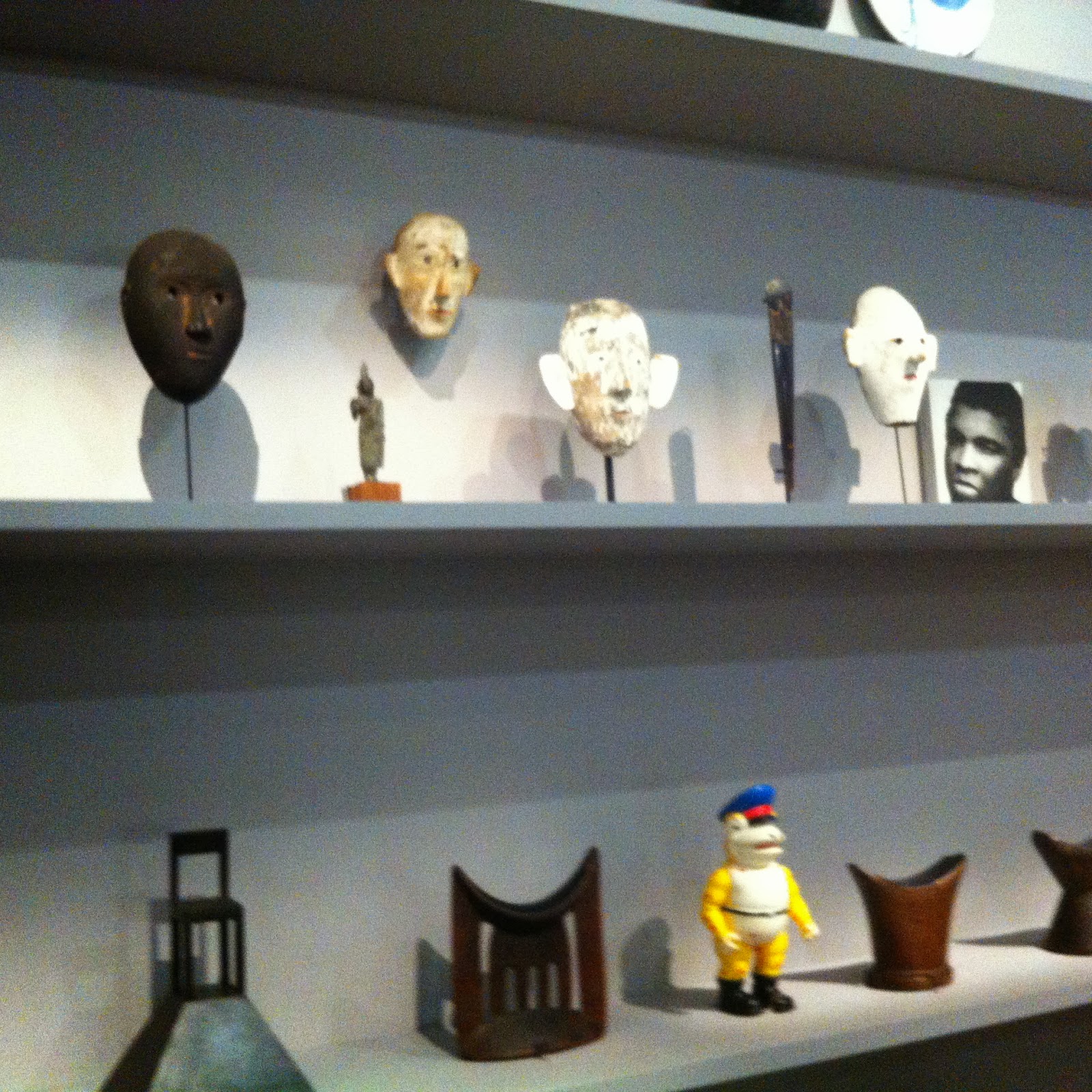
In keeping with their tradition of inviting contemporary artists to engage with and use the works in its collection, the Louvre is currently displaying Robert Wilson – Living Rooms. Wilson, the renowned American Minimalist theatre director, accepted the invitation, turned it on its head, and then inside out. He moved his own art collection into the Louvre instead of working with theirs as every other artist has done. Wilson has organized his belongings in La Salle de la Chapelle, covering the walls from floor to ceiling with artworks, ephemera, masks and totems from native cultures, and memorabilia. In the centre of the space is his bed with a compelling video with Lady Gaga at its foot and a collection of native figurines at its head. All the objects in La Salle de la Chapelle are precisely placed, often being put behind glass and in vitrines in spite of their apparent mundanity.
Robert Wilson, Living Rooms, 2013
While I understand the references to surrealism, most significantly André Breton’s collection of art and ethnographic material, I was unsure of how to approach the display, what to make of it. I wasn’t sure of what I was being asked to look at? Usually, when we see inside someone’s collection of art or trinkets, we gain privileged access to the personality who collects. Or, as is the case with Breton’s collection, unknown, unappreciated objects are given new light, energy and contexts. Alternatively, the collection itself becomes a work of art, as we know so well from Joseph Cornell’s boxes. But at the Louvre, there’s little to learn about Wilson that we don’t already know, and although some of the Alaskan artefacts are interesting, there’s not a consistent or overall lesson, even impression, to be gleaned from their collection by Wilson. As a result, it is fun to see Marlene Dietrich's used shoes on display, or an anonymous photograph of Albert Einstein, but their appeal as curiosities only goes so far.

Marlene Dietrih's Shoes, in Living Rooms, 2013
In two other spaces — Le salon Denon, the heart of the great French paintings of the the 19th century, and la Salle de la Maquette in the subterranean Medieval wing — are a collection of Video Portraits of Lady Gaga. For these works, films Lady Gaga in video performances of Andrea Solario’s The Head of John the Baptist on a Charger, 1507, the Neoclassic painting by Jacques-Louis David, The Death of Marat, 1793, and Mademoiselle Caroline Rivière, 1793-1807 by Jean-Auguste-Dominique Ingres.

Robert Wilson, Mademoiselle Caroline Rivière
by Jean August Dominique Ingres, 2013

Although I am impressed by Wilson’s translation of one medium to another, here painting to video, I was left asking the same questions. What exactly am I looking at? How am I being asked to approach these installations. I kept wondering why these, again very deliberate and precisely framed, images are titled Video Portraits of Lady Gaga? What do they have to do with her? Other than the fact that she is the actor in the image, what role has she played in the production of the video re-enactments?  What does her presence say about France’s heritage in painting?


Robert Wilson, Video Portrait of Lady Gaga as Marat from The Death of Marat by Jaques Louis David, 2013
If there is some comment on or engagement with the images that are re-enacted, Wilson’s use of Lady Gaga is even more disturbing. That Lady Gaga literally becomes the revolutionary in The Death of Marat nonchalantly hanging amid the great works of French painting might be said to turn this heritage into a “celebrity culture,” but I am not sure I agree with Wilson on that score. The transgender performer Lady Gaga turns enigmas that have perplexed art historians for years into camp glamour. I also wonder what Wilson’s re-enactments have to say about video art today? Especially when the videos look as though they were made by Bill Viola, which is to say, there is nothing new or formally innovative in Wilson’s videos.

Ultimately, I was disappointed by Robert Wilson — Living Rooms: it turned out to be a very hedonistic installation on a number of levels. Not only because unlike every other contemporary artist who has been invited to exhibit at the Louvre, Wilson seems to disregard the vast collection of the Museum, preferring his own creations. But also, because other of Wilson’s contributions to the Paris cultural scene this winter were outstanding. It’s no secret that Wilson is an artist who still has the capacity to push the boundaries of theatre in exciting ways. And yet, in his exhibition for the Louvre, in what must be a great honour for a contemporary artist, Wilson neither surprises nor challenges his audience.