Tuesday, November 19, 2013

John Currin at Gagosian, Paris

John Currin, San Remo, 2013

John Currin’s current exhibition of pornography-inspired paintings at Gagosian really brought home to me how long I have now been out of the United States, and how out-of-touch with contemporary American painting I have become. Not only was I not familiar with Currin’s work, despite the fact he has had retrospectives at the Whitney, the Hirshhorn and various other major American institutions. But I couldn’t connect with them in anyway. It is quite clear what the paintings are trying to do, but I found them conceptually overwrought and visually not that interesting.


John Currin, Lynnette & Jeanette, 2013

That said, there were elements of the paintings that I did appreciate. In paintings that cast a critical eye over the manufacture of sex and intimacy —  as it is made by advertising, pornography, art history — Currin paints (usually) women being sexual in ways that we never talk about: explicitly provocative, exposed, with no vulnerability, and no compromise. What I enjoyed was that the women’s bodies were never perfect. While they were not “normal” in the sense that they were not necessarily bodies that I see in the locker room at the gym, they are also not the airbrushed perfect, flawless bodies that we see in magazines. The woman can vary in age, size, with extra flesh, loose flesh, discoloured flesh. Their faces are always discontinuous with the bodies: innocent, doll-like, not real. Their bodies are voluptuous, provocative, raunchy, sometimes even grotesque. But the grotesquery is not because of the bodies, it’s because of the positions they are in, the explicitness of the display of female sexuality and pleasure.

John Currin, Tapestry, 2013
Everything about the images makes them confrontational: that the women are looking at the viewer, and if their eyes are not, their genitals are. They are also confrontational because we are used to sex being sold to us, being told of our obsession with sex in ways that these images defy: genitals dominate the image, fornicating lesbians, female orgasm, lusty, female prototypes. Even in 2013 when you would think nothing could phase us, all of these images continue to confront. We also see these kinds of images on bus stops all over the city, but there is a difference: the women used by advertising are airbrushed nipples and no apparent cellulite, rather than sagging tits and oversized butts.
John Currin, Installation View at Gagosian Paris
The images also appear confrontational because of the glib references to art history, references that come in the use of colours that resemble aged surfaces, the attention to detail, to character even though it’s not always present. Currin’s paint is thin, not like an old Master painting – despite what the gallery information claims – the surfaces have no sheen, no gloss, no density, there’s something very exposed about the paint on the canvas. The paint technique is however, apparently close to a sixteenth and seventeenth century way of working. Currin paints an undercoat, in flesh colour, “raw umber” with a binding agent of sun-thickened linseed oil. And from there he begins to build up the flesh tones. The figures themselves are drawn from the face of his wife, his own body parts, and often with the same bodies and faces painted over and over again. The use of the same model also makes the paintings unsettling, adding to the grotesquery, where the figure loses character and individuality, becoming even more of an object of sex on display. 


image copyright John Currin


Friday, November 15, 2013

Le Printemps de la Renaissance au Louvre

Luca della Robbia, Madonna and Child
From the very first room of this exhibition, I was completely amazed by the fact that it is even taking place. I kept asking myself, how did they manage to get all these priceless works of art to Paris? Huge public sculptures, frescoes, devotional portraits priceless Donatello sculptures. Ghiberti’s alternate sculptures for the doors of the Baptistry, and works by the likes of Luca della Robbia, Michelozzo, Pisano and the list goes on, fill this exhibition. The priceless works were exquisitely lit, and although there was no photography allowed, the security was all but non-existant, allowing for closeup consumption of these exquisite works. It was awe-inspiring from beginning to end.
Roman Period, Le Tireur d'Epine
The exhibition tells a narrative, the sort that has me wondering how it was determined? By the works that are available? In advance, thus driving curatorial choices? It has me wondering because it seemed somewhat arbitrary: beginning with the establishment of Florence as the new Rome, rivalling the capital’s tradition with a turn to Greek sculpture and the Classical tradition. As we know, in Florence, this began with the building of the Duomo, Brunelleschi’s challenge to perspective in representation, the shift to humanism in painting. The exhibition proceeds through various themes of sculpture in the quattrocento (including some amazing Donatello masterpieces) and in the final room are various portrait sculptures commissioned by the Medici family, and of the Medici family. Thus, it moves from art made for the church, to art made for bankers, via sculptures and frescoes made for various institutions, such as the Hospital for Innocents.

Donatello, Saint Rossore

All the magnificent sculptural works by Donatello, Ghiberti, Brunelleschi and others aside, my favorite of all the pieces on display were the breathtaking devotional Virgin and Child sculptures by Luca della Robbia. The enameled terracotta, made to evoke white marble and the blue sky behind the Madonna radiated luminosity and looked as though they could have been made yesterday. They were in perfect condition. I was also completely overwhelmed by the breathtaking beauty of the flawless white marble statues in the final room. The Olympia for example, had the most exquisite, smooth skin, like china, with a delicacy that elicited a desire to stroke the faces. It was as though the soft, translucent marble were skin itself. In keeping with the emphasis on humanism, these sculptures were remarkable for their full and vibrant personalities.
Desiderio da Settignano, Marietta Strozzi, 1460
My one reservation about the exhibition stemmed from looking at Renaissance artworks in a museum, as opposed to the spaces for which they were commissioned. So much of the meaning and verve of the exhibition is lost as we walk around ogling at gold plated putti and bronze saints, however magnificent they are, in glass boxes. Andrea del Castagno’s fresco serious Four Illustrious Men and Women are an excellent example of what is lost through displacement of the works. The three dimensional figures in various postures of walking out of their recesses would have been painted in different positions around a wall. Their looks, the placement of their bodies, the viewer’s perspective of them would have been measured and determined according to their placement. So when we see them lined up along one wall in a museum, the experience must be impoverished.
Andrea del Castro, Four Illustrious Men and Women
According to L’Express Paris has not seen such a rich exhibition of Florentine art since 1935, and many of these works are leaving Italy for the first time. So I would suggest ignoring my reservations and making a point of getting to the Louvre as soon as possible. And, while I am unsure about the crowds that may or may not be rushing to the exhibition, I went on Wednesday night and the exhibition as all but empty. 

Wednesday, November 13, 2013

Yan Pei-Ming, Help! at Galerie Thaddaeus Ropac in the Marais


Yan Pei Ming, HELP!, 2011

Yan Pei-Ming paints in grey — never black and white, despite what is claimed by his critics and commentators. And he uses grey for a number of reasons. As Robert Fleck says in the catalogue essay accompanying the exhibition HELP!, grey is about the momentary, the state of transience of the historical moment caught in the brushstroke and what it represents. Although there is a lot of reference to grand scale history paintings in Pei-Ming’s work — their size is something we rarely see in paintings this pure — they sit more comfortably within an avant-garde that dares to use grey to question, as Pei-Ming would have it, to attack. Grey has the potency and the capacity to challenge, to sit on the margins of an art world in which colours sell. And for Pei-Ming, as for Picasso before him, the grey canvas is about politics, about the press, the media images that litter our contemporary environment. Even though grey —or so called black and white — is now all but extinct in the press, the movies, photographs, Pei Ming reminds us that grey still has a lot to say.
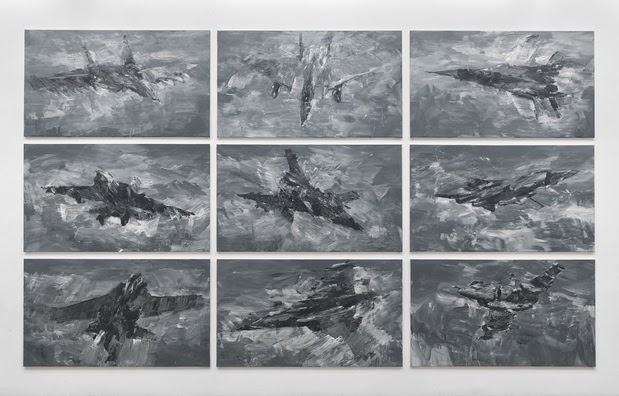
Yan Pei Ming, L’Autre Oiseau I-IX, 2013
Equally as distinctive as the multifarious grey canvas, Pei Ming’s paintings are executed in thick, grey brushstrokes. The aggression of the brushstrokes echo the violence and chaos of war. In the monumental paintings in the main ground floor gallery at Thaddaeus Ropac, HELP!, 2011, Quartier Chinois de Saigon, 2012 and Char, 2013, dense, staccato-like brushstrokes in a spectrum of greys confront the spectator with the destruction and death promised by the content of the images: re-presented iconic media images of past and recent wars in Vietnam and the Middle East. The density of the paint, the sketchiness of the stroke, and thus the form it creates gives for a style of painting that approaches the uncertainty of abstraction. Up close, luscious, thick paint loses all signification outside of itself.
Yan Pei Ming, Char, 2013
And then as we move away from the canvas, the objects and shapes become more clearly defined, against an indefineable background, they become recognizeable, we have seen them before in the press. We know well the image of a Vietnam National Policeman, his back turned to us, his gun against the head of the Viet Cong member, in a summary execution that came to stand for the horror of war. When we move back from the canvas the magnitude of the image comes into view, the angry, abrupt brush strokes transform into historical and political narratives that rail against the familiar events. However, unlike history paintings, Pei Ming’s work takes on the warnings of the present, it is as though he paints memories made to show future generations the violence and destruction of war. This present that creates memories for the future is in the very brushstrokes so that, in Char for example, just as we are confronted by the tank that might fire in our direction at any moment, we are also confronted by a violence given energy by the paint.
Yan Pei Ming, Colombe I-XII, 2013
In the vestibule to the main gallery, Colombe i-XII, 2013, painted doves of peace are hung, elevated, as if they are in the sky, circling the confrontational events that await in the next room. In an ironic repetition of the doves, a series of 9 canvases entitled L’Autre Oiseau I-IX, 2013, hang opposite the history paintings in the main gallery. These so-called birds are really fighter jets, in varying stages of descent, ascent and approach, in the same turbulent and dangerous array of grey brushstrokes.
Yan Pei Ming, Autoportrait à un Dollar F56789603 H, 2009
On the first floor, still in grey, skulls in watercolour are placed over the top of meticulously painted American dollar bills. The bleeding and deterioration of the money and the death of the skills come together to confront us with a chaos and danger of a different kind: the death and disease of the attachment to money. The two works become even more highly charged in light of their titles: Autoportrait à un Dollar F56789607 H, 2009 and Autoportrait à un Dollar F56789603 H, 2009. The two self-portraits bring the value of the artist, in closeup and profile, to the bleeding and deterioration of an image that resembles the decay of nitrate film. The violence depicted here is of a different kind from that of the paintings downstairs, but the message we take away from their common exhibition in HELP!, is that they are of the same cultural landscape of destruction.

What a treat to find this wonderful exhibition by painter Yan Pei-Ming at Galerie Thaddaeus Ropac.  Although I am sure they must exist, I can’t think of another contemporary painter who continues to use the medium with such provocation.