Sunday, May 25, 2025

Oliver Beer, Resonance Paintings: The Cave 2 Thaddaeus Ropac, Marais

Resonance Paintings: The Cave 2
Installation @ Thaddaeus Ropac

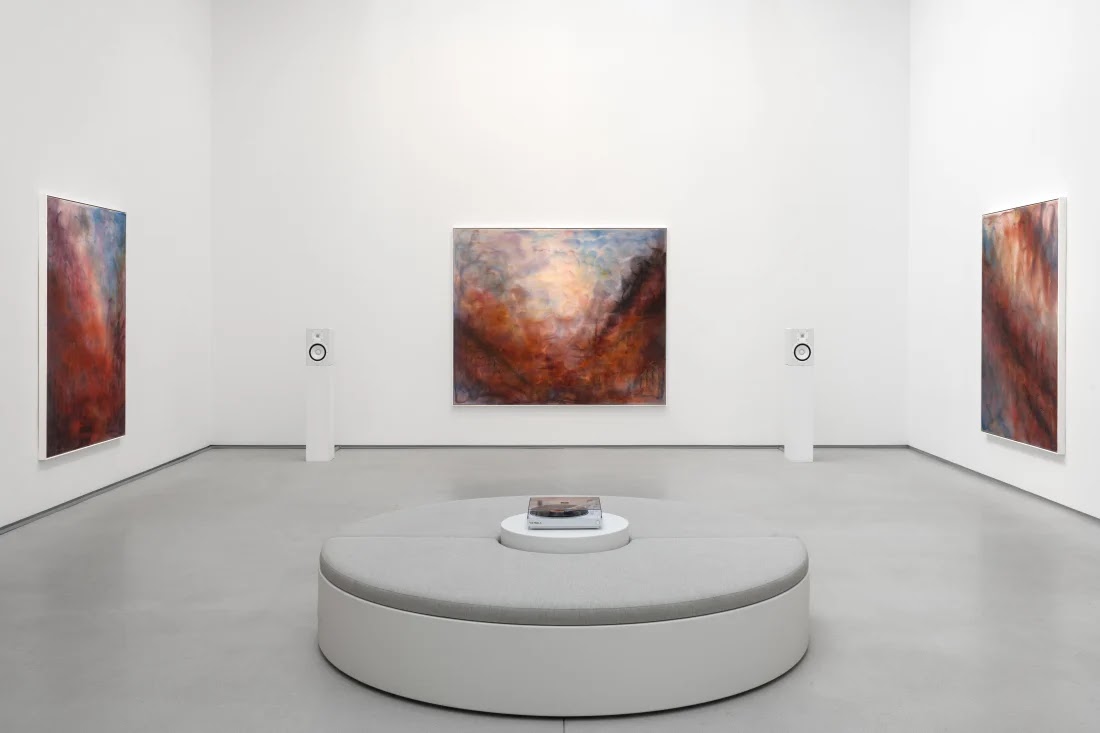
Oliver Beer's paintings are mesmeric. Walking into Thaddaeus Ropac's Marais gallery was like entering a mystical space of worship. The experience was made haunting and mythical by the sound filling the main gallery space, the walls adorned with paintings, carrying the visitor into an almost transcendental state. Hung with one painting on the south wall and three on each of the side walls, the paintings could be mistaken for a transposition or translation of religious scenes, an abstraction of figures ascending from earth to the heavens. Moreover, the large paintings along side walls in the main gallery remind of triptychs on an altar.Wisps of earthy pigment drift upwards to blue and white skies. 

Oliver Beer, Resonance Painting (Winter Morning), 2025

Beer worked with singers in the Paleolithic painted caves of Dordogne, where he discovered that the voices had a unique resonance. The sound recordings were then placed beneath loose pigment covered canvases, the vibrations of the music moving pigments to create abstract forms, paintings that are literally a visualization of music, in images that remind of the mysterious cave paintings. On entry to the main gallery, I didn't know whether to look at or listen to the paintings. Inside the gallery, the music that inspired the work was played, inviting the visitor to drift into the spirit of the works. In the breaks between soundtracks, in the quiet of the space, we were shown that the paintings function in time. Beer's process is slow and develops over time, processing and then re-using the sound recorded in the Lascaux caves. Similarly, the experience of the paintings gathers profundity over the time spent with them.

Oliver Beer, Resonance Painting (Sweet Wood), 2025

Beer's paintings not only merge music/sound and painting, but they are filtered through history. In an interview, Beer tells of how the sonic vibrations in the caves become increasingly resonant when his microphone is closer to the drawings that have existed for thousands of years. Thus, the paintings become tracings of a history, even if the exact time period is not clear. We can only ever know that a history is behind the drawings, not what that history is. In addition, when recording, Beer discovered that certain frequencies of the human voice stimulate sounds from the cave walls, creating sounds that transcend those produced by the singers. The mystical sounds are thus created through the stories of the walls over thousands of years. Simultaneously, the sound filling the gallery space is reinforced as placeless, having travelled across distant times, belonging outside of the material world.

Oliver Beer, Resonance Paintings (Shadows), 2025

That said, there is also something very physical, even corporeal about the works. Having recently rewatched David Cronenberg's Crash (1996), the pulsations and vibrations of pigment formed on the surface of Beer's canvases reminded me of scars on bodies from accidents, skin ripped open and sewn back together, trauma traced on skin. While there is nothing traumatic about the paintings, we remember that the sense of the past is heightened by the traces of what took place before. In turn, though we do not know what happened to the Aurignacians (who painted the cave walls 15,000 years ago), we do know that they disappeared, moved on, perhaps because of climate change or disease. The darkness and lightness of history are thus brought to mind in these superb works.
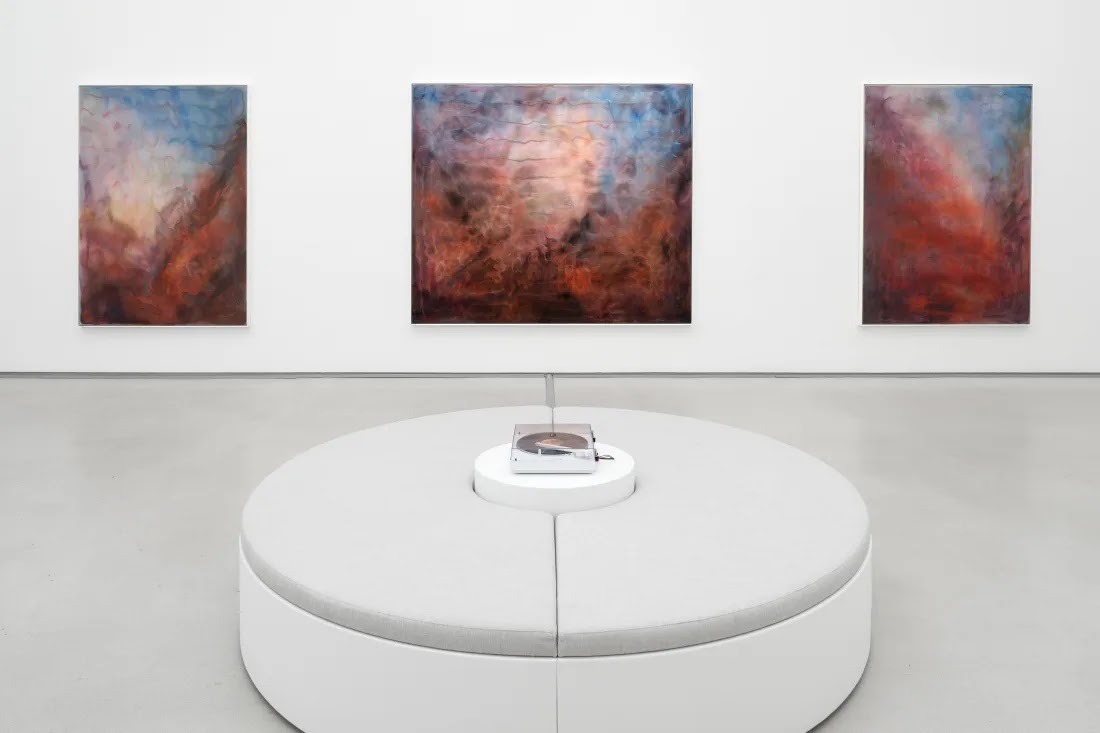
Resonance Paintings: The Cave 2
Installation @ Thaddaeus Ropac

Beer also talks about how his paintings speak to the history of art, in particular, twentieth century abstraction. Abstract painters have always been inspired by music, particularly in their search for painting beyond materiality and representation. Beer's works move into the space of complete abstraction when we are lifted up and away by them, as if to another realm, all the time maintaining their materiality. Beer's abstractions are both conceptually inspired by music and reach this transcendental ethereal space created through music. Similarly, as I say, Beer literally takes us to this realm through exploring the space between the two mediums, encouraging us both to listen and to look, simultaneously. As such, thanks to the synergetic space of image and sound, Beer's Resonance Paintings exceed the limits of abstract painting.

Friday, May 9, 2025

Josephsohn vu par Albert Oehlen @ Musée d'Art Moderne de la Ville de Paris

Josephsohn vue par Albert Oehlen
Installation View

I dragged my feet a little to this exhibition; the sculptures looked interesting but unvaried in the posters around town. It took time, walking around, but over the course of a couple of hours, I was charmed and increasingly fascinated by Josephsohn's bold and intensely emotional works. Likewise, the sculptures gained in complexity over the course of my two hour visit. The exhibition was curated by Swiss artist Albert Oehlen who wanted to privilege the materiality of the sculptures. Given the physical immensity of Josephsohn's work, and their enormous presence, it would be difficult to privilege any other aspect! 

Josephsohn vue par Albert Oehlen
Installation View

The list of Josephsohn's references is diverse, including Egyptian funerary statues, Giacometti, Brancusi, Fautrier, styles and forms that are visible in the plaster and sometimes brass sculptures. The figures are moulded, pressed, developed by touch and pinch and squeeze. However, unlike his contemporaries, Josephsohn's sculptures are absolute, resolute figures in the world, taking up space in their particular environment, not about to move for anyone. 
The sculptures are also formally very different from the work of an artist such as Giacometti: Josephsohn's figures are formed by building up the surface, not attacking it and scraping in a search for perfection. They are also reminiscent of Rodin's oversized public commissions. Heaving figures, often leaning left or right such as late Untitled bodies and torsos reminded me of Rodin's Burghers of Calais, always dragging.

Josephsohn vue par Albert Oehlen
Installation View

At first sight, the forms are a complete mess: they are unmistakeably human, but the proportions of torsos, heads, and facial features are often skewed. The faces are particularly deformed, sometimes only a protruding triangle as a nose, a ridge beneath as a mouth is all we are given. And yet it is enough. We clearly recognize the human likeness. There is also a distinct difference between the male and the female forms. The male figures legs and torso are more defined than the women's. And however stopped the man is, he's often in motion. We do not always notice the details because the overwhelming sense that we get is one of loneliness and loss. Always, the figure is along on its plinth, even if it interacts with other works. 
Thanks to Oehlen's stunning curation, they form communities, repeated, always with a slight difference. 


Hans Josephsohn, Untitled, 2005

Contemporary artist Oehlen's curation is itself a work of art, emphasizing as it sets out to, Josephsohn's materials and the materiality of the figures. As I say, it would be difficult not to focus on the material because the plaster and brass are so sensuous. In many ways, the sculptures are about the material and the form that results from gouging, pitting, plying. It is as if Josephsohn is asking himself over and over: how can I push the material to create an extreme human form? We may even think of the sculptures as evidence of the artist thinking with his hands. Josephsohn has no interest in narrative, the difficulty of being human and living in history. Rather, he is enamoured with the plaster and brass. The figures are raw, rough, haptic, reminding us of volcanic rock. The deformed bodies that result say as much about how the artist sees beauty as it does his political or historical world view. 


Josephsohn, born in what was Königsberg, and is now Kaliningrad to a Jewish family, is said to have filled his sculptures with the tumultuous energy of growing up in Nazi Germany. This chaotic agitation and anxiety is literally present in the physical form resulting from manipulated material. Nevertheless, these works are still about the human hiding inside the material and the method of execution. Josephsohn's hands have a presence in their movement around the sculpture.  In the early works, the plinth is as important as human form, and then by the end the figure reaches such levels of abstraction that it becomes the plinth. As a result, Josephsohn's creations become monsters, gentle and warm, but deformed giants, nevertheless. 

Hans Josephsohn, Untitled, 2005


Monday, March 31, 2025

Noah Davis @ The Barbican

The Missing Link 4, 2013

Davis was one of those rare painters who could bring the political, aesthetic innovation, humour and poignancy, figuration and abstraction into a single frame. Davis's dexterous works exist in a difficult-to-place in between world, neither everyday reality, nor fantastical other worldly. The one thread running through all his work might be his commitment to the plight of invisible and marginalized people, evident in paintings populated by African Americans. But what is most striking is the way that Davis paints his figures. They rarely have discernible facial features, are typically shown in imbalanced frames or placed within fantastic narratives, in poses suggesting or depicting movement through environments, most often the street. And yet, we also see frames within frames everywhere in these paintings, the figures rarely feel entrapped, mostly because they are in motion. 

Pueblo del Rio: Arabesque, 2014

The face as the mark of identity and recognition of the individual is typically removed from Davis's black figures. Faces are erased, masked, veiled, blurred, splashed with paint, silenced through the removal of the mouth. The figures' facelessness makes them both individuals in a challenging world, and metonymical black figures in American history. 


40 Acres and a Unicorn, 2007

Another striking element of Davis's paintings is their surface. Beyond or in addition to the translucence created through his use of rabbit skin glue under paint and the scraping and washing of some canvases, surfaces are emphasized in scenes filled with reflections, squares and frames within frames. Drips, bleeds, shadows, cover urban streets and landscapes comprised of blocks of colour. This turns the backgrounds or space around the figures into areas as variegated and fascinating as the figures themselves. For example, in The Missing Link 4, a body of water in front of a modernist building captures the reflection of sky and concrete, merging with two figures playing. The texture of water and reflection is as compelling and curious as the housing project filling the upper two thirds of the painting. 

You Are ... 2012

Davis is one of those painters who begins from photographs and lens based media, mostly representing an interpretation of how black people are shown in these media. Several powerful paintings in the exhibition show the contrasts and constant flexibility and fluidity of Davis's paintings. Those beginning from anonymous amateur and family photographs find altogether different characters, relaxed, casual, at times exuding intimacy and connection. Other figures are isolated, alone, walking through worlds surrounded by painting and art, but unable to connect to other people. In 2012, Davis made a series of paintings inspired by midday trash television in which everything is constructed, stylized, and forced. These paintings, such as You Are ... are highly designed, the figures strategically placed, manipulated. Again, the figures are faceless, emphasizing the manipulations to staging, performance, and the cult of the TV personality and the de-individualization of the black participants.

Painting for My Dad, 2011

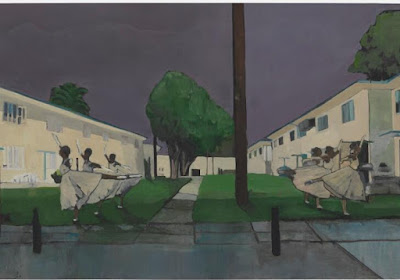
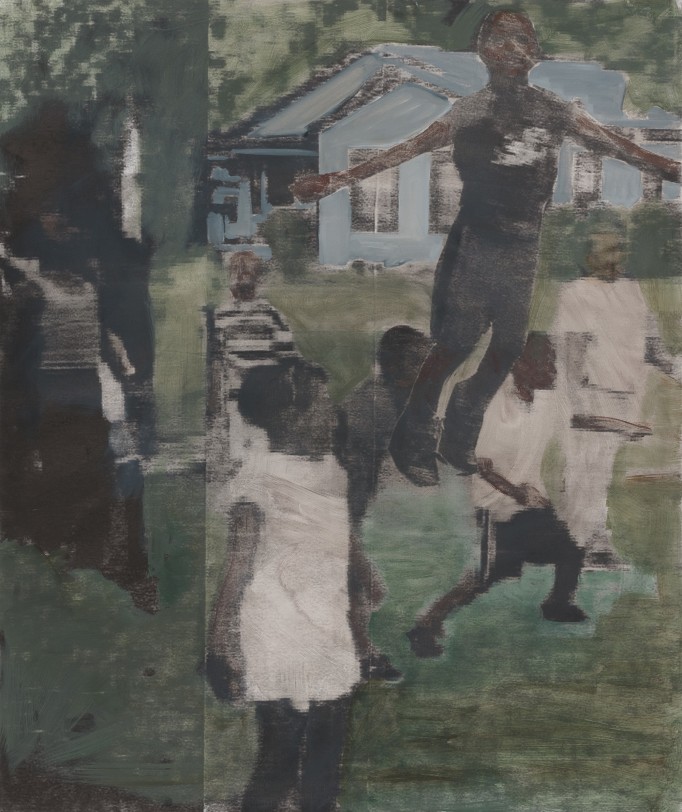
Davis's pictures can also inhabit the other wordly: in paintings such as 40 Acres and a Unicorn we see ghosts and unicorns. In others modernism meets black aesthetics and mysticism, in which impossible things happen, such as ballerinas performing at a housing project, and in a painting such as The Missing Link 1, a young boy levitates in a garden as other children look on. 

The Missing Link 1, 2013

Davis's references are wide ranging and eclectic. We see a man walking through an urban environment that resembles a Rothko painting, an exhibition curated at his own Underground Museum in 2012 titled, Imitation of Wealth referencing the Doulas Sirk film in which a black girl passes as white - in which a white woman has a moral breakdown, in which white culture distorts the self-perception of black people. There are also references to Mondrian and the geometricization of the image, Friedrich and the wanderer, though Davis's journeys in the night. Marlene Dumas, Peter Doig, Luc Tuymans are also also recognizeable in receding figures in ambiguous landscapes.

Untitled, 2015

While Davis's work is vast and diverse, intellectually rich, aesthetically innovative, and most significantly, committed to a politics of bringing unseen and unseeing people to visibility, as well as giving them the opportunity to see art, it's also extremely intimate. Viewers will sense the bond between three young men hanging out on a doorstep, surrounded by project housing, or two women asleep on a sofa. Perhaps most intimate are the paintings in which Davis himself is present, either literally as in a painting of his wife in a magic yellow costume or in a painting of a funeral in the distance, nevertheless within reach. It's impossible to see these paintings without noticing Davis's very personal spirit hovering around the walls. And it's impossible to see the exhibition without paying heed to the shadow of Davis's early death. As the exhibition presents it, the memory of Davis's art is clouded by death. 

Untitled, 2015
It's as though the fever to paint is so high as he approaches the end that he has to include everything he knows in his paintings. The history of art, the history of representation of black people, the way they are treated, pictured in images. Davis's body of work speaks to universal issues, and yet, is so intimate and personal about his isolation and the tragedy on its way to him. Leaving the world on his own, isolated, walking through a world covered in painting. And when he paints other people in the final works, they live together with art, their spaces literally taken over by paint, merged together with paintings on walls, paint dripping down onto the body, wiping it away.