Showing posts with label sound. Show all posts

Thursday, July 19, 2018

Ryoji Ikeda, Continuum @ Centre Pompidou

Ryoji Ikeda, Code-verse, 2018
Ryoji Ikeda is back at the Centre Pompidou with two new compositions, Code-versa, and A [continuum], both from 2018, in an exhibition in Galerie 3 titled Continuum. I find much contemporary digital visual art to be unconvincing, primarily because it is so often an image shot with a digital camera that does very little with the medium. Ikeda’s work is everything that the run of the mill digital art is not. It’s complex, intricate, multivalent and best of all, it pushes the boundaries of sound and image, aesthetics and technology.

Ryoji Ikeda, Code-verse, 2018
Ikeda’s work is impressive because it works on multiple levels. On its intellectual dimension, the artist polyphonic compositions “compress vast, dense mass of data together,” and pushe a single pitch (in this case, a piece in which five hyper-directional speakers emit a piercing, almost nauseating sound, the infinite tones of the note A) into infinity through treating frequencies as pure materials. And on another level, Ikeda's creations are endlessly fascinating and invite the computer, sound and music illiterate to enjoy them physically and mentally. It’s difficult to pull ourselves away from the pieces as we become mesmerized by a search for logic and order, for beginnings and endings that don’t exist, and for the perfect place from which to experience them.  

Ryoji Ikeda, Code-verse, 2018
Not being among the viewers who understand the computer coding that creates the sound/image manipulations, I can only give the layperson version of the exhibition. In the hypnotic code verse our attention is held over time as we are sutured into the dizzying, multi-dimensional optical art created through the permutations of sound and images resulting from Ikeda’s computer coding. The long screen moves through what start to resemble images of an interstellar out of space journey seen from the cockpit of a flying machine, leading us into another world. At other times, the icons moving across the screen looking like a creeping cursor, and at still others, the shifting to a two dimensional floor that transforms into a sky, and then shifts perspective to take us back to three dimensional time travel.

Ryoji Ikeda, A [continuum], 2018
In the second white-carpeted and white-walled room, the five hyper-directional speakers emit the infinite permutations of 'A' resulting in a work that will never repeat itself across the ten week run of the exhibition. The sound is piercing to our ears and penetrates our consciousness, leading to a corporeal experience on the slow path to headaches and nausea. Ikeda explains the noise of the installation to be generated through subjecting his data (in this case the multiple instances of the note 'A' played by orchestras and musical instruments around the world) through his individually coded programs. The end result is a manipulation of time and space through the materiality of sound.

Ryoji Ikeda, A [continuum], 2018


Afterwards, I went upstairs to the Chagall. Lissitzky, Malévitch exhibition (which is not about their work, but rather, the story of the Vitebsk School of Art which Chagall opened in 1919). The exhibition is mildly interesting, but what consumed my thoughts as I walked around was the fact that Ikeda could well be understood as a twenty-first century El Lissitzky. Certainly both artists are looking to push the boundaries of the medium of their respective moment, they are looking to move beyond what is possible in and through representation, moving into and exposing dimensions of creation and consequent existence not yet articulated. The major difference between the two being that for El Lissitzky art should always focus on its political concern, whereas Ikeda’s codings seem to stay on the level of the aesthetic. Which is not to say that Ikeda’s work couldn’t be used in the service of social critique, but he is not using technology against itself as were the great Soviet abstract painters of the early twentieth century.


Monday, December 4, 2017

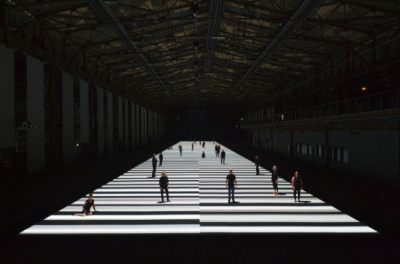
William Forsyth x Ryoji Ikeda @ La Grande Hall, La Villette

Image result for ikeda at la villette
Ryoji Ikeda, Test Pattern. 
I have seen a number of Ryoji Ikeda’s installations over the years, and in this current one in the Grande Hall at La Villette he reaches a whole new level of creation, affect and meaning. On entering the Grande Hall we hear a strange technically produced sound by which we are pulled into the most spectacular of Paris’s former slaughterhouse spaces enclosed by a glass and cast iron structure. The visuals of the work laid out across the floor of the hall are a highly complex “test pattern” in which Ikeda has translated the everyday images that bombard and surround us into electronic form. The result is a fluctuating series of black and white lines, bands, grids moving unpredictably in a test pattern that is simultaneously hypnotic and slightly disturbing. It is like stepping onto an enormous pulsating barcode. The sound is likewise culled from the everyday and translated into a dramatic technobeat. Together, the sound and image form a complete environment that envelops us, overwhelms us and simultaneously soothes us. To stand in the middle of this highly structured chaos is like being in the middle of an endless ocean of sound and images. Or, as my friend with whom I visited the installation remarked, it’s like being on acid.


My visit to the piece was made even more compelling by a young dancer who improvised a performance over the test pattern. His movements were led by the sound and the light as they swept up and across the floor. Even non-professional dancers will intuitively move to the beat as they walk across and around the environment. Indeed, this physical engagement with the light and sound is imperative because only then can we experience the unpredictability of the music and light patterns. No sooner do we find the beat than it changes. Ikeda’s work is this mix of the most sophisticated mathematical computations, engineering design and an old-fashioned culling from the popular cultural environment. What impressed me most was its appeal to everyone: with the involvement of professional dancers, Sunday strollers, parents and children, old and young alike, this work unlike others of his I have seen was a community event.
 
William Forsythe, Nowhere and Everywhere at the Same Time no. 2
Across the hall is William Forsythe’s Nowhere and Everywhere at the Same Time no. 2. In this piece hundreds of pendula hang suspended from the tracks of an automatic rig at ceiling height. We are invited to enter the space and move among the pendula, but are warned not to touch or disturb them. Until we are inside the forest of pendula we don’t realize that it is actually very difficult to avoid the hanging weights. Because they constantly change speeds and move in different, unpredictable directions. Presumably through a computer designed algorithm, the pendula change the speed and arc of their trajectory according to the shifting speed and direction of the tracks above from which they are suspended. Thus, the experience is unsettling: we begin casually strolling through the pendula, and then, suddenly their speed changes and we have to run, jump, twist and contort our bodies to evade them. This sense of their command over us created a kind of ominous feeling when inside the installation. Watching others from the cast iron balcony above it was possible to see how they evoked anxiety, a heart rush, panic, all in the attempt to avoid touching them. There was literally nowhere to go dor refuge from their predatory movements.

Image result for william forsythe nowhere and everywhere at the same time
Forsythe inside Nowhere and Everywhere at the Same Time no. 2
Brighton Festival

Once again, the inanimate objects dictate (not simply influence) the movement of the human body: we have no choice inside their system that is ungraspable to us. Forsythe as the vanguard choreographer is here committed to exploring the form and limits of human movement. And while it is fascinating to find see our bodies move in ways we do not expect if we follow the dictate of the pendula, it would also be interesting to see Forsythe himself dance inside the installation.  Because it is on tour around Europe and has been to the US, there may still be opportunity to experience this. 

Thursday, April 16, 2015

Bruce Nauman, Fondation Cartier pour l'art contemporain


It’s always with a dose of apprehension that I go to see an exhibition of the work of an artist who has a reputation made and confirmed in a past historical and cultural moment. What could Bruce Nauman be doing today that will continue to push at the boundaries of possibility as he tested them in the 1970s? And how will he live up to the billing he has been given at one of Paris’s most seductive spaces for the exhibition of contemporary art? These were the skeptical questions in my thoughts as I approached the Bruce Nauman exhibition at the Fondation Cartier pour l’art contemporain.

image
Bruce Nauman, Pencil Shift/Mr Rogers, 2013

On entry to Jean Nouvel’s modernist—or is it post modernist?— glass building on Boulevard Raspail, the view is consumed with Pencil Lift/Mr Rogers (2013). A short pencil sharpened at two ends is held between two sharpened pencils by the artist in his studio. A diptych, two giant LED screens, one with a blank white background, the other with Nauman’s studio desk, show the “pencil lift” images on an asynchronous loop. The moment I liked best was on the right screen, when we saw the passing presence of the Mr Rogers of the title. Nauman’s cat walks across the table, each paw seemingly weightless as it is nonchanantly placed on a CD and a pile of papers on his path. Mr Rogers’ presence is the heart of an otherwise manual and intellectual exercise, though I didn’t really see the conceptual point of the actions.

In the smaller ground level space there was an audio piece—For Children/Pour Les Enfants— a sound installation in the genre of Nauman work that was so radical in the 1970s, but today lacks a little lustre. The words, “for the children” and “pour les enfants” are endlessly repeated, eventually creating an auditory illusion. I was reminded through experiencing this piece, how words for Nauman never communicate in the conventional way, language is always made into a kind of misinformation that then carries the theme.

Installation View of Bruce Nauman 
The three installations downstairs had none of the playfulness of Pencil Lift/Mr Rogers. On the contrary, Carousel (Stainless Steel Version), 1988 is one of the most terrifying artworks I have seen in a long time. Taxidermy cast sculptures of fragmented body parts of deer, lynxes and coyotes are dragged around the floor by wires around their necks that are, in turn, tied to a complex carousel-type structure. The piece is frightening because the animals are screaming silently, unable to audibly cry out against the injustice that has been committed against them. The sound of their paws gently sweeping the floor as they are dragged around, makes their utter powerlessness confront us, especially as we think of Mr Rogers gentle poise as he walks across the table upstairs.

“Carousel (Stainless steel version)” (1988) (detail)
Bruce Nauman, Carousel (Stainless steel version)" , 1988 detail
The brutally tortured animals share the space with another equally violent installation from 1991. The head of the classically trained singer Rinde Eckert is projected three times, once upside down, and on six monitors stacked on the floor to create a circle of heads. He repeats “Feed Me, Eat Me, Anthropology” “Help Me, Hurt Me, Sociology” and “Feed Me, Help Me, Eat Me, Hurt Me” with the volume turned up so high that the gallery guard was wearing headphones. The voice is aggressive and violent, giving the visitor a headache from the dissonance when standing in the middle of the circle. And just when the voices trail off and we think it is going to stop, they begin again. It’s not possible to sit with it for any length of time. Because Anthro/Socio (Rinde Facing Camera) is so confrontational – it pushes the aesthetic beyond its limit. I felt trapped, violated almost, in its presence. At the same time, if we do stay with it we begin to hear the music as, once again, repetition leads to an auditory illusion and the words become lost in the din.

Ultimately, the frightening, violent works in the downstairs galleries from the Nauman archive, so to speak, are still the most powerful works of the exhibition. Pencil Lift/Mr Rogers is visually striking and rhymes with the glass walls of the Nouvel designed space, but I am not convinced that he is doing anything conceptually that would come close to the challenges of Carousel and Anthro/Socio downstairs. What I also found interesting was the human element of the earlier works, what they evoke in the viewer. In distinction to the cuteness of  Pencil Lift/Mr Rogers, the downstairs pieces evoke substantial feelings, and a visceral experience.


Saturday, February 28, 2015

Takis. Champs Magnétiques @ Palais de Tokyo

Takis, Télépeintures, installation view
There are few artists working today whose work continues to surprise and delight its audiences. When I say “surprise,” I do not refer to works that shock or engage their audience in some kind of intellectual dialogue on morality, politics and culture. I mean surprise in the most joyful of ways. And what makes Takis’ works resonate long after we have left the Palais de Tokyo is that they continue to reveal their invisible layers of enchantment. For works that present as clinical and scientific and mathematically, rationally structured, Tarkis' installations, sculptures and environments are remarkably human and playful. That’s what makes them exciting.

Takis, Signaux, et Peintures
Vue de l'Exposition
As I thought about the works after I had left the museum, every thought I had turned into its opposite over time. For example, in works that claim to be concerned with questions of invisibility, these works are extremely visual. I watched visitors sitting in the environment created inside the Palais de Tokyo listening to the sound installation, Sculptures Musicales. Inevitably, they (and I) couldn’t resist the temptation to walk up to the white panels on which a needle is pulled to a wire by a magnet behind the panel, to see how it works. Thus we all looked for a visual explanation to a sonic performance. Or alternatively, in the Télépeintures magnets deform the solid coloured canvas behind which they are hidden when they attract metal cones supported at a distance on the ceiling. The strange shaped canvases are infinitely fascinating because although we cannot see how the attraction is created, we understand that it is, and thus, we continue to investigate through vision what we cannot see.  

Takis, Gong
All of Takis’ works on display here sit at the crossroads between science and art, rationality and creativity. Again, in the case of the Telepeintures, we begin by looking for the physics of these strange sculptures, and yet, we find elements held in place by magnetic elements, that lead to a discourse on gravitation, orientation, a discourse that tells of our invisible and inexplicable attraction to each other, our limitation as humans. Another discourse hidden from the eye, one that becomes very obvious very quickly is that of the relationship between people, its inexplicability: the force field that surrounds or attracts two people, a person to a thing is never visible, not something we can figure out, it’s just there, and it is irresistible, timeless.
Takis, Magnetic Sheet, 1971
In another example in which nails are available for the visitor to throw against a metal sheet with magnets placed strategically at certain points behind the sheet, appears, at first sight to be a discourse on some kind of scientific logic about what makes nails stick to a metal sheet. But then, in time, we recognize the piece as a conceptual reflection on our experience, it becomes a discourse of aggression towards the museum. Or perhaps visitors understand the piece as I did when I was reminded of the side show when we shoot the ducks or try to get the balls into the clown’s mouth. We have to aim right to get the nails to stick to the metal at the point where the magnet is, and it’s so difficult to win. When all the nails fall into the gutter below the sheet, we understand that attraction is never a guarantee.
Takis, Sculpture Musicale, 1977
 While magnets are the primary medium in Tarkis’ extensive artistic vocabulary, in some pieces the magnetic force is supplied by the earth’s gravity. When his works respond to this magical, inexplicable, invisible force, confusion is created. In his panels of dials and signals as well as the Giacometti-like Signaux, the scientific, engineering invention goes awry, the needles nervously fluctuate, as they are pulled in all different directions. When any kind of technology takes over in Takis’ world, it inevitably fails to measure, to direct, to orient.


For Takis, the invisible energy that creates the rhythms and resonance of a gong as it hits a cymbal, the arrows that kill St Sebastian, or the erotic desire that propels sexuality and sexual intercourse, are all driven by the same invisible force. All of the signs, signals, whether they be philosophical, astronomical, physical, mythical, are organized by invisible energies that we can never fully comprehend. And even if we do, they are likely confuse so that comprehension is only ever fleeting.