Monday, June 13, 2011

Burke + Norfolk, Photographs from the War in Afghanistan, Tate Modern, Level 2

John Burke, Timur Shah's Mosque, 1879
Hidden away on level 2, in a tiny gallery on the Thames side of the Tate Modern is, for my money, the pick of the temporary exhibitions currently on display: Burke + Norfolk: Photographs From the War in Afghanistan by John Burke and Simon Norfolk.
John Burke, Khyber Pass, 1878
Contemporary British photographer, Simon Norfolk returned to Afghanistan in the footsteps of John Burke, a nineteenth century apothecary who smuggled himself and his camera onto the battlefield of what was the second Anglo-Afghan war between 1878-1880. Burke’s photographs are dreamy: a wet plate collodion process that produces creamy browns and reds, a spectrum of color and movement in the photograph that has no equivalent today. The image is textured, detailed, and yet, soft and silken. There is no way to reproduce the delight of Burke’s images and Norfolk doesn’t try. Instead, what fascinates Norfolk is that Burke does not take photographs of the battlefield itself, perhaps because he does not want to show the British in a bad light, decimated by the Afghan army. Perhaps Burke shows no dead bodies and no exploding bombs because the expense of the labor intensive photographic process and prints meant there was too much to lose by taking a camera to the frontline. In the end it is not important why Burke photographs the Afghan war beyond the battlefield such that there are instances when (as my friend James pointed out) we could be looking at images of nineteenth century Texas. What is important is the immense and unending vision of the nineteenth century apothecary’s camera. 
Simon Norfolk, A dumping ground for an abandoned Russian-era bomber
that has now been incorporated into the car park of "Shamshad TV", a new media company
supported by American money
, 2010-2011
And for all of Burke’s sense of possibility and permanence as it is given to the camera by nature, Norfolk matches it with a transience and a foreshortening of the perspective to emphasize that today, in the midst of another war in Afghanistan 130 years later, the same landscape has become scarred with the detritus of man made disaster. The detritus that collects, not of war technology itself, but in the support of war – containers, makeshift buildings, camps, man made junk – scars an otherwise perfect landscape. These structures and objects as the consequence of war re-articulate a vast, once glorious landscape so that it is now one huge capitalist clutter.
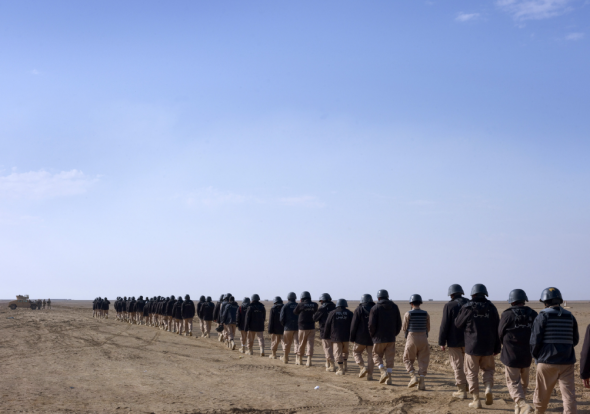
Simon Norfolk, Afghan Police Trainees, Camp Leatherneck, Helmand, 2010-2011
When there is a perspective, as in an image such as one that shows “Afghan police trainees being taken to the firing ranges by US Marines, Camp leatherneck, Helmand” the line of vision goes nowhere. In this example, the column of trainees walk into the distance, across the desert, with no purpose, for no apparent reason. As is so often the case in Norfolk’s depiction of Afghans, added to the irony of an image that echoes the structure of a nineteenth-century composition, and empties that composition of all significance, the Afghans here are configured like prisoners. The visual language in Norfolk’s image is identical to that depicting trains of prisoners herded across Europe first by the Nazis and later by the Red Army in World War II Europe.
Simon Norfolk, Internet Café, Herat, 2010-2011

John Burke, Main Street Jellalabad, 1878


Simon Norfolk, Kabul "Pizza Express", 2010-2011


Norfolk’s photographs are brilliant, not inspite of the fact that he does not show the war, but because of its absence. Norfolk flattens out the photographic vision in order to underline the loss of hope, possibility, infinity as it was captured in the vanishing point perspective of nineteenth century landscape photography. Norfolk’s frontality, the use of lenses and filters, reinforces the disposability of life in a makeshift environment.  In exhibition at the Tate Modern Norfolk’s images sit side by side with digital prints of Burke’s – the same dimensions, which are themselves, no longer found in photographs today. Not only do we see photographs of an Afghanistan that look strange because of their difference from the thousands upon thousands of news reportage from the war, but the photographic form itself is made strange, of another era. In a compelling juxtaposition, Burke’s version of the main street of Jellallabad showing the covered bazaar sits in between Norfolk’s of pizza express behind of the bus station in Kabul and the Rasa internet café in Herat.  The internet café is tacky, a tack emphasized by the lenses and the printing process, the gloss of the photograph, all of which push the colored facades and the intense sunlight into the realms of the plastic and the absurd. Where once the merchants in the bazaar may have been poor, but their commerce had dignity and logic, today, the internet cafés and pizza joints of downtown Kabul and Herat are a different story. Moreover, the comparison through juxtaposition makes the trash and gloss of today absolutely frightening. The psychedelia of Norfolk’s images somehow comes to stand for the absurdity of the war that is being fought. Norfolk’s is a caustic commentary on the violence of war and colonialism.


John Burke, Landholders and Laborers, Kabul, 1879

Because Burke also photographed groups and portraits, Norfolk does too. These are some of Norfolk’s most disturbing photographs, again in their juxtaposition, their dialogue as he calls it, with Burke’s. The group portraits are powerful and searing in their critique because they are subtle, unsettling because they are so different from the way that war is photographed in the twenty-first century. And so they enable us to look at this war that we have seen countless times before, from a completely different angle.

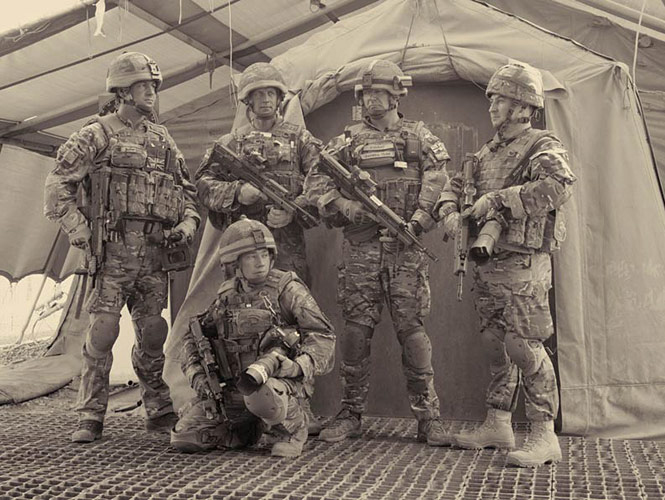
Simon Norfolk, Media Operations Team, Camp Bastion, Helmand, 2010-2011
Groups of people, both Afghans and contemporary British, are proud and made regal by Burke’s camera, against backgrounds of nature that expressed their dignity. Today through Norfolk’s viewfinder, groups engaged in the war effort are awkward in their poses, disinterested in the fight they are waging, performing in a play whose script they don’t believe in. Even though they take on poses familiar from nineteenth century representations of official groups, Norfolk’s actors are placed on a stage that might collapse at any moment, and clearly have no notion of what they are doing. Norfolk’s work functions on so many different registers: it is ironic and poignant, in places revels in the absurdity of what it can see, in others it is tragic. Even though they never show the war, the photographs look its tragedy and futility in the eye, making it both innovative and highly political. 
Simon Norfolk, Pro-Taliban Refugees, 2010-2011
My one disappointment is the exhibition itself. The accompanying catalogue (with superb reproductions) indicates that only about half the series is on display in the current exhibition. This, together with its location in a tiny gallery on Level 2 of the Tate Modern is a source of considerable frustration. Upstairs, occupying prime real estate on level 4 are Taryn Simon’s photographic archives. Simon’s photographs trace the “bloodlines” of the living dead, terrorists, Nazis, rabbits, genocide victims and an array of other international curiosities. As far as I could see, the photographic series and repetitions meant to “map the relationships among chance, blood and other components of fate,” were superficial form without substance. They were admittedly beautifully presented, but nevertheless, pieces that did not penetrate the consequences of portraits in their series. Why, I wondered, was this second-rate work by an unknown New Yorker given precedence over the compelling and complex, politically acerbic, morally urgent images of a young British photographer? 

Monday, June 6, 2011

Mitch Epstein, American Power, Fondation Henri Cartier Bresson

Mitch Epstein, Gavin Coal Power Plant, Cheshire, Ohio 2003
Epstein’s latest photographs, American Power, big, shiny and new, represent the way that “power” in its most extreme and varied forms, is threaded through the very fabric of daily life in the contemporary US. Inspite of their aesthetic appeal, the images are frightening. There is nothing upsetting or shocking about the photographs themselves; on the contrary, they are pristine, meticulously composed, slick and sometimes beautiful photographs. However, what the photograph is and what it shows could not be further away from each other. Inside the highly aestheticized images, we see scarey worlds in which, for example, a group of worshipers baptize one of their number with the Rancho Seco nuclear power plant in the background in Herald California. Life is shown to carry on as usual, while power plants, nuclear reactors and all manner of industrial monstrosities spew waste, fumes and poisons. Thus, these images so upsetting.

Mitch Epstein, Fort Pierce Florida, 2005
In one of the most difficult images, a man with an artificial leg, cigarette in hand, his stomach bulging as he chats with his friend, nonchanantly guards his fishing line. But this is not the most prominent element of Fort Pierce Florida, 2005. What matters is the offshore drilling platform in the background. It is not only bigger than the human, but the machinery is centered in the frame, and overwhelms the human. Our first thought when we look at this image is that the men are fishing in the same body of water into which the waste of the oil rig will spill. Does he really think that he will catch fish? And if so, who is going to eat these fish? Probably you and me. Only after being unsettled by the idea of the polluted waters in which he fishes, do we begin to think about the fact that his leg is artificial. And whether or not it is the case, the immediate assumption is that he must be a Vietnam veteran.
Mitch Epstein, Amos Coal Power Plant, Raymond West Virginia, 2004


In another striking image, the Amos Coal Power plant is literally the backdrop to a tenderly cared for yard in Raymond, West Virginia. What is so frightening here is the tension that emerges between the traces of the human that tell of the enormous care and love of home, garden and environment and the promise of deathly waste from the coking plant that will infect the air that these same thoughtful people breathe. In this and other images, the tensions and contradictions emerge between the photograph and what it pictures. Again, the crisply lit scene, the perfectly composed frame, the clarity of vision become undone by the horror of what lurks in the background of the same scene.


Mitch Epstein, Ocean Warwick Oil Platform, 2005

This tension reaches its ultimate articulation in those photographs that resemble —even to the most casual of viewers – the Romantic landscapes of Casper David Friedrich. We cannot help but compare the beauty of Turner’s clouds with the Gavin Coal Power Plant. And in the Ocean Warwick Oil Platform off Daupine Island we are not mistaken when we see Casper David Friedrich’s Eismeer (1824). But whereas in Friedrich’s painting it is nature that triumphs, at war with the world and peacefully at rest, content with itself, in Epstein’s photograph, the victor is of a different ilk altogether. With its saturated blues and purples marking the end of the day, this platform is the monstrosity we have created and left to poison the sea. And thus, in Epstein’s worlds, we have reached a moment when nature will no longer survive the violence of our manipulations.

Mitch Epstein, BP Carson Refinery, California, 2007

What is so impressive about Epstein’s photographs is that they neither celebrate nor condemn the power and industry that has destroyed the natural environment and the manmade ones we inhabit. Epstein’s refusal to judge or critique comes thanks to the hyperrealism of the images. Their presentation of "what" is enabled by the tension between the aesthetic perfection of the photograph and the devastation that surges within its frames. Similarly, the matter-of-factness of these images comes courtesy of the eternal present that is the American way of life.  My interest in and familiarity with representations of similarly insidious destruction wrought on the environment by industry in the Ruhr Valley in Germany makes the “nowness” of Epstein’s photographs easier to identify. In Germany, similar images are aware of a past in which the industrial was to be celebrated, and a future in which it is to be phased out. However, in Epstein’s photographers there is nothing outside of the present. There is no sense of nostalgia, no sense of anything every being different, ever, and no call for a different future. This is the way that life is.

Saturday, May 21, 2011

Anish Kapoor's Leviathan at the Grand Palais


A friend who visited Anish Kapoor’s  Leviathan, the latest in the Monumenta series at the Grand Palais , told me that it was “beautiful”. He used words such as “breathtaking”, and “divine” – and had an image of something that would be ethereal, gorgeous, dreamy, something that would give the experience of serenity.

And as I entered the belly of Leviathan, I felt my body swaying, I became nauseous, not knowing where to look, completely disoriented, wanting to find a place to stand, my experience of this mindboggling “sculpture” (if that is what one calls such a creation) was anything but soothing. In fact, I was troubled. This was a monster that could only begin to be described by its title. As I stood back, looking at the entrance, I saw the people coming in, black shadows falling into the void, as if walking involuntarily into the mouth of Moloch. It reminded me of the nightmare of the underground world of Fritz Lang’s Metrolpolis, only everything was red, creating intensity and destabilization. But Leviathan has a kinship with Lang’s world where everything has gone awry despite the pretence of order. 


The seams of the red PVC balloon structure are in many ways the most intriguing parts of Leviathan. Because the seams are the place that we look to for explanation, for order, for a sense of orientation. Of course, it is impossible to find one’s bearings here, because this is a world in which there is a constant unsettling of everything we know: we are enveloped by a not so reassuring red, where color has become tactile and weighs upon us. I read somewhere that Kapoor likes to create structures that remind of the womb, and yes, I think to myself, this is where I am – intrigued, disoriented, wondering how long I need to stay in here before it is time to leave. And then everything changes – the sun comes out and I see the reflection of the iron structure of the roof of the Grand Palais reflected on the now translucent PVC shell that protects me. It is gorgeous. Like a chain reaction, everyone inside lies down. They put their bags under the heads and they lie down to look, to dream, to imagine the world outside of the womb. The monster comes alive, and people’s response to it changes completely.
Anish Kapoor, Leviathan, c. designboom

As in the past Monumenta installations, the Grand Palais and the French Ministry of Culture, employ young students to discuss the work with visitors. They explain this mythical, incomprehensible beast to an intrigued and voracious public. One young man tells me that the work is breathing, when I look at it and remark on the transformations that take place in the sunlight. He tells me that it’s the red, the unrelenting red, the purity of red that makes me feel lost and troubled, that unnerves me. He wants also to say that Kapoor has created a space of the imagination. And yet, as I take off my jacket because it is so hot, as I nervously look to see who is creating the echoes that reverberate throughout, as I try to find a place to be inside this belly of a beast, I do anything but follow the temptations of my imagination. I am so physically confronted, there is no possibility of transcending the body. At night, he tells me that the PVC balloon looks like cement, because it takes on a density. I wonder if Kapoor knew this would happen at night? How could he have known how it would behave because this was the first time it was ever inflated? In many ways, it is the aleatory, the “onceness” of Leviathan that makes it so mysterious. How can it be so perfect, not a wrinkle, not a flaw in its skin? And how can Kapoor have designed such a structure, not knowing what it would be like, look like, feel like? It’s the technical impossibility of Leviathan that makes it so confounding.

I watched people touch it: everyone did, everyone went up to it, just to make sure it was there, just to make sure it was where we thought it was. Strangely, because of the illusions created by red and the illusion of perspective realized by the seams, the material of Leviathan is not where we it appears to be, we are completely deceived, as the PVC lining is further away, on an angle, not perpendicular as it appears. And once people have touched it, ever so cautiously, they step back, leaving it to do what it must, on its own.

On the outside, it is a different story. The piece has a life of a different kind, it is imposing, and magnificent. It is magnificent because it sits in the nave of one of the most extraordinary buildings in turn of the century Paris. Almost anything that sits inside this structure cannot help but take on some of the magnificence of the building. But Leviathan on the outside, welcomes the volume, the light, the verticality and simultaneous horizontality of the enormous space. The now purple structure is touched by the lattice work of the ceiling, in reflection, on its skin, making it mysterious once again, but in a gesture of openness and magnificence, where the inside was unsettling and troubling. The outside is still inconceivable because still we cannot see where it begins and ends. And it is inconceivable because it cannot possibly be the skin, the outside of the same structure that we fall into on the inside. Like coming into the world, being born, wide-eyed, there is nothing that connects in there with out here. Nothing.