Friday, December 14, 2012

Caravaggio, The Fortune Teller, 1595-98

Caravaggio, The Fortune Teller, 1593-95


Unable to get near the door of the Orangerie to see the Soutine exhibition because of the crowds, Tim and I executed plan B last Friday, and settled for an afternoon at the Louvre. I had recently read an article on The Calling of Saint Matthew (1599) and so, with Caravaggio on the mind, we headed up the great hall to find Caravaggio’s The Fortune Teller (1593-95) or La Diseuse de Bonne Aventure as the French title card names it. 

Much is often made of this painting’s narrative: a young boy being seduced by a fortune teller as she surreptitiously takes his ring, he being so mesmerized that he is oblivious to her duplicity. It is true, there is an eroticism to the touch of his hand which is made ven more compelling by the warm light coming through the window to the left of the painting. But what seduces the viewer of The Fortune Teller is not the narrative, it’s the light and the fabrics of the clothes worn by the young man especially, in Caravaggio’s demonstration of wealth, social status, the boy’s naievety and the woman’s deception.
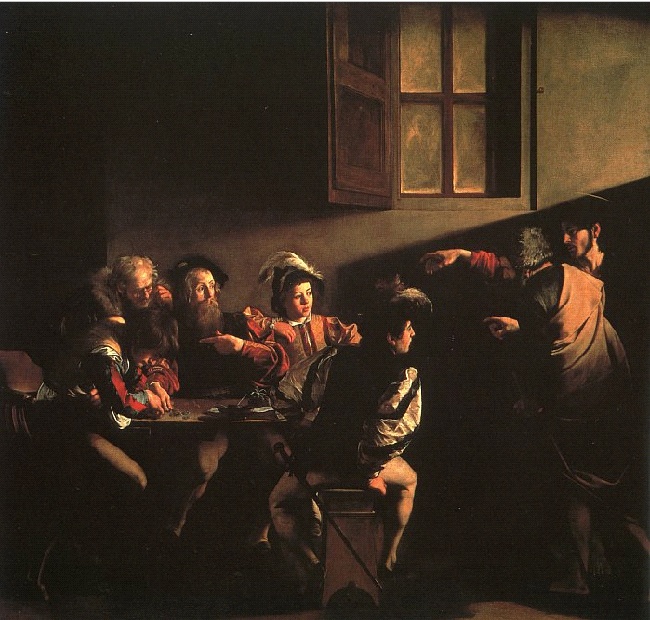
Caravaggio, The Calling of St Matthew, 1599
The light coming in from the window somewhere to the left and in front of the scene is glorious. As in his later masterpiece, The Calling of St Matthew, in which light evolves from compositional force to the very subject of the painting when Christ’s presence envelops Matthew, the light in The Fortune Teller does so much more than simply illuminate the clandestine scene. Light bathes their actions in a soft erotic glow. The light defines the boy’s face, making him cherubic, naïve and innocent. It also accentuates the texture of his gloves, the stitching, the frills on his collar and cuffs, and every hair in the feather on his hat. The sword, the feather, the fabrics, including the boy’s skin and the woman’s fingernails overtake the substance of the woman’s deceit. And if colour is enabled by paint as light, let’s not forget the rich caramel of his jacket, the warm yellow of the wall, the beautiful folds of his gloves. 

The other curious detail that keeps the viewer transfixed is the relay of looks between the two characters. Neither of them looks at the other. Their looks both miss the other’s line of sight very slightly, giving them both a self-containment, and thus, a distance from each other. And then there is the “look” or momentum created by the painting. Our eye is drawn up towards the window that does not exist, from where the sun is coming. The source of the light might be said to be the true centre of the painting, which might explain why the two human figures are pushed back by the light, towards the right of the composition. Again, as if in a preface to The Calling of St Matthew four years later, the light streams in as the compositional energy and the source of all delight on this canvas.


Sunday, December 9, 2012

Philippe Decouflé, Octopus, Théâtre National de Chaillot


Always wanting to expand our theatre repertoire, Anne and I dutifully went to see the celebrated French choreographer's latest extravaganza, Philippe Decouflé's, Octopus at Chaillot last night. Because he has been so applauded, particularly in France, we were expecting big things. But Anne captured the entire show when she announced at the final curtain "half time at the superbowl is better than that." I am not sure why Decouflé is such a big name in France, but clearly, it's not because of the depth of his choreography or the profundity of the creations in their totality. Octopus, a mélange of acrobatics and fancy dance moves offered nothing of substance to discuss over dinner afterwards. In 2007 he apparently did the parade for the Rugby World Cup, a genre of entertainment I imagine he did very well. Personally, I think he should stick to the World Cup and leave the stage at Chaillot to more substantial performances.


Images courtesy the Artist

Monday, December 3, 2012

Canaletto-Guardi. Les Deux Maîtres de Venise, Musée Jacquemart-André

Canaletto, La Place Saint-Marc, vers l'est, 1723

I have to admit, lover of modern art that I am, this has to be my pick of the fall exhibitions I have seen in Paris so far. When my friend Jim suggested we go to the Canaletto-Guardi exhibition at the Musée Jacquemart-André, and then when we were greeted with a 45 minute wait on arrival, I was not convinced. Once inside I was seduced by the richness of these treasured paintings and the comfort of their display. One of my biggest problems with the major Paris museums is their zeal to stage massive and overwhelming exhibitions. Unlike the major museums, the Musée Jacquemart-André does not feel this same urge to place Canaletto and Guardi’s work in an extensive, and ultimately unnecessary context. The exhibition is devoted entirely to the “Venice-scapes” of Canaletto and his student Francesco Guardi. Indeed, it is a treat from beginning to end.
Francesco Guardi, La Fête du jeudi gras sur la Piazzetta, 1712-93
Before the entrance to the exhibition, there is a small display on the camera obscura. I can’t be sure why it is there because examining the display would have meant losing my place in the line for the entrance. But I assume that Canaletto and/or Guardi were using a camera obscura for the designs of the buildings, in particular, and also the relationship between water and buildings on the Venice canals. I say this because the mathematical precision to every building, their form, their masonry, their ornamentation, is extraordinary. The detail down to the last window sill forges a realism that will find its most articulate embodiment in the photographic image 150 years later. In addition, like the image created through a camera obscura, the paintings' perspectival vision is as it would be seen through a lens. The lateral sweep of Guardi’s paintings give his images an anamorphic distortion, including the convex curve of the water as it meets the buildings along the canal. Likewise, the depth of field in Canaletto’s suggest a deep focus lens. And in both cases, the rigor of the detail remains razor sharp even as the water flows to a diminishing perspective in Canaletto’s painting and across the horizontal axis of Guardi’s. 

Francesco Guardi, Le Canale di Cannaregio,
avec la Palazzo Surian-Bellotto, l'ambassade de France
vers 1778-80
What’s also exciting about the perspective is that we are placed in a position somewhere before and above the piazzas and the waterways: we look into them, our eye being channeled vertically through the spaces of Canaletto’s Venice, and then when our gaze reaches the back of the square, or the other side of the lagoon, we are lifted upwards and outwards, into a voluminous and luminous sky. The movement through the paintings articulates a curious depth of field that initially follows the principles of classical perspective, and then when our eye reaches the vanishing point, it is as though we are placed behind a camera in motion, on a crane, taking us on a journey perpedicular to the picture plane and then parallel to it. And yet, we are still in the mid-eighteenth century. 


Francesco Guardi, Le Campo Santa Maria del Giglio, vers 1770
I could write endlessly about the richness and intrigue of these paintings, but other than the perspectival renderings, the one element that will charm every viewer is the use of light and lighting: the shadows as they fall across the Piazza San Marco, the luminosity of the sky that somehow illuminates the squares and waterways of the mysterious Venice, the reflections on the waterways as the Venetians go about their business being so perfect that we can identify the time of day effortlessly. The light of the day is in turns sharp and soft, giving the details of the buildings, creating the atmosphere of the activities on the water, in Piazza San Marco. And the colors, as we know them, are the colors of Venice: deep reds, contrasting the blues and greens of the water, sky and the earth tones for the buildings that line the canal. The clarity of these paintings is the light, but it is also in the color and form of composition. 

Canaletto, L'Entré du Grand Canal, avec Santa Maria della Salute et le canal de la Giudecca,
vue de l'extrémité occidentale du Môle
, 1722
Venice in the mid-eighteenth century comes alive in these paintings. And it is a Venice where people are always working – they consistently stand in twos or threes, deep in discussion, doing deals no doubt, or alone, carrying, pushing, selling, As they are pictured here, and as we know them through reputation, the Venetians are always working. They do not relax in the way that we do in Venice today, drinking coffee, eating icecream, watching people and idly walking around Piazza San Marco. Canaletto and Guardi remind us of Venice as it was meant to be, not as the museum it has become.

I can’t possibly write about the exhibition without mentioning our fellow visitors. At a conservative estimate Jim and I were at least twenty years younger than the other visitors. And because of the small spaces, together with the crowds, we were thrust together with them, subjected to telephone conversations, the usual French pushing and shoving, the audio tours turned up too loud, and incredulous stares as Jim and I discussed the paintings - in English. This is both a word of warning, and preparation for an atmosphere that bustles with a liveliness that has to be taken as part of the Canaletto and Guardi experience.