Showing posts with label dance. Show all posts

Sunday, December 9, 2012

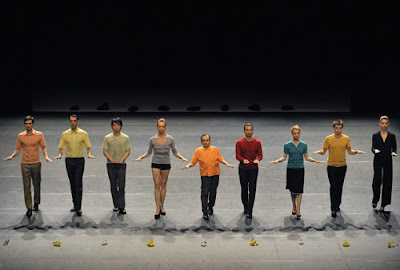
Philippe Decouflé, Octopus, Théâtre National de Chaillot


Always wanting to expand our theatre repertoire, Anne and I dutifully went to see the celebrated French choreographer's latest extravaganza, Philippe Decouflé's, Octopus at Chaillot last night. Because he has been so applauded, particularly in France, we were expecting big things. But Anne captured the entire show when she announced at the final curtain "half time at the superbowl is better than that." I am not sure why Decouflé is such a big name in France, but clearly, it's not because of the depth of his choreography or the profundity of the creations in their totality. Octopus, a mélange of acrobatics and fancy dance moves offered nothing of substance to discuss over dinner afterwards. In 2007 he apparently did the parade for the Rugby World Cup, a genre of entertainment I imagine he did very well. Personally, I think he should stick to the World Cup and leave the stage at Chaillot to more substantial performances.


Images courtesy the Artist

Sunday, October 28, 2012

Tanztheater Wuppertal Pina Bausch @ BAM


As a graduate student I used to venture out to BAM regularly to visit what was, in the 1990s, one of New York’s few locations for international experimental theater. And when I went over the bridge last night, I was relieved to find there is still one place in New York where people are not glued to their iPhones, one place that technology consumerism hasn’t yet colonized. Anja insisted that we get there 20 minutes early to watch the people arrive, and to be sure, the audience was as varied and as interesting as any cross-section of New York’s cultural and intellectual world. There were people of all ages, some dressed with abandon, others very meticulously put together, still others who arrived with their head still in a book. New York’s most vibrant intellectuals had crawled out of the woodwork to see Tanztheater Wuppertal Pina Bausch’s final work.


I last saw Tanztheater Wuppertal perform in New York, at Lincoln Center, in 2002. I remember it as being intellectual, avant-garde, somewhat experimental, I remember the dancers being of all different ages, being strong in personality, and saw them pushing at the boundaries of what it means to dance, to perform, to act.

But last night’s performance at BAM was softer, more fluid, more dreamy, less intellectually challenging. It was a delight. While it was enjoyable and engaging, there was nothing particularly radical about the dancing or the message being conveyed in the series of vignettes that made up "…como el musguito en la piedra, ay si, si, si…" (Like moss on a stone). Unlike vintage Pina Bausch from the 1970s, the performance was not experimental and nor did it push boundaries. The overall narrative was resoundingly heterosexual: men and women struggled, fell in and out of each others arms, loved each other, writhed in agony and anger, but always, they came back to the fundamental belief in the resilience of the heterosexual relationship.


While the kind of relationship explored in the vignettes that made up "…como el musguito en la piedra, ay si, si, si…"  was conventional, so much of the delight of the piece was in the strength and power of the women as they reveled in their femininity. Not only did the women outnumber the men, but they wore an exquisite array of colorful, sensual dresses – in familiar Pina Bausch style. The men, however, were often shorter, wore black, and were more generic, less distinctive in their appearance. The women teased the men, combatted them, resisted them, and then they fell into their arms, like honey as they melted into their feminine softness. And all the time, the women were playful and joyous, filled with an energy that spoke their endless enthusiasm for life.


The women dancers were beautiful, but not always in a conventional sense: striking in their defined facial features and the clarity of their movements.  They all had long, thick hair that became as integrated into their identities, their power, and the overall narrative as did their gorgeous dresses. They used their dresses not only as clothes, but as paniers for rocks, for grass, they transformed them into screens, fans, and curtains between them and the men. The women were always more beautiful and more exotic than the men with their colorful dresses, their long hair determining the shape of the dances as well as the stories, claiming their power as women. This feminine strength was uplifting, something to be celebrated.

The theatrical dance itself was about the intensity of what it means to love, to be intimate, the struggle to find emotional security and the difficulty of holding onto it. So the emotions conveyed in movement were at times profound. The pain, for example, of a woman at the end of a rope tied around her waist as she tugged, and writhed at speed, like a dog on the end of a lead was excruciating. It was painful because we may not all have been tied to the end of a rope, but we know the feeling of being unable to break loose from the chains that hold us back, hold us in one place. Then, in one of the most sensuous and erotic scenes, all of the dancers formed a line diagonally across the stage, sitting linked in the space between the legs of the one behind (above). As they sat, leaning back into the one behind, each brushed and massaged the hair of the one in front, to the beat of the playful music. It was, again, revealing of intimacy and tenderness.

Such moments of harmony were broken when a single dancer broke into an intense solo, at a pace that ensured we were transported into a realm of confrontation, into the isolation and untrained energy that puts distance between the need for love and the love itself. And so, the dancing was expansive and intense — as we came to expect from Pina Bausch — between comedy and intimacy, antagonism and isolation. And, to reiterate, I came away uplifted by the energy of the women as they indulged the depths of their femininity. Ultimately, however, I am not sure that this performance added to my understanding of what dance can do, or where it can go.

Saturday, March 31, 2012

Saburo Teshigawara, Mirror and Music. Théâtre National de Chaillot


I recently heard Akira Lippit discussing Hirokazu Kore-eda’s wonderful film After Life. Lippit compellingly identified in the film the haunting memory of Hiroshima and the dropping of Atomic Bomb as the traumatic memory that would never heal, the trauma that pointed to the disaster that, in turn, always lay on the horizon in twentieth century Japan. Lippit identified in Japanese culture, an imaginary built on a memory, and a conception of historical memory of a trauma yet to come. And when the Fukishima Daiichi Nuclear Power Plant exploded as the domino effect of a Tsunami and an Earthquake of inconceiveable proportions, the promised disaster arrived. As Lippit convinced me, it’s so difficult to see anything Japanese without looking through the lens of the violent disruptions to its history and identity effected by these traumatic events.

And so I was surprised that none of the reviews of Saburo Teshigawara’s recent piece, Mirror and Music make any reference to the disasters that underwrite Japan’s more and less recent histories. When a dancer (Teshigawara himself) stands in the line of a strobe light that tears the stage along its diagonal, music blaring with an unrelenting rhythm, we begin to see what is not there, our eyes deceiving us as the strobe creates the persistence of vision, or is it that our eyes become overwhelmed by what our ears tell us to see. Namely, the illusion of movement? The deception of vision, the overwhelm of the imagination, the loss of definition to the human body, and the intense bombardment of music that is nevertheless familiar, took me right back to the struggle to know what is real, what is reality in a world turned asunder. And because Teshigawara and his 8 dancers are Japanese, I am immediately plunged into the nightmare of the context of the country’s old and new disasters.

Teshiawara, in particular, but also the dancers who accompany him, move to a realm that pagans such as myself might recognize intellectually, but could never experience. Mirror and Music is captivating because the dancer’s movements are familiar, just like the reverberations of baroque music gone awry that dominate the soundscape. Every movement begins as a move we know from classical ballet, but the recognition only lasts momentarily. The dancers take off and through endless repetitions, and distortions, exaggerations, under the intensity of either fixed spotlights or a strobe in full force, their bodies become ephemeral, intangible, otherwordly. There were moments when the arms of the dancers moved so fast, with such repetition that their hands became replaced by some kind of transparent, multi-colored substance that wove through the air. Any resemblance the dancers might have had to you and I, restricted by the physical and spiritual limitations of being human, disappeared.

Teshigawara himself, always in motion, making repetitive gestures that defy his physicality, is like a Buddhist monk in his extraordinary ability to be in the same pose for an unending amount of time. Except, that unlike the monk in meditation, Teshigawara in a body that defies time with its classically sculpted perfection, is in unending motion. It’s as though he steps outside of his body and lets it take control as it spasms impossibly, at the same time as it is caught in a pose beyond what we know the body can do. Of course, it’s not just classical ballet that forms Teshigawara, but the politically subversive Japanese Butoh. The absurdity and poetry of Butoh, as well as its sedition and discipline, are everywhere weighing on the form and expression of Mirror and Music. Teshigawara and his dancers thus dance in a language that resonates for a cult following in Japan, and simultaneously, draws a full house to Chaillot. And like audiences of Butoh in the wake of World War II, at the end of the 75 minutes of Mirror and Music, we in the West understand the urgency to face the social (and cultural) challenges of contemporary Japan. 


Images courtesy of Sakae Oguma

Sunday, December 18, 2011

William Forsythe Company, Sider au Chaillot


Sider was like nothing I have ever experienced or seen before. Of course, it is recognizeably dance, but beyond that, there is little for the audience to hold onto. Forsythe takes dance beyond anything we know, anything recognizeable, placing out of reach any hope of identification with the narrative and narrational logic for which the human body is usually a vehicle, or the logic that usually enables identification of and with the body. Every movement, every gesture towards rhythm, tone, coherence, all is ruptured, thrown into a vertiginous disarray that frustrates, enervates but never disappoints its audience. If Forsythe's earlier work invoked the protocols and vocabulary of classical ballet only to subvert them, Sider does away with any reference altogether.

The Chaillot website announces William Forsythe’s latest choreography thus: The “intricate patterns of [Elizabethan theatrical] speech are communicated to the performers via the soundtrack of a filmed version of a late 16th century tragedy. The adherence of the performer's actions to this vocal score instigates disquieting configurations of incongruous musicality that underscore the drama's themes of analogy and obscuration.” I include the quote because I would never have known that the discontinuous, fragmented and always unfinished movements were in fact inspired by the spoken text of a of a filmed version of an Elizabethan tragedy, which was in fact Hamlet. We were sitting too far back to notice the in-ear microphones that fed this text to the dancers. But even now I know it, I can’t say that it gives me any more insight into what I saw, heard and experienced at Chaillot last night.

I don’t know much about the Elizabethan theatre or the Courts that I assume were deconstructed in Sider, but I do know the music from the period. And I know that it is music in which the form cannot shift or change, ever. The harmony can explode if neccessary, but the form remains constant, a fortress, whose walls and dictates must be observed without choice. I also think of the perfection of the elaborate 16th century garden with its emphasis on symmetricality, formal, one could say, scientific complexity. While pleasure might take place in the garden, its architecture is as rigid as the social forms of those who designed it. All this is shattered in Sider: any resemblance to form has been set asunder. There is no base line, nothing for us to hold on to, at least nothing that might resemble the narratives that help us make sense of the world, and our place within that world. The stage of Sider was overrun by chaos and disarray. Nothing cohered, nothing made sense, and just when I thought I was beginning to grasp what was happening, the rug was pulled out from under me. Anne and I laughed as we climbed the magisterial staircase of the Théâtre National de Chaillot, and I announced that I thought it was going to end when a male and a female dancer found each other under a cardboard sheet, and in one of the few moments of human interaction, they slink off the stage together. But no, of course, this is the Hollywood ending to a piece of choreography that couldn’t be further removed from the manufacture of dreams. True to the non-logic of Sider, the end was not really an end, but rather, the place it happened to stop.


Other than the fact that the dancers kept their same costumes throughout the performance, the only constant was the use of the huge cardboard sheets as props. Of course, the dancers made the handling of the sheets look effortless, but I was in awe of the dexterity and diversity of their use, knowing how awkward cardboard of that size actually is, thus recognizing the intense demand of the dancers' movement. At various points the cardboard sheets were made into fortresses, at others they became shields against each other as enemy, weapons, drums to be beaten. And then the dancers used them to create the semblance, or the beginnings of rhythms: they kicked the cardboard to make loud repetitive noises, dragged a sheet across the stage for the sound of the wind, or dropped it to create that of an axe slicing through wood. The cardboard sheets were also the sole connection between the dancers, though usually as that which separated one from another. In perhaps the only tender moment in the performance, they hastily built a house in which to hide, though from what it was not clear. And at times the one male dancer who was not in the guise of a creature from another era, another planet, or reminiscent of another life form slid like an eel behind a sheet, only to have his protection ripped away. 
A friend from Frankfurt had told me about Forsythe’s Ballet Frankfurt in the 1990s when I was writing my dissertation on light in German cinema. My friend had said then that Forsythe’s company sculpted its mise-en-scène in light. In the 1990s, the use of light was no doubt different from its use in Sider but it’s true, the low-hung bands of fluorescent light, dictated by the same digital sounds as the bodily movement, contributed to Forsythe’s challenge to what constitutes dance. At one point, the lights were turned off altogether and we were left listening to dancers and cardboard making mysterious gestures across the stage. In its integration, or amalgamation of sound, light, text, movement, Forsythe’s work is about as close to a contemporary gesamtkunstwerk as anything I have seen in my lifetime. And so, it’s not simply a reframing of everything we understand dance to be, Sider is experimental art at its most cutting edge.

Sunday, October 2, 2011

DV8 Can We Talk About This? Théâtre de la Ville


As I sat fixed to my seat at Théâtre de la Ville watching the latest DV8 production Can We Talk About This? there was a moment when it suddenly crossed my mind that it would not be surprising if someone, even a group of people, wielding machine guns burst into the theater and held us all hostage. And if indeed this were to occur, I wouldn’t have been able to tell you the political or religious identity of those with the guns. For Lloyd Newson’s documentary “physical theater” takes no definitive stance on the highly-charged and thorny discourses on Islamic law, multiculturalism, xenophobia and racial intolerance. As its title suggests, Can We Talk About This? is a manifesto-like call for open and honest discussion of what it demonstrates to be the decades old conflict between Muslims and Christians in the West, and particularly, in Britain. The absence of truths is what lifts the credibility and conviction of Can We Talk About This? above and beyond all the other representations of what should and should not be done to resolve the otherwise irreconcilable ruptures in British society. All that said, despite its intention to open the doors to debate, rather than to point fingers, this is a searing critique of the British government’s irresponsible, and ultimately, racist address of these problems.


I am no theater critic, but I do know that DV8’s Can We Talk About This? is exciting because it pushes at the boundaries of what dance conventionally does. The eleven actors/dancers perform what looks to be the most exhausting performance as they constantly move their bodies in impossible ways and simultaneously talk, speaking the words of many figures from all sides of the debate who gave interviews for the piece. This might be the closest dance comes to documentary as the actors move in and out of character playing historical figures who have spoken out against and for observance of the Koran, forced marriage, crimes of honor and racial violence.


What I most appreciated about the multiplicity of representation — words, body movement, sounds, acting, archival footage screened on monitors — was the movement of the dancers/actors. In what I understand is a characteristic of Newson’s choreography, their movements were exaggerated gestures from every day life transformed into fluid dance. A nervous rolling of the hands, a repeated lift of the shoulder, a turn of the head made in tandem with one, two or three others, a sudden shut down of the body in reaction to the fear incited by an opponent. All of these gestures were legible, if exaggerated and transformed into the medium of dance. Similarly, when two or more of they dancers were on stage, they may have danced in pairs, but they never danced together, always working off one another, using each other as props, to shape their own body. I understood these subtly confrontational movements that never directly responded to or engaged with the other to echo the form of public discourse and debate on racial integration, the upholding of Sharia Law and so on in Britain today: no one ever says what they mean, and they never say it directly to the one concerned. I understood the physical movements and the dancers’ lack of direct relationship to each other to be a critique of the age old British tendency to talk at cross purposes, to avoid the truth when it hurts, and to use each other as a ploy to get what they want. There is even one scene when a dancer playing Ann Cryer, British Politician who campaigned against forced marriage, sits on another dancer and drinks a cup of tea. It’s the inability to say what is meant, preferring to drink tea when things get too tough, that makes the discourse go round and round in circles.  The contortions of the body, the dancers’ wrapping themselves around corners, standing upside down, are the very acrobatics that we all do to avoid having to talk about the challenges of reality. 

DV8 do not present any material we don’t already know. From the Fatwa against Salman Rushdie, through the brutal slaying of Theo van Gogh for his film Submission about a woman forced into marriage by her family and raped by her uncle, to the establishment of Sharia Law councils in the UK, nothing new is revealed about the tensions and conflict between the Muslim and the Western worlds. But the way this material is presented makes it worthy of outrage. There were many moments that induced such incredulity in me. To name just one – on a monitor isolated by a darkened stage, an adamant David Cameron insists that less tolerance be shown to those who speak out against “whites” (his term) in an effort to bring equality to the insistence on the practices that condemn and punish racial prejudice against “Muslims”. I wondered silently, is he stupid? racist? a political fool? 

As I say, the question in the work’s title is left as a question. There are no answers given in this powerful piece of dance theater. But then, simultaneously, as a question, “Can we talk about this?” becomes the solution to the problem. In spite of the powerful juxtaposition of contradictions and incompatibilities, the ultimate message of the piece is clear: we need to sit down and discuss. And we need to discuss not religious beliefs but the plight of the individuals who hold those beliefs.  Like the impact of the great manifestoes in history, we come out of Théâtre de la Ville with raised fists and a determination to fight the long struggle to commence responsible discourse on issues which are, to be sure, tearing apart the very fabric of everyday life, and not only in Britain.


Monday, December 20, 2010

Raimund Hoghe, Si je meurs laissez le balcon ouvert


At a work Christmas party tonight, I talked with a colleague about the density and complex chaos of the Wooster Group’s productions. And as I rode my bike home through the snow, I thought how the performance I saw on Saturday night, Raimund Hoghe’s Si je meurs, laissez le balcon ouvert,  might possibly be as diametrically opposed to the Wooster Group as it is possible to be. Hoghe’s collage of dance styles and traditions, dissolving from Romanticism into abstraction, seemed to move at a pace as gentle as the Wooster Group’s performances are frenetic. Where the Wooster Group pack a kaleidoscope of people, things, times and spaces, as well as geographical locations, theatrical traditions and oeuvres onto the tiny stage of the Performing Garage, Hoghe’s stage is sparsely populated, lonely, intensely introspective, lyrical and abstract. Where I have come away from seeing the Wooster Group in the past marveling at their ability to create profundity out of a chaotic layer upon layer of texts, images, bodies, cacophonic dialogue, and sets that are constantly on wheels, in motion, I came away on Saturday night with a sense of quiet awe at the serenity of Si je meurs, laissez le balcon ouvert

 Takashi Ueno and Marion Ballester 
This is not to say that Hoghe’s choereography, inspired by a Lorca poem, Adieu is emotionless or stagnant, far from it. Rather, there is something about it that makes me come away feeling as though I was meditating for three hours. Even though at times there is a powerful intensity to the dance and the emotions it expresses, these moments are couched in a quiet resignation to the place of such emotions in the montage of life on its way to death, of the advent of death, and its opening up to life, from the balcony. In one extraordinary vignette, somewhere in the middle of the three hours of fragmentary dance, the frustrations and anger, the resignation to loss and its shadow over every movement that comes in its wake, is danced to the crescendos of a full orchestra requiem. Marion Ballester was literally chased around the stage by Takashi Ueno, passionately, in a frenzied desperation. He never catches her, and yet, as she evades his reach at every turn and twist, he smiles with glee at her cold, relentless cruelty. Suddenly, Hoghe, who has been sitting watching the performance, holding a bouquet of flowers on the side of the stage, gets up, yells his disapproval and comes between them to break the tension, momentarily. But the arrest of this painful pursuit is always impossible because Ballester is the figure of death, clad in black, angry and raging out of control.


Si je meurs laissez le balcon ouvert is supposedly an homage to Dominique Bagouet, the young dancer who died of AIDS last year. But when Hoghe appeared in a soft silk dress, my friend Anne leaned across and reminded me it was a Pina Bausch dress. Hoghe quietly moved a hand, raised the shoe lace straps, placed his arm around the tall woman next to him, quietly and gently offering one of the few moments of human contact in the entire performance. As if in homage to Bausch, such gestures resonate throughout the performance to create something beautiful, strange, tragically hopeful. Si je meurs laissez le balcon ouvert was, like a Bausch performance, a surreal reflection on death, memory, hatred and desire, none of which can be pinned down.

And then Hoghe appears appeared in a black jester’s hat and a long black coat, I imagine paying homage to Dominique Béjart who also died recently in 2007. Like Béjart’s most celebrated productions, Hoghe’s work appears so simple that there are times when it seems as though not so much is happening on the stage. But it is in the raising of a hand, or the peeling of an orange (as Hoghe does opposite Ornella Balestra in a breathtakingly beautiful scene) that everything about being human, every desire and frustration, is revealed. And like Béjart, Hoghe places the young male dancer in the spotlight. Witness Emmanuel Eggermont shift from burlesque through pantomimic and classical dances to his closing solo in which he twists and turns his body such that it becomes an abstraction in the slowly fading spotlight. He was, in many ways, the highlight of Si je meurs laissez le balcon ouvert. Thus, this is a piece about death, loss, memory, about the end of the twentieth century, the end of an era in modern dance, an era which was shaped by three masters who recently died: Pina Bausch, Dominique Béjart and Merce Cunningham. And it is simultaneously a celebration of the life of the male body.

Emmanuel Eggermont

Faced with the difficulty of interpreting Si je meurs laissez le balcon ouvert, I am left simply observing a work filled with confrontation, pain and remorse. The confrontation extends limitlessly: between texts taken from Goethe, Lorca, and others, music of all eras and genres, between the rich variety of colors and the death of black that cloaks their bodies, between death and the life that is invited in through the open doors of the balcony, between the dance styles of Bausch, Béjart, Cunningham, all of which, for Hoghe, begin with the classical. And then, as Balestra stands tall, imposing, completely possessed of her own grandeur stands as if on her balcony, and as she beckons her audience below to adore her, I am reminded that the confrontation extends into the space between life and representation. As Si je meurs laissez le balcon ouvert slides into the world of representation, we are invited to occupy that space opened by the death of representation and of dance in the twentieth century, as well as that space of mourning that we drift in and out of in the unconsciousness of loss. This is the only way to explain why it is so mesmerizing.

Saturday, December 4, 2010

Mathilde Monnier and Dominique Figarella, Soapéra au Centre Pompidou


A choreographer and a painter joining forces to create an opera, Soapéra, in which the medium is soap bubbles? It was all very unlikely, and I couldn’t imagine what this would be like. I am so happy I surmounted my skepticism of what sounded like one of those camped up, post modernist, not very meticulously sewn tapestries of faux intellectual frivolity. Mathilde Monnier, the choreographer and Dominique Figarella, the painter, created a piece that was as sensuous and subtle as it was dense and imaginative.

As we arrived in our seats in the large theater at the Pompidou Centre, soap bubbles were spewing forth from a huge pipe suspended above the stage, settling into a cloud of soap bubbles of considerable dimensions. As we sat in silence, we began to see something. Though I was initially unsure if I was imagining it, the cloud of soap bubbles began to change shape ever so slowly and slightly. The first half had begun. It was a mesmerizing image as the four dancers very slowly crawled underneath the soap, moving as if they were on the moon, slowly, at the same pace as the soap bubbles. They made shapes with the soap, standing up, lifting an arm, and the soap would obediently rise up, as a mass, to a height double that of the standing human figure. Who knew this is how excessive amounts of soap bubbles would behave? Accompanying this entrancing vision was a soundtrack, eerily like heavy breathing, as though the astronauts wading across this previously undiscovered planet whose surface is covered in soap were breathing artificially.

As we watched in total silence, the manipulations, distortions and elongations of the soap bubbles, the moment came when everyone in the audience began to cough. Again, who would have thought that soap detergent gives off fumes that could make the entire audience in the Pompidou’s huge theater cough uncontrollably? And so our coughing took over as the soundtrack, noises generated by soap bubbles.


And then, in what I understood to be the second part of Soapéra, the bubbles disintegrated. Without soap, the dancers were left on a black felt-laid stage with a white square in the middle. This square then became their medium. They picked it up, slammed it against the wall (above), rested it on their outstretched legs, and then when the soap had all disappeared, they danced on the white square, writhed on it, crawled underneath and around it.

 
Because much is made of the fact that Monnier the choreographer comes together with Figarella the painter to create a new medium on this strange planet of Soapéra, I was compelled to imagine the dialogue between dance and painting as I watched the piece. In the first half, the soap was the paint, flowing, viscous, being pushed around the canvas by the dancers as unseen brushes, molding their movements to become one with the medium. In the second half, the merging is complete: they take off their grey protective hooded jackets, to become four brushes: golden, green, yellow and white, their tops colored as though their upper bodies have been dipped each in a different colored can of paint. And as brushes, they danced on their white canvas. The dancing and movement was as agitated, energetic and disconnected in the second half as it was minimal, fluid and gracious in the first. And so the unpredictability of paint, the sensuousness of working it across a canvas in a search to discover its infinite forms of behavior, its endless possibilities, is perhaps just like the exploration of another planet; strange, unknown and a constant negotiation with the unknown, the not yet colonized.

Often today, contemporary dance performances are uneven, a single dancer being so much better than all the others such that an imbalance and a kind of inertia result on the stage. However, the last thing I must say about Soapéra, and one of the qualities that make it so captivating is the equality of the four dancers. Each was very different in his and her particular personalities, but their level of exertion, the assimilation of their movements with the body as energy source and their physical relationship with each other was, in all four dancers, exceptional.

Monday, July 19, 2010

Tacita Dean, Craneway Event, 2009


While Dean’s film installation is, as it’s subtitle claims, “a film with and about Merce Cunningham,” I also want to insist that it is a film with and about Tacita Dean. Filmed on location in the craneway of an abandoned Ford motor factory in San Fransisco bay, Dean’s realist film aesthetic is so perfectly suited to Cunningham’s choreographic minimalism. To give one example, if Cunningham’s life’s work results in a de-objectification of the human body of the dancer, then Dean’s observational practice echoes the anonymity and formal precedence over narrative development, thus desire, in film. In what must be one of the most articulate embodiments of the realist aesthetic in documentary film today, Dean’s long takes and long shots fuel a work that, over time, becomes transformed into a lyrical treatise on the ethereal elements of water, time, motion, light and space. Over the course of the 108 minutes of Craneway Event, Dean’s film and Cunningham’s dancers in motion in the breathtaking hangar structure thus become synergetically fused.
Despite my conviction that Dean’s film is about light, movement, the ethereality and anonymity of the human body in its interaction with the camera, I am prompted to consider what it says about Cunningham, the master choreographer because it was billed as a “portrait” of Cunningham when it screened at the Frith Street Gallery in London. There are some very poignant shots of Cunningham as he sits reflective, sometimes perhaps dozing in the afternoon warmth of the sun and light as they stream through the magnificent hangar space that is the setting of the rehearsals. Of course, we are mesmerized by his alertness at the age of 89, as he moves in a wheelchair that glides quietly like the sailboats that drift in the bay outside the windows. However, these shots say very little about Cunningham and everything about the inability of film to capture a person. Put another way, Cunningham’s image in this film becomes another element in the beauty and serenity of a world in quiet motion. He too is given the delicate insubstantiality of his dancers. Perhaps that is, in itself, the most profound claim about the work of the great master: his ability to choreograph a workplace so harmonious, fluid and ethereal that even his presence gives over to an otherworldliness in which the trials and tribulations of being human and living in the world no longer matter? And it is an otherworldliness that is so perfectly reflected in Dean’s aesthetic.
Lastly, I must say something about the carefully crafted soundtrack that completely undoes the lightness and liveness of the image track. My American friend thought that the near on two hours of Craneway Event would have been “easier” to watch with the John Cage music that usually accompanies Cunningham’s pieces. However, Dean’s decision to film the dancers in rehearsal is just the point. The exaggerated shuffle of feet, the thud of a dancer landing on stage, the creak of the floor, the dulcet tones of Cunningham’s voice as he communicates the transitions, directions and synchronization of the dance are exquisitely held by the silence that otherwise surrounds them. And because Dean manipulates the sounds, they interrupt the dreamlike image, with their matter-of-factness and, at times, raucous echoes through the huge open space. Ultimately, the sound prohibits us from falling headlong into the dreamworld of the stage, ensuring our attention to the reality of two hours of film.

Saturday, December 12, 2009

Raimund Hoghe, Sans-Titre, Théâtre de Gennevilliers


When Raimund Hoghe walked onto the stage at the Théâtre de Gennevilliers last night for the performance of Sans-Titre, I exclaimed without thinking to my friend James “oh look, he’s a hunchback” and immediately felt guilty for my indiscretion. And then, when Faustin Linyekula removed his shirt to expose his perfect black body, I was relieved that it wasn’t Raimund Hoghe’s body I was being asked to watch. Apparently as is usual with the lyrical and mesmerizing movements of Hoghe’s choreography, I was transfixed for the following 90 minutes. He laid out single sheets of A4 paper around the stage creating the frame for Linykula’s movements. And as Linykula writhed his perfect black body in agony at his enslavement to the deformed white captor, I was enchanted and amazed at how two bodies could so lyrically, yet, discordantly express the pain of being in each other’s worlds. They fought against each other, but not once did they touch. Until, Hoghe walked to the front of the stage with his awkward gait, and lay down on his stomach. Linykula began one by one, to place stones along the spine of his nemesis, crowning the arrangement with a stone on the point of the hunch. It was the most tender and loving expression of acceptance, a gesture that completely transformed my wariness for the man whose body didn’t accord with what I know as normal. And so, by the time Hoghe removed his shirt, the relationship between the two dancers and all of its implications of violence, aggression, and injustice prepared me to see through different eyes: the tenderness in the heart of the oppressed for his oppressor had fully replaced my fascination and repulsion for the hunch on Hoghe’s back.

There was a reference in the program to Pier Paolo Pasolini, about the necessity of throwing the body into the fight. It apparently inspired Hoghe to go on stage. He says, “other inspirations are the reality around me, the time in which I live, my memories of history, people, images, feelings and the power and beauty of music and the confrontation with one's own body which, in my case, does not correspond with conventional ideals of beauty. To see bodies on stage that do not comply with the norm is important - not only with regard to history but also with regard to present developments, which are leading humans to the status of design objects.”

I am in total amazement that he dares to show his body on stage, and yet, why shouldn’t he? As I writer, I recognize that my task is to creep ever closer to whatever it is that words cannot explain or describe. And if, as a writer, that takes the courage not only to access, but also to reveal my most intimate secrets, made up as they are of failures and flaws, then why should the dancer not reveal his? For a dancer, it is understandably healing and necessary to reveal the beauty and perfection of a body that is not usually seen as perfect. Hoghe says, “it is important to be able to work and to go your own way - with or without success. I simply do what I have to do.” Hoghe is clearly beyond attachment to what the likes of me with all my prejudices and social conformity think: he is motivated by an imperative that needs nothing more than its own fulfillment. To live and to express himself with the body he has been given.

Wednesday, October 21, 2009

Tsuyoshi Shirai and Takayuki Fujimoto, True at the Maison du Japon


Tsuyoshi Shirai’s True is another of the Japanese dance works that open up whole new ways of thinking about dance and performance. First, I have to admit that there is a lot about the work I still do not understand. For example, the relevance of the title to the piece still eludes me. In an interview the director and lighting designer, Takayuki Fujimoto, says that the piece “tries to show that what we perceive to be a lie can also speak the truth.” Conceptually, there’s little to disagree with, but the connection to the dance performance is obscure. And that's through no fault of the piece itself! Perhaps this is because the knowledge base and aesthetic references of a performance such as True are, like so much that comes out of Japan, of a different realm, steeped in Japanese history, ways of thinking, and seeing the world.

True opens with what appears to be a street kid in a hooded sweatshirt and chinos familiarizing himself with his environment, mainly handling the objects that sit on a 10 meter long table. A cup, a glass, a globe, a puzzle, a toy aeroplane among other everyday treasures. Tsuyoshi Shirai, picks one up, inspects it, turns it around, looks at it from different angles, and then puts it back on the table. Ever so slowly the tension mounts and as Shirai handles an object, an electronic noise is emitted simultaneous with his taking it off the table. The second he puts it back where it was, the noise stops. Then the lights are activated. LED lights that beat at the rhythm of the technological sounds and bathe the space in their red, blue or yellow. This integration of sound, light and human body was extremely impressive.

In the West we are accustomed to thinking of dance as being about the body, and indeed, the body of the dancer is usually fetishized — through lighting and movement etc — such that the form and movement of the body is the very substance of modern dance. However, in True, the body shifts from a technological sound board to no more than a silhouette. Sensors are attached to Shirai’s body such that the movements of his muscles and his brain register on a computer and trigger sound and light simultaneously creating a world of technological wonder. Even when Shirai’s slight body is in motion, and indeed, his movements are often extraordinary, it is otherwise unremarkable. Dressed in street clothes we would walk straight past him were he to cross our path out in the world. And even though his movements are often of the highest technical demand, they are not flamboyant, but rather, most often they are an intensification of an everyday movement that you or I would make, unthinkingly. This understatement of the body is a very different language of dance than those we are used to, and might perhaps account for a reviewer for the New York Times complete misunderstanding of the piece. When Japanese art and performance is seen in the West, it might, on one level seem straightforward, but I would argue that it is rarely coming from an aesthetic and epistemic history that we have at our fingertips. This leaves me at least without the tools to understand, let alone analyse a work such as True. And yet, I was nothing short of riveted for the 90 minute performance at the Maison du Japon the other night. There was something so exciting about the sophistication and ease of this concert in light, sound and human bodies reduced to movement.


As Illustration of the “foreigness” of the references, my friend James pointed out with amusement a question posed to Fujimoto in the program. The French interviewer asks “In Renaissance painting for example, the table symbolizes knowledge. Does the table in your work have the same significance?” Without even reading Fujimoto’s response, common sense would tell us that in True the table belongs to a completely different order of things. The dancers pull it apart, use it as a jungle gym, they pass objects through it, and are drawn to it as a safe haven for objects that otherwise create intense noises when they are touched, or even worse, lifted off the table. The table is a constant source of fascination, something to return to, but also a mystery that can be transgressed, its parts used for innovative games (at one point a cylinder that is cut out of it is rolled across the stage). Whatever it is, the table obviously does not represent the sturdy resolve of knowledge.