Wednesday, October 27, 2021

Alex Katz, Mondes Flottants, Galerie Thaddaeus Ropac, Pantin


Alex Katz, Floating Worlds, Installation
Thaddaeus Ropac, Pantin

I have never been a big Alex Katz fan. I know that he's an important 20th century painter, and that the high society women in sometimes gaudy colours are sophisticated critiques of capitalism and the art market. But, there's something about the hyperrealism that I find off putting. The works in current exhibition at Galerie Thaddaeus Ropac's Pantin space are, however, a different story. The paintings of water of different types, in different states are mesmerizing, even when they are painted in glaring blues and greens.
Alex Katz, Hommage to Monet, 5, 2009

A few of the works in the exhibition include people. I couldn't help notice how the human figures interrupt the cool, flow of the water. The human disturbs the expanse of blue that is nature's existence. Even though Katz painted these reflective works a decade ago, I was struck by their resonance with today's alerts for our devastation of the environment. In works such as People (2012) featuring people, the bathers horizontally dissect the water, interrupting, the figures seemingly conversing, playing, bathing, create a wave around them. The peaceful aqua blue of the sea is forced to change direction, lap around them.

Alex Katz, Reflection with Lilies, 2010

The paintings are also about reflection, about light as it dances across the surface of the water, and in this, the water, comes together with paint. The sea and painting have been partners in exploration of the limits of what we see and know. For centuries, artists have used the sea as a way to move beyond the human world, and in Katz's works that push is found at the limits of abstraction. Abstraction enabled through the marriage of paint, blue, water and light is brought to the fore of the paintings. Without depth and sometimes without any articulation of orientation or definition of space, we are left looking at the flow of paint that is the flow of the water.

Alex Katz, People, 2012

Another thing that is striking about these works is that we often don't know whether we are looking down at the water, across it. We lose orientation, in space as well as time: is that the moon shining on a night sky reflected in the water? Is it a grey day and raining? Is that a sea covered in mist? Is it a reflection, upside down in a lake? The intrigue and ambiguity of what we see in the image contributes to its oscillation between abstract and figurative. Again, the ambiguity like the abstraction comes in their bringing together of water, paint, perspective and light bounding around the canvas, reflecting and refracting off the water.


Alex katz, Wave 4, 2000

Ultimately, these works are more personal, more intimate, more reflective than anything else I have seen by Katz. And in the oasis that is Thaddaeus Ropac's Pantin gallery, housed in a renovated 19th century red-brick boiler house - its xenethal lighting makes the experience one of a calm, cool summer afternoon, far away from the noise and pollution of the city

Wednesday, October 6, 2021

Anish Kapoor @ Lisson Gallery

Anish Kapoor
Installation @ 27 Bell Street, London

I opened my London season of gallery visits with Anish Kapoor's latest creations at Lisson Gallery. I can't remember the last time I was so inspired by an exhibition. I realize many people reading this will not get to London to see this exhibition, but hopefully, there will be other opportunities to experience the works. As we walk into Lisson's main gallery space, we are met by Anish Kapoor's Sacrifice (2019). A steel structure draped in red resin that immediately brings associations of the innards of a slaughtered being. Whether that being is animal or human is not so important as we are overwhelmed by the mess of blood still dripping out the gutters that have been installed for this very purpose. The bloody entrails of what we imagine to have been a ritualistic killing—whether of the industrial or mythical kind—globbing and bubbling into their disintegration is gut wrenching. Sacrifice is filled with trauma and the slow painful death that we sense viscerally, even if we do not see the murder taking place. The rest of the exhibition offers no escape from the gaping wounds of a world filled with death, destruction and no promise of rebirth.

Anish Kapoor, Inhuman, 2020


The shapes and forms in sculptural and painted works remind us of things as variant as vaginas, bleeding wombs, monsters running rampant through volcanic landscapes, fire and rage of mythical proportions. The body and the natural landscape join forces in agony, screaming for help, watching their own disintegration at the hands of an unrelenting force. It's mindboggling to think that this is what Kapoor produced in lockdown, while we were all on Zoom meetings, avoiding people in the supermarket and getting depressed on our sofas. 

Anish Kapoor, All There Under my Skin III, 2020


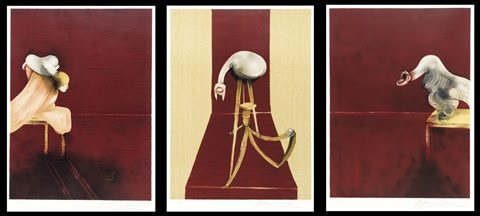
The Lisson gallery flyer mentions Kapoor's engagement with the history of art, reminding us that artists from Leonardo all the way to Francis Bacon have been obsessed with raw flesh and meat. Halfway through the exhibition, it becomes clear that Kapoor is not making vague references to his predecessor's concerns, but rather, that he draws specifically on the work of Francis Bacon, if not others. Kapoor followers will remember the Rijksmuseum's coupling of Kapoor's Internal Object in Three Parts (2013-2015) and Rembrandt's Carcass of an Ox. The artist's debt to Rembrandt is well known. And in the works on view at Lisson Gallery, the debt to Bacon is unmistakeable. Even before seeing the three-dimensional frame in the corners of the untitled works on paper, Bacon's gaping mouths, bleeding wounds, distorted and deformed flesh, screaming with pain are so clearly haunting Kapoor's intense and angry abstract compositions. As much as the triptych Diana Blackened Reddened (2021) might be about fertility and hunting, it is also about Francis Bacon's Second Version Triptych 1944. As Tate's website blurb quotes, Bacon's is a work that reflects "the atrocious world into which we have survived." One gets the feeling that Kapoor's triptych is saying something similar. 

Anish Kapoor
Installation @ 27 Bell Street, London


Francis Bacon, Second Version Triptych, 1944 1988

And then, we must not forget that these works are also about painting. Where the raw flesh of a body slaughtered body hangs limp over an unrelenting steel frame, so paint is filled with emotion and rendered alive in the accompanying paintings. But, by extension, paint is as connected to death in these works as Damien Hirst's Cherry Blossoms are to life. It is as though Kapoor were saying something to the effect of painting cannot be separated from flayed bodies, oozing entrails and violently desecrated souls. Painting is about the destruction of our humanness. In turn, if Kapoor is so intent on seeing our bodies slashed and slammed in the abattoir of existence, then he must also be saying something about the modern condition. Certainly, there is not much to look forward to—unless of course, the pleasures of the flesh are also captured in these visceral distortions. Certainly, the proliferation of bleeding orifices and spewing volcanoes would strongly suggest that death and sex are never far apart.

This exhibition is breathtaking from beginning to end.


Sunday, August 29, 2021

Damien Hirst, Cherry Blossoms @ Fondation Cartier pour l'art Contemporain

Damien Hirst, Cherry Blossoms, 2020
Detail

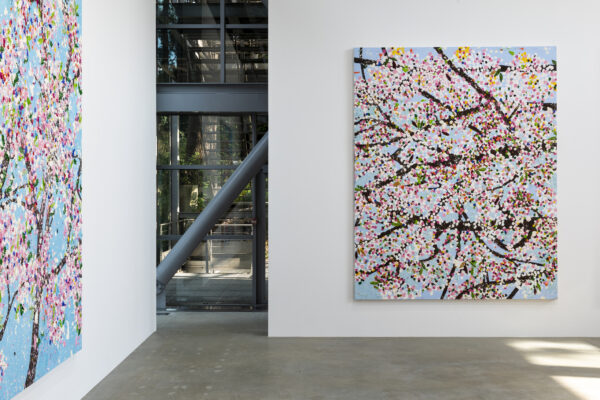
Damien Hirst's Cherry Blossoms are like nothing else shown at the Fondation Cartier in recent years. Likewise, the Cherry Blossom paintings are, at first glance, unlike much of what Hirst has produced over the past decades. This is apparently his first institutional exhibition in France, and that makes the exhibition even more unusual. One would expect to see sharks in formaldehyde, dots and diamond studded skulls in his inaugural exhibition. And yet, the lush, delightful oil paintings seem to find their perfect home in an exhibition set inside the glass house of Jean Nouvel's dynamic building, itself in the lush gardens of the Fondation Cartier. With the light streaming in at the end of the day, glinting on the surface of paint and making the colours sparkle, it's difficult to imagine the Cherry Blossoms anywhere else.


Damien Hirst, Cherry Blossoms, 2020
Installation @ Fondation Cartier

While these luscious and sensuous paintings are quite different from anything we have seen Hirst make over the years, there are obvious similarities to the visual candy and the dot paintings. If the dot paintings are about control and systematization of colour, the uniformity of the application of paint, the formal geometicality of the canvas, the cherry blossom paintings are the very opposite. Thick globules of paint are lovingly applied with fingers, sticks, and brushes, left to coagulate and blister unpredictably over time. The intensity of paint still in the process of drying mimics the ephemerality of the blossoms that will, eventually, wither. And yet, in this, they continue the artist's career-long preoccupation with death, the body, the disintegration that comes with the passing of time — in a dead animal, a promise of renewal in medicine cabinet. 

Damien Hirst, Cherry Blossoms, 2020
Detail

Up close to the paintings, I was reminded me of Cy Twombly's mid-career works in which congealed paint sometimes falling off or moving around the canvas makes visible the presence of the artist's body that was once there. The difference, however, from Twombly's paintings is that the traces of him on the canvas are revellations of the artist thinking, even in the doodlings. Hirst's blobs and globules of paint are intensely physical and emotional. They are the manifestation of an artist at one with the canvas, delighting in the possibilities of his medium. Unlike much of Hirst's other work from the past 35 years, they are the work of a painter playing in his studio, alone with his paints. On these brilliant canvases, we see Hirst free from the demands of the structures, grids, formal principles that overwhelm his work of the past thirty years. It is as though he lets go of all the pressures of being an artist from whom the world has expectations.
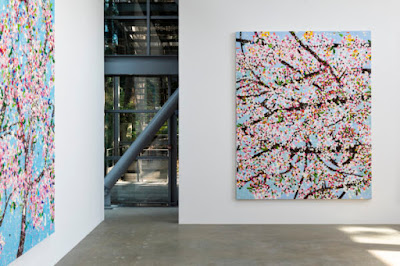

Damien Hirst, Cherry Blossoms, 2020
Installation @ Fondation Cartier

It is also refreshing to see how non-masculine these paintings are. They may be huge in size, and placed side by side in his studio, forming one enormous frieze of cherry blossom trees, but they are not big powerful works expressing an overblown male ego. This is not to say that these canvases are delicate, but they are ephemeral. It is as though they capture the lightness of air blowing blossom from the trees and swirling in the air. There is no control to the blobs and daubs, but rather, they appear, like a rainbow in the sky. Indeed, the arbitrariness of their application gives them movement as they blow in the wind. 

Damien Hirst, Cherry Blossoms, 2020
Detail
On display at the Fondation Cartier, the abstraction of the compositions is underlined by the fact that they are placed out of order. That is, they were painted as trees across multiple canvases in the studio, but the panels are separated on display, mixed around so that the figure of the tree is often lost. We are left looking at abstract canvases of colours. Up close we are left to ponder the colours which, surprisingly, are not all pink leaves and brown tree trunks. There are bright oranges and greens, purples, reds, yellows, greens. And every colour comes in a spectrum of shades. The result is that each canvas is a different tone, a different temperature, a different hue, has a different personality. This, of course, is Hirst's lifelong obsession with abstraction, played out in his exploration of colour, scale, application and the tension between technical virtuosity and the aleatory.

Damien Hirst, Cherry Blossoms, 2020
Detail

I overheard one of the guides saying that because the paint is so thick, much of it has still not yet dried. And when it does, the colours will change, they will become dull, like the falling of blossom from the trees as the seasons move from one to the next. The transience of Hirst's paint, the abstraction of the compositions, and the sensuous joy that we experience in their presence fills them with surprise and joy. But, let's not forget, these works are also pervaded by the promise of death. After the sun has stopped shining over fluttering blossom, the only thing for them to do is to die.