Monday, September 9, 2013

Ethan Murrow, American Ego @ la galerie particulière


Ethan Murrow, The Old Aristocratic Colours Breaking Through, 2013
On my way past the La Galerie Particulière the other night on my bike, I glanced through the crowd to glimpse Ethan Murrow’s images. I thought, from a distance I was looking at photographs. When I went back for a closer look, I was pleasantly surprised to find huge graphite on paper drawings, huge because this is a medium usually used for more intimate scale pictures. Murrow depicts a strange, archaic America inspired by, and at times, depicting well known American literary myths and legends, paintings and historical events. As a lady from the gallery walked around the exhibition identifying the references and influences in each work for me, I wondered if most viewers would have even heard of the names and narratives, let alone recognize them in Murrow’s drawings.

Ethan Murrow, The Boast of Clotilde, 2013
Nevertheless, when standing before an image such as Moby Dick, 2013, the ambiguities are not in the subject matter of the image. If only thanks to the title we are immediately made aware of the grand narrative of adventure and discovery that is woven through the exhibition. In spite of the realist detail of the image, there is always something surreal in Murrow’s drawings. The title Moby Dick, does not sit well with four wheel drive vehicles, in a canyon, on the shores of a lake that has no depth, tiny figures holding umbrellas or wearing hard hats, with no rain and no reason for protective headwear. And when an elephant falls into the water in The Old Aristocratic Colours Breaking though, he falls off a raft that could never have held him. We know we are in the world of magic and miracles with this image. And yet, the title of this drawing is taken from Alexis de Tocqueville’s Democracy in America: “The surface of American society is covered with a layer of democratic paint, but from time to time one can see the old aristocratic colours breaking through”.  Thus, we become alerted to the multiple layers of works that are all at once political, playful, art historical and technically precise.

Ethan Murrow, Early Warning System, 2013
Many of the images contain antiquated and clearly malfunctioning machines: helicopters, cars, or in Early Warning System, a chimpanzee sits on a raft surrounded by an infinite stretch of water, accompanied by an unwieldy machine that could not possibly get him to where he is going. This is espite the face that his raft is named “ABLE.” When technology is introduced, the historical becomes the arcane, in narratives that are made unreal, and filled with the promise of failure. The narratives that Murrow references, revises, critiques and makes fun of are always about the discovery and colonization of America. They are about the formation of the American identity, its flaws and foibles, built as it is on conspiracies, whale sightings, UFOs, supernatural and animal life.

Ethan Murrow, Kingdom, 2013
What I loved most about Murrow’s drawings was their complex layers, as I say, not all of which I had access to. These images discourse through narratives of discovery, the movies, the Colonization of the American West, in cutting and simultaneously, highly entertaining depictions. Similarly, Murrow’s drawings are technically superb: painstakingly detailed in their reach for photographic realism in the form of graphite drawings. 


All images courtesy the artist and La galerie particulière

Wednesday, September 4, 2013

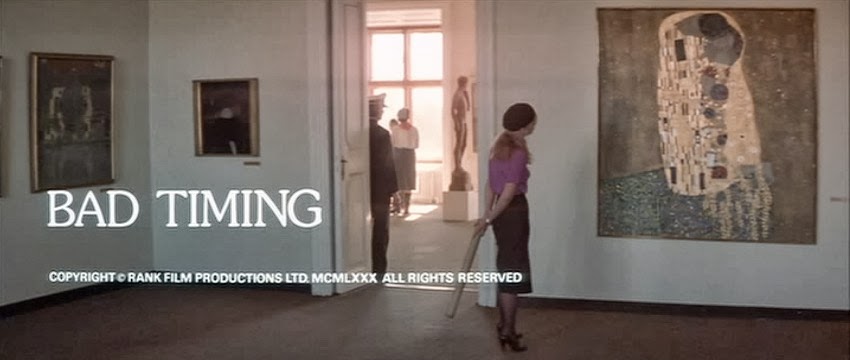
Bad Timing, dir. Nicolas Roeg, 1980


Even though it is supposed to be my métier, I rarely have much to say about film these days. Least of all do I have much of an opinion on contemporary releases. But every now and then an old film will have a new print made and enjoy an extended run at one of the repertory cinemas in the 5th. Whatever we think of the film, its content, the apparently transgressive scenes of rape, Nicolas Roeg’s Bad Timing is a film that looks gorgeous. With its provocative – and kind of 1980s – use of montage, its lyrical, drifting narrative of closely cropped images, explicit sex and some extremely painful obsessions engaged in by the incognisant, Alex Lindon played by Art Garfunkel, the 35mm technovision image is glorious. I was left reciting the warn out refrain, bemoaning that they stopped making films that look like this.

On the Czechoslavakian-Austrian border: Art Garfunkel and Teresa Russell in Bad Timing, 1980
Even beyond the way it looks, Bad Timing has some lovely gestures that make it completely a film of its time. For example, the use of the border between Czechoslavakia and Austria as Milena crosses for never fully explained reasons, is very much of its time. Shot in 1979, the film assumes all of the chill of the border crossing accompanied by the strains of Pachabel’s Canon that pervaded divided Europe during the Cold War. And then when the film cuts to an austere Vienna, Milena infuses verve and colour to an otherwise stiff, colourless world. The most daring Vienna can offer is the seduction of the Gustav Klimt paintings, surrounded by which we first see Milena and Lindon sharing their wisdom on sex and love as they move through the Secessionist museum.


It’s not a perfect film by any means. The Harvey Keitel character of the Austrian investigator of the “crime”, Milena’s mysterious death, is tentatively placed as a mirror to Garfunkel’s Lindon, but the mirroring isn’t developed. As Linden, the professor of psychoanalysis (an appropriate profession for a film set in Vienna) becomes more and more disturbed, in what is a textbook obsession for Milena, the vivacious woman he can never fully own and dominate, Keitel’s character walks around looking very handsome, but not doing an awful lot. How he reaches his genius insights that prove Lindon’s rape and ultimate guilt in causing the death, is assumed, never explained by the film. The only insight into Keitel’s character is so unexplained that it seems irrelevant to the narrative when he comes home one night and we see the photos of his wife on he dresser.

Similarly, why Milena has left her husband in Hungary is never made clear – his role seems to be simply to tantalize Alex and to ensure he has reason to distrust her, to confirm his reasons for obsession.

The narrative of Bad Timing does not collapse in the same way that Performance ‘s does, both at the level of the gender collapsing and the narrative’s imitation of that collapse. However, in Bad Timing the narrative has a very meandering, lazy forward motion. While we never know where it is going, its unhurried wanderings are forgive because the look of the film is so enticing, as is the conviction with which a masterful depiction of sexual obsession that is only just on the other side of the line that separates us from Alex Lindon. Bad Timing, with its radical storytelling techniques and its images of sexuality at its most violent and irrevocable still puts a chill in the air. Especially when the other films on offer here in Paris are the likes of Wolverine, Star Trek, and Spiderman.

Wednesday, August 28, 2013

Guarding Germany's Treasures


Joseph Beuys, Straßenbahnhaltestelle - Ein Monument für die Zukunft, 1976
I was surprised at how much I had forgotten about life in Berlin, but like getting back on a bike, it didn’t take long to be plunged back into the cultural familiarity of this extraordinary city. I recently read Thomas Bernhard’s Old Masters as well as Asunder, by a young writer, Chloe Aridjis, both of which give life and personality to the otherwise “invisible” museum guards in the Kunsthistorisches Museum and the National Gallery in London respectively. With these two novels on my mind I was alert to the comportment of the museum guards and it didn’t take long to be reminded of this unique human specimen: the Berlin museum guard.


All of the guards in galleries on Museum Island were just as I had remembered them when I visited Berlin during the Cold War: upright, proud civil servants with a sense of propriety over the goods in their charge. The one difference — and it is a significant difference — is that their uniforms have been updated to reflect the striking renovations of the rooms they inhabit.

I was struck by the fact that at the Hamburger Bahnhof where the contemporary art sometimes resembles objects from a waste bin, the guards were fierce. The manner in which they instructed visitors to put their bags in the cloakroom, the unflinching authority with which they refused a group of French tourists entry one minute after the said last entry, the fierceness of their look as they guarded the ephemera of Joseph Beuys — bits and pieces he sometimes picked up from the side of the street — and their policing of photographs of works that couldn’t possibly reproduce on an iphone, made it seem to me that they had been trained in a simulated environment and were unable to translate their skills to behavior more appropriate to the art that surrounded them. Their rigidity and officiousness would have been comical if it wasn’t so confrontational.

At the Alte Nationalgalerie by contrast, where the paintings are among the most glorious in Berlin, indeed, in all of Germany, where whole rooms glow thanks to the luminescence of Casper David Friedrich’s landscapes, the exquisite and delicate brushstrokes of Schinkel’s cathedrals and Böcklin’s lighted skies, the guards were far fewer in number and tenfold more generous and friendly. It was as though the treasures of German art history lightened their spirits. We watched as five guards rallied around a young boy with his leg in a plaster cast in a wheelchair to place a ramp over three or four stairs to a mezzanine level. It was quite a performance, but the guards jovially took a break from reading their iphones and made it happen. Children were at the museum with their parents on an otherwise glorious summer day, looking at the history of their nation’s art. On more than one occasion I saw the guards engaging the children in discussion about the art on the walls, proud of their familiarity with images that accompany them day after day at work.

It was as though the delicacy and softness of German art had resonated with their being. We don’t expect German art to be so gentle, and neither did I expect the guards to engage so generously with the children in their midst, especially when at one of Berlin’s oldest, most esteemed institutions.

More like the Hamburger Bahnhof than the Alte Nationalgalerie were the cries of the guards at the Memorial to the Murdered Jews of Europe. One of the most delightful, and simultaneously, unsettling expanses of the new Berlin is the 19,000m2 field covered by Peter Eisenman’s concrete slabs at Potsdamer Platz. As visitors wander through this cemetery, children and young people race along the narrow pathways, hiding from each other around corners, climbing onto the stelae, laughing and screaming as they outwit their friends. Because of the height of each stela our sightline is limited to what is in front and behind, we cannot see to the left or the right, and so we put one foot in front of the other with trepidation, timidly advancing, eager to keep moving. The light pouring onto our path is eerie, compromised by the colour and density of the slabs. Young people sat on the columns, talking, kissing, quietly reflecting on the experience of being at the Memorial, or simply of being together. And then came the guards in their official uniforms, complete with hats and ties: literally yelling at the top of their voices, ordering people to get down, to stop running, to obey orders. 
I couldn't help wondering whether the German guards were protecting a historical treasure or extending a legacy as they constantly ordered these young people into line at the Memorial to the Murdered Jews of Europe?