Saturday, February 29, 2020

Daniel Arsham, Paris, 3020 @ Perrotin Paris

Paris, 3020, galerie Perrotin : l'archéologique fictive de Daniel Arsham
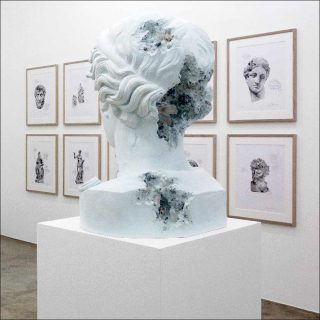
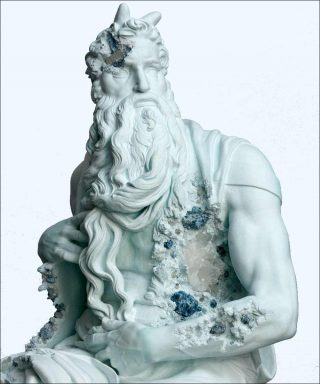
Daniel Arsham, Blue Calcite Eroded Moses, 2019

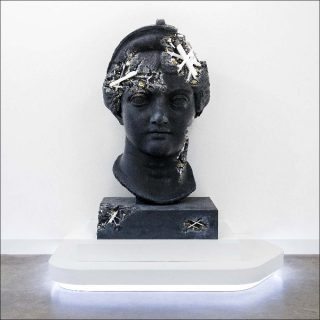
Daniel Arsham's eroded sculptures reproduce some of the world's great sculptural treasures, and is the perfect exhibition to see on return from a trip to Rome. The young American artist apparently gained access to the French molding atelier, the Réunion des Musées Nationaux - Grand Palais, that reproduces masterpieces for Europe's major encyclopeadic museums. Using the same molds and scans, Arsham casts perfect replicas of famous sculptures in hydrostone, a kind of uncoated terracotta clay. He then chisels erosions into the sculpture, exposing crystals of blue calcite, selenite, and quartz. The result is figures that are both disintegrating and, simultaneously, showing their mode of construction. They are both eroding and revealing their increased value, icons whose infinite reproduction and copying is in itself as much a cultural phenomenon as the object itself.

Image result for daniel arsham paris 3020
Daniel Arsham, Blue Calcite Eroded Melpomene, 2019

Having just returned from Rome, I couldn't help thinking of the gallery upon gallery of cultural riches at the Vatican museums. The endless rows of heads, animals, ancient gods and then the tapestries, paintings and sculptures acquired by each pope, adding to those already amassed from the previous one in the Vatican museums are the ultimate glut of accumulated objects. These collections that announce, "this is mine, I own it," is both the subject of Arsham's laughter and his critique of our readiness to consume everything in sight. On the one hand, the artist is showing the way that these relics are crumbling and disintegerating thanks to our unrelenting idolization, and on the other hand, with the sparkle of the precious crystalline stones discovered inside the objects, they are offered up to be further revered.
Image result for daniel arsham paris 3020
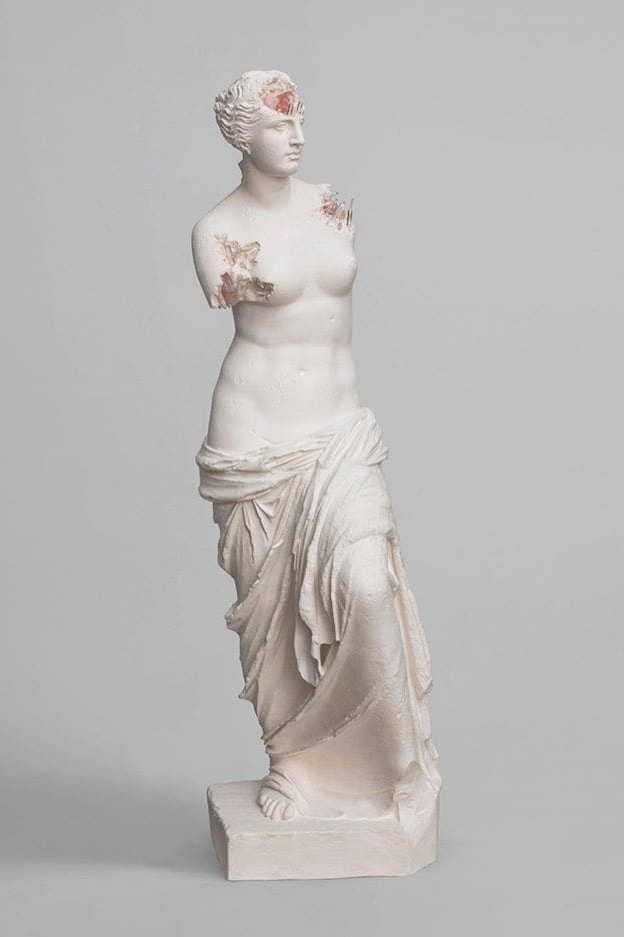
Daniel Arsham, Rose Quartz Eroded Venus de Milo, 2019

It is striking to notice that Arsham is doing the same thing with each of his reproduced statues.There is no differentiation between them, other than of course their form. But they are all the same material, they all go through the same process. To the point where, once we have seen one of these objects, we have seen them all. Nothing new is revealed by moving on to the next one. Except of course the fact that the repetition is itself a comment on the practices and processes of reproduction and adoration. The repetition might trivialize these great works of art, but it also gives them value. Furthermore, Arsham comments on our own behaviour in museums as both diminishing and elevating the value of objects on display. Rather than examining the work for its artistic qualities, we move to the next one, asking "who is it," ignoring its aesthetic qualities and historical significance in preference for  "spotting the great work of art." 

Paris, 3020, galerie Perrotin : l'archéologique fictive de Daniel Arsham
Daniel Arsham, Ash and Pyrite Eroded Head of Lucille, 2019

Arsham titles the exhibition, Paris 3020, in a clear gesture towards the future of these relics. In 1000 years, the art lovers of Paris will be traipsing off to see the works, even as they disintegrate and lose all materiality. And yet, Arsham is also surely critiquing the present. These are the past works idealized in the present, made over and over and over again, not just by the RMN, but in the form of miniatures, key rings, light shades, and the list goes on. They are also reproduced in every material - metal and plastic being the most popular. We can never get enough of the iconic treasures of yesterday.
Paris, 3020, galerie Perrotin : l'archéologique fictive de Daniel Arsham
Daniel Arsham, Paris, 3020
Installation View @ Perrotin Paris

Arsham's work typically represents the decay of the objects and icons that we blow out of proportion through our adoration: footballs, computers and televisions, for example. All of these objects have a lifespan that makes them immanently disposable - at least that's what he draws attention to. But when those objects are centuries' old museum statues that are being reproduced for encyclopeadic museums, they take on a whole new dimension. Arsham's works become about collection, exhibition and reproduction, and in turn, how each of these practices diminish and exaggerate the value, destroy and recreate the importance of art. 

Y Z Kami, Night Paintings, Gagosian Rome

Image result for Y Z Kami night paintings
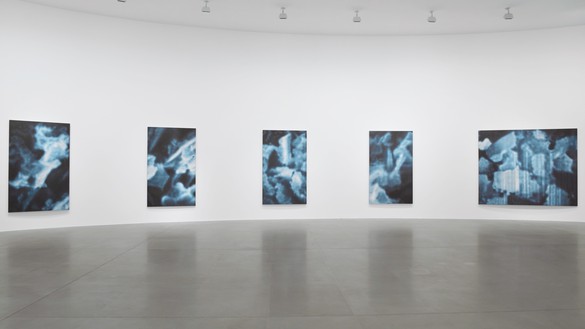
Y Z Kami, Night Paintings
Installation View @ Gagosian, Rome
As a way to mitigate the inevitable overwhelm of history, culture, architecture, and art in Rome, I always visit one place, or do one thing that I haven't done before. After four days of looking at ancient, medieval and renaissance art last week, I headed for Gagosian's Rome gallery, just behind the Spanish Steps. This glorious space is not just a haven from the buzz of the streets, but stepping into a contemporary art exhibition brought relief from the layer upon layer of history that makes up the palimpsestic city. The clarity of the light flooded space, together with Kami's indigo and white paintings offer reprieve from the weight of history all around.

Image result for Night painting 2 for william blake
Y Z Kami, Night Painting 2 (For William Blake), 2017-2018
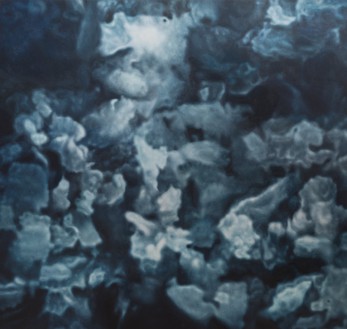
Contributing to the already obscure, floating shapes of the Night Painting series, Kami works with oil on linen, producing works on which the ill-defined shapes seem to float. I wondered for a long time what I was looking at. But Kami manages to obscure the abstract to the point where the white gradations and forms don't resemble anything in the everyday world. Almost resembling forms under the sea, perhaps under a microscope, in a gaseous state, or even x-ray images, the forms are always out of reach, never quite discernible.

Image result for Y Z Kami night paintings
Y Z Kami, The Great Swan, 2018
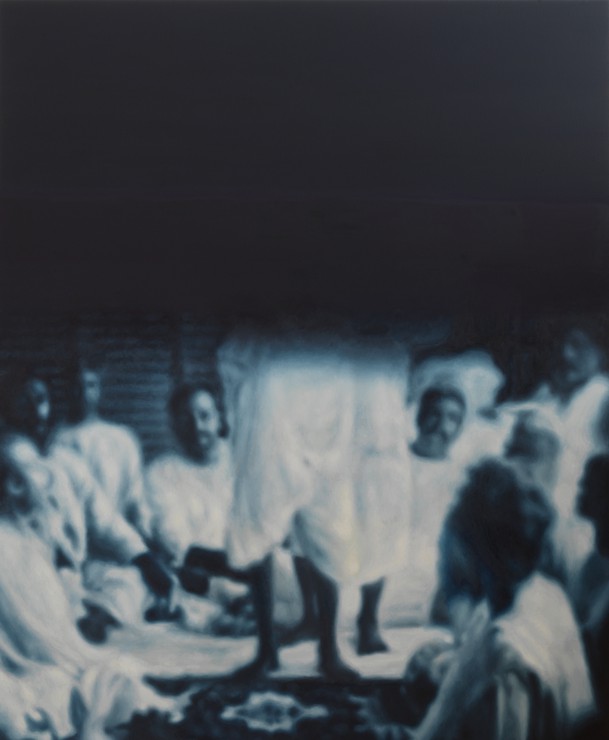
Also on display are two paintings from The Great Swan series. These two larger works are striking for the black veil that comes down over the figures, obscuring parts of their bodies and heads. The paintings of Hindu mystics surrounded by rapt worshippers may have figures, but like the Night Paintings, it is impossible to say what is happening in the image. The eclipsing of the top half of each painting effectively cancels out the hints of figuration underneath. Though we may be tempted to ascribe a political or social significance to the scenes of The Great Swan paintings, whether their discourse is on greatness, or worship of idols, or the other worldliness of the prophet, in the end, the blurring of the faces and obscuring of the scene, renders all meaning, once again, out of reach. Thus, in the end, as much as Kami's paintings gesture towards the larger significance, they remain enigmatic. 


Friday, December 13, 2019

El Greco, @ Grand Palais

El Greco, An Allegory with a Boy Lighting a Candle in the Company of an Ape and a Fool, 1577-79
Having tried unsuccessfully to see the El Greco exhibition at the Grand Palais on several occasions, only to find it was closed thanks to the general strike, I conceded and saw Toulouse-Lautrec, which was a pleasant, if somewhat exhibition. The El Greco around the corner is, however, magnificent.

The exhibition seeks to create a new narrative around El Greco’s work, departing from the often attributed stereotypes—the mystical genius, accursed artist, ascetic lunatic, early pioneer of Cubism and Expressionism. Instead, the Louvre and the Art Institute of Chicago have curated the works by placing them within their historical moment. The wall texts and hanging are done to identify the influence of Michelangelo on the Greco-Spanish artist’s work, as well as his apparent influence by the Renaissance. There is constant mention of his influence by Tintoretto as seen in the Venetian reds and blues, his particular use of light and shadow, and though there is little mention of it, the obvious influence of luxurious Venetian fabrics. There is also a conviction in the display of El Greco’s copy of Giorgio Vasari’s The Lives of the Artists with notes in the margins as proof of his commitment to art history.
El Greco, Portrait of Felix Hortensio Paravicino, 1609-1611
For all these efforts, it’s difficult to see El Greco as anything other than an individual who pursues his inner most convictions. The portraits are like nothing else being painted in his midst. The now familiar the loss of perspective coming as early as the 1570s marks his portraits as unlike anything in Rome or anywhere else in Italy. It becomes evident that El Greco’s fascination for capturing ephemeral human soul, creating the the outward expression of internal states, beliefs and morals is what makes his work so unique. But given this individuality, it’s impossible not to see the beginnings of the twentieth century expressionist vision in these canvases.
El Greco, Saints Peter and Paul, 1605-08
Particularly striking is the extraordinary pain and agony of the figures. Thus, even in the religious commissions, El Greco is shown to be more interested in the inner emotions than he is in the biblical narrative. In these paintings with religious figures, the iconography saves him from having to give the narrative details, and instead, to focus on the emotions and relations between characters through the intricacy of their hands. In among the sumptuous clothes of Saints Peter and Paul, what matters is their exchange as it is captured in the reciprocity of their hands, particularly their openness to each other following their dispute.
 
El Greco, Saint Peter and Saint Paul, 1590-1600
Of course, there are elements in El Greco’s paintings that are unmistakably influenced by the Renaissance. Perhaps the most striking element of the works on display is the use of fabrics. The fabrics frame each figure, dwarfing the figure, cutting the figure off from everything around him, and sometimes her. One gets the sense that if he could have, El Greco would have painted entire canvases of abstract colour fields. The fabrics of the coats and robes are El Greco’s exploration of the folds of fabric, often up close being filled with a multitude of different colours. So often, the fabrics are the most important elements in the image. In addition, the fabrics are not given realistic proportions. All that matters is the expression of the face and hands and then the composition as it is effected through fabric. The backgrounds tend to fade out or comprise a dark grey, rendered minimal and unnecessary to the fullness and power of the moment being painted.
 
El Greco, Saint Francis Kneeling in Meditation, 1585
In an exquisite painting of St Francis Kneeling in Meditation, 1595-1600, El Greco brings together his obsessions with cloth, hands and light. No reproduction can do justice to the way that St Francis’s tender face is gently illuminated by the light of the crucifix. It creates a closed and intimate world, giving us an opportunity to see the deeply personal moment in which St Francis is entirely caught. In the very famous An Allegory with a Boy Lighting a Candle in the Company of an Ape and a Fool, 1577-79, the light from the candle not only illuminates the scene, but brings the three figures together in a private, perhaps secret activity. It’s this feeling of intimacy that El Greco is able to create, even when he is painting an allegory, that sets his paintings apart. The works are always about something much larger than the figures, but at the same time, they are closed, private worlds. This complexity makes his works extraordinary.  As he continues in his career, the private moments transform into moments of transcendence for the figures. They are always everyday people who are both of the world and ethereal beings.
El Greco, The Pietà, 1587-1600
I sensed the presence of a master as I wandered around this relatively small exhibition, an overwhelming presence that makes it challenging to articulate just how powerful the works are. I have never seen religious commissions and public portraits made to be quite so tender, emotionally subtle, and breathtaking in their realism. And yet, as his works become increasingly mannerist, the elongation of the figures and the distortion of the figures also makes them increasingly abstract. This abstraction is indeed identifiable from the beginning. The proportions of the body are already off in the portraits, the long fingers, skewed angles, the small heads and, for example, Paravicino’s massive book.

Lastly, El Greco’s oeuvre is extremely painterly. From the beginning, we find a pronounced brushwork on the canvas, often in his representations of light. Similarly, paint is used liberally to communicate the turmoil around El Greco. The enormous energy of crowds of people on small canvases stuffed with figures, giving each image a sense of urgency.  Beyond the brushwork, the depiction and use of light, and fabrics, the painterliness is also found in El Greco’s fascination for color. Of course, his Italian ancestors and Spanish contemporaries are also interested in color, but it is not put to quite the same ends.


-->