Showing posts with label architecture. Show all posts

Monday, July 13, 2026

L'exposition générale @ Fondation Cartier pour l’art contemporain

Installation Fondation Cartier pour l'art contemporain

After years of scaffolding and construction sheets covering the east side of the Place du Palais Royal, the Fondation Cartier pour l'art contemporain finally opened last October. Before upgrading from its digs on Boulevard Raspail, the Fondation had celebrated architect Jean Nouvel work his magic in a stunning renovation. Before thinking about the building, a few words on the exhibition.

Joan Mitchell, La Grande Vallée VI, 1994 and
Damien Hirst, Cherry Blossoms, 2020

The inaugural exhibition itself is vast and leaves little time for reflection as there are so many works. On display is a single work by each of the artists held in the Fondation collection. If not all the artists are represented, most are. Many people will be familiar with the works from past exhibitions at the Boulevard de Raspail gallery—a Damien Hirst Cherry tree painting, a Ron Mueck woman, a Sally Gabori abstract painting, Matthew Barney's Cremaster. There were also works that I had not seen before, for example, a wonderful selection of David Lynch's drawings, jottings, scribbles and scrawls. Some of them were clearly conception sketches for films—some very familiar shapes and ideas from Blue Velvet , Twin Peaks, Eraserhead—while others looked like reflective jottings made while on the telephone. It was a real treat to see Lynch's mind at work in the drawings.

Sarah Sze, Tracing Fallen Sky, 2020

Another work that fascinated my friend and colleague Oksana who joined me for the afternoon was Christian Boltanski's Ephémère (2017) in which linen cloths play and dance, inside moving fragments of projected light projected. As the cloth blows in the wind, light flickers and jumps, and then moving inside, it is like being inside an experimental film. Sarah Sze's installation, Tracing Fallen Sky (2020) was fascinating as it could be seen from above from a higher floor and below on its floor. In it, objects and monitors, and a model planet create a whole world that, in keeping with the innovative sight lines is also always moving. 

Christian Boltanski, Ephémères, 2017

The most exciting thing about visiting the new space was, however, discovering the building, its history, and Jean Nouvel's redesign. The building at 2, place du Palais Royal, was built in 1852 as a hotel to accommodate visitors to the 1855 Paris Exposition. By the 1880s, the ground floor shops had expanded to the point where they took over the entire building along rue de Rivoli. The Palladian architecture made for a grand bourgeoise building in the heart of Paris, showcasing the prosperity of the Second Empire of Napoleon III. As part of the renovation project of Barron Haussmann, the Grand Hotel du Louvre was designed as a luxurious symbol of developing industrialization and economic prosperity in the city.

Looking up and out

Jean Nouvel's redesign has maintained the symmetry and perspective of Palladio's interpretation of classical architecture and made it contemporary through introducing moving parts, reflections, windows onto the city offering unexpected perspectives. A walk around the vast building is filled with surprises and extraordinary perspectives. Particularly, looking up from lower floors at the building's arcade along rue de Rivoli, at times glimpsing the windows of the Louvre opposite, and at others, watching people pass was a wonderful sight. This is another paris museum for which visitors will spend a lot of time admiring the architecture as well as the art. But what is most noticeable, is how easy the space is. Big spaces (like the Louvre) can be exhausting to navigate, but at the Fondation Cartier, there was never any sense of being frazzled by other people. It is also large enough that there were very few people around and on a hot day, the chilly air conditioning made it relaxing and enjoyable.  I am looking forward to the Fondation Cartier's first exhibition, especially to see how they use the space to showcase their amazing collection. 

Wednesday, August 27, 2025

Wolfgang Tillmans, Nothing could have prepared us. Everything could have prepared us @ Centre Pompidou


Installation view on empty shelves of the public library

German photographer Wolfgang Tillmans has been given carte blanche at the Pompidou Centre for a few months before the cultural mecca shuts down for five years of renovations. The simple activity of entering the Pompidou to visit this exhibition is a novel experience, even for those of us who are regulars. Visitors must cross the empty ground floor, walk up stairs, then take an escalator through a space not previously accessible to the public. On arrival at the second floor, having completed this unusual traversal of space, we enter the old public library. All other areas are boarded up. Even before I reached the entrance to Tillmans' exhibition, I was happy to be there. 

Installation view

I had taken my time to visit this exhibition because I am not a big Tillmans fan, but seeing so much of his work in one place — and in this space — was rewarding. Tillmans' photography is often not aesthetically pleasing, which is part of the point, and also, one of the reasons I am not always drawn in. That said, there are works that are highly aestheticized—particularly those in which he experiments with photographic materials and light. More often exhibited in France is Tillmans' vast collection of personal and public photographs resembling something like an amateur archive of images depicting his journey through a changing world. As a body of work, these photographs make visible every day life over the past fifty years. 

Wolfgang Tillmans, Resolute Rave, 2020

I was surprised to see so many hip young people at the exhibition, because Tillmans' world is historical and presumably unknown to many of the visitors. Because Tillmans is my generation, his world is very familiar, and hence, I  enjoyed seeing the breadth of his vision across decades. Under glass over five tables, Tillmans has curated photographs, programs, flyers, books from the past five decades. I spent a lot of time in Berlin in the 1990s and 2000s, and the immediate post-wall Berlin of Tillmans' generation was the same one that I skulked around in those years. The ecstasy nightclub scene, grunge living, and the freedom of a world seemingly without limits, in a united, undeveloped Berlin. It is a city that we will never know again in our lifetimes. Perusing Tillmans' photographs of Berlin in those years, I looked with nostalgia, and grateful to have been a part of during an extraordinary period in history. 

Wolfgang Tillmans, Renzo Piano, 2024

Tillmans was given carte blanche to do as he wished, and perhaps the most interesting thing about the exhibition is that his installations are always in dialogue with the space. Whether it is a mirrored tabletop at which we peer and see the exposed pipes and ducts of the Pompidou ceiling, empty shelves of the one time library—the shelves of the arts and humanities being emptied while the scientific ones are filled with space travel books to indicate the state of knowledge today—a photograph of Renzo Piano in front of the building he designed, or photographs of the space we are in, Tillmans constantly reflects on the radical architecture of the Pompidou building. 

Wolfgang Tillmans, Freischwimmer 234, 2024

Among Tillmans most stunning works are the Freischwimmer and Greifbar works - images that he makes using different light sources in the darkroom without a camera. Huge abstract works that look like ink dye playing on surfaces, and in some, creatures busily fanning across paper. The colours he finds through light play in the process of image production are sumptuous, always different. Similarly, the Silver works remind of carefully worked abstract paintings. Photographic paper is fed through used developer triggering chemical reactions. The resultant images are varied, appearing to be marked, blemished by the silver salts of the paper. Over time, we see that they are gorgeous, but enigmatic. And then, over time, their appearance as something that they are not, disappears.

Wolfgang Tillmans, Paper Drop (green), 2011

Lastly, a lot of fun was to be had by visitors who spent time lounging around, talking, searching at computer stations - just as they did in the old library. Nothing could have prepared us. Everything could have prepared us was an experience as much as it was a visit to an art exhibition.So yes, I had a fun time at the Tillmans' exhibition, and I would highly recommend it as a lovely goodbye to the Pompidou as it goes on its five year restoration journey. 

Friday, December 13, 2019

El Greco, @ Grand Palais

El Greco, An Allegory with a Boy Lighting a Candle in the Company of an Ape and a Fool, 1577-79
Having tried unsuccessfully to see the El Greco exhibition at the Grand Palais on several occasions, only to find it was closed thanks to the general strike, I conceded and saw Toulouse-Lautrec, which was a pleasant, if somewhat exhibition. The El Greco around the corner is, however, magnificent.

The exhibition seeks to create a new narrative around El Greco’s work, departing from the often attributed stereotypes—the mystical genius, accursed artist, ascetic lunatic, early pioneer of Cubism and Expressionism. Instead, the Louvre and the Art Institute of Chicago have curated the works by placing them within their historical moment. The wall texts and hanging are done to identify the influence of Michelangelo on the Greco-Spanish artist’s work, as well as his apparent influence by the Renaissance. There is constant mention of his influence by Tintoretto as seen in the Venetian reds and blues, his particular use of light and shadow, and though there is little mention of it, the obvious influence of luxurious Venetian fabrics. There is also a conviction in the display of El Greco’s copy of Giorgio Vasari’s The Lives of the Artists with notes in the margins as proof of his commitment to art history.
El Greco, Portrait of Felix Hortensio Paravicino, 1609-1611
For all these efforts, it’s difficult to see El Greco as anything other than an individual who pursues his inner most convictions. The portraits are like nothing else being painted in his midst. The now familiar the loss of perspective coming as early as the 1570s marks his portraits as unlike anything in Rome or anywhere else in Italy. It becomes evident that El Greco’s fascination for capturing ephemeral human soul, creating the the outward expression of internal states, beliefs and morals is what makes his work so unique. But given this individuality, it’s impossible not to see the beginnings of the twentieth century expressionist vision in these canvases.
El Greco, Saints Peter and Paul, 1605-08
Particularly striking is the extraordinary pain and agony of the figures. Thus, even in the religious commissions, El Greco is shown to be more interested in the inner emotions than he is in the biblical narrative. In these paintings with religious figures, the iconography saves him from having to give the narrative details, and instead, to focus on the emotions and relations between characters through the intricacy of their hands. In among the sumptuous clothes of Saints Peter and Paul, what matters is their exchange as it is captured in the reciprocity of their hands, particularly their openness to each other following their dispute.
 
El Greco, Saint Peter and Saint Paul, 1590-1600
Of course, there are elements in El Greco’s paintings that are unmistakably influenced by the Renaissance. Perhaps the most striking element of the works on display is the use of fabrics. The fabrics frame each figure, dwarfing the figure, cutting the figure off from everything around him, and sometimes her. One gets the sense that if he could have, El Greco would have painted entire canvases of abstract colour fields. The fabrics of the coats and robes are El Greco’s exploration of the folds of fabric, often up close being filled with a multitude of different colours. So often, the fabrics are the most important elements in the image. In addition, the fabrics are not given realistic proportions. All that matters is the expression of the face and hands and then the composition as it is effected through fabric. The backgrounds tend to fade out or comprise a dark grey, rendered minimal and unnecessary to the fullness and power of the moment being painted.
 
El Greco, Saint Francis Kneeling in Meditation, 1585
In an exquisite painting of St Francis Kneeling in Meditation, 1595-1600, El Greco brings together his obsessions with cloth, hands and light. No reproduction can do justice to the way that St Francis’s tender face is gently illuminated by the light of the crucifix. It creates a closed and intimate world, giving us an opportunity to see the deeply personal moment in which St Francis is entirely caught. In the very famous An Allegory with a Boy Lighting a Candle in the Company of an Ape and a Fool, 1577-79, the light from the candle not only illuminates the scene, but brings the three figures together in a private, perhaps secret activity. It’s this feeling of intimacy that El Greco is able to create, even when he is painting an allegory, that sets his paintings apart. The works are always about something much larger than the figures, but at the same time, they are closed, private worlds. This complexity makes his works extraordinary.  As he continues in his career, the private moments transform into moments of transcendence for the figures. They are always everyday people who are both of the world and ethereal beings.
El Greco, The Pietà, 1587-1600
I sensed the presence of a master as I wandered around this relatively small exhibition, an overwhelming presence that makes it challenging to articulate just how powerful the works are. I have never seen religious commissions and public portraits made to be quite so tender, emotionally subtle, and breathtaking in their realism. And yet, as his works become increasingly mannerist, the elongation of the figures and the distortion of the figures also makes them increasingly abstract. This abstraction is indeed identifiable from the beginning. The proportions of the body are already off in the portraits, the long fingers, skewed angles, the small heads and, for example, Paravicino’s massive book.

Lastly, El Greco’s oeuvre is extremely painterly. From the beginning, we find a pronounced brushwork on the canvas, often in his representations of light. Similarly, paint is used liberally to communicate the turmoil around El Greco. The enormous energy of crowds of people on small canvases stuffed with figures, giving each image a sense of urgency.  Beyond the brushwork, the depiction and use of light, and fabrics, the painterliness is also found in El Greco’s fascination for color. Of course, his Italian ancestors and Spanish contemporaries are also interested in color, but it is not put to quite the same ends.


-->

Wednesday, November 21, 2018

Tadao Ando (and Franz West) @ Centre Pompidou

Tadao Ando,  Hill of the Buddha, 2015

I was surprised not to like the Franz West exhibition at the Centre Pompidou. It’s no fault of the exhibition, but West’s trash aesthetic and anti-art intentions left me feeling cold and uninspired. I can imagine that it must have been very radical in Austria in the 1970s to experience West’s interactive sculptures and autonomous performances. But without West present to help me have that experience, I felt very much the intellectual snob.

I felt even more guilty as I walked into the Tadao Ando exhibition in one of the small first floor galleries and breathed a sigh of relief to be looking at modernist plans and buildings. The intellectual brilliance of Ando’s architectural conceptions, the challenging aesthetic that is simultaneously, strangely beautiful, was far more comfortable than West’s playful, apparently revolutionary works. My cultural tastes are apparently more bourgeoise than I would care to admit.

Tadao Ando, Wrightwood 659 Chicago, 2018
I am no architectural expert, so I don’t know how easy or difficult it is to exhibit architecture, given the point of this art form is to walking inside and experience a three dimensional space. Moreover, I would have thought that the discerning architectural critic needs to have the experience of living with the design over time, through different seasons, even at different times of the day and night. With those caveat’s in mind, I did think that the Pompidou exhibition showed the wonder of Ando’s creations from their conception through to three-dimensional video representations of their execution and finished state.
Tadao Ando, Church of the Light, 1989
I have always wanted to go to Osaka to visit Ando’s neighborhood Church of the Light built in Ibaraki. I don’t have the language with which to describe this structure, not only because I am not an architecture critical, but because I find it mind boggling that anyone could ever imagine, let alone conceive of, the mechanics of the building. To have a shaft of light enter through scissions in the wall and not only form a crucifix in light at the altar (somehow this is the easy part), but to invite light to flood into the space of the church through an opening that also functions as the entrance is mesmerizing. And then, to ensure that the congregation sitting in the intense light of the sun when inside what is in fact a simple concrete box, is sheer magic.
Tadao Ando, Church of the Light, 1989
Exterior
Ando has made lots of art galleries and I can see how art museums and libraries are especially suited to his aesthetic. The choice of a brutalist concrete allowed to breath and to come alive through the events that take place within its walls, provides the perfect blank slate for art and books. Although it is a little difficult to know how comfortable these spaces are, I am looking forward to seeing and experiencing the Bourse de Commerce at Les Halles transformed into a museum.
 
Tadao Ando, Hill of the Buddha, 2015
Interior
Perhaps the most extraordinary of Ando’s work was the Hill of the Buddha in Sapporo that he built to surround a stone statue of the Buddha. Buddha had been erected in the middle of a flat plain fifteen years prior to Ando’s construction. He built a hill, but only up to the shoulders of the Buddha, allowing his face be seen from a distance and from above, contemplating. The hill was then covered in lavender, and the accompanying video showed the hill change colour with the seasons: green in spring, purple in summer, white in the snow. Ando built a pathway to the Buddha that could not be seen from above, in order not to interrupt the field of green, purple or white. The design is the perfect demonstration of Ando’s integration of the most functional and, ultimately unaesthetic, manmade material of concrete, and in turn, how concrete becomes transformed by the natural environment. In addition, Ando’s aesthetic and philosophy suggests that the spirit of the visitors to his sites immersed in the natural world would enliven the brutalist concrete forms. Humans transform these spaces, not simply through using them, but also through our very being, in interaction with them.
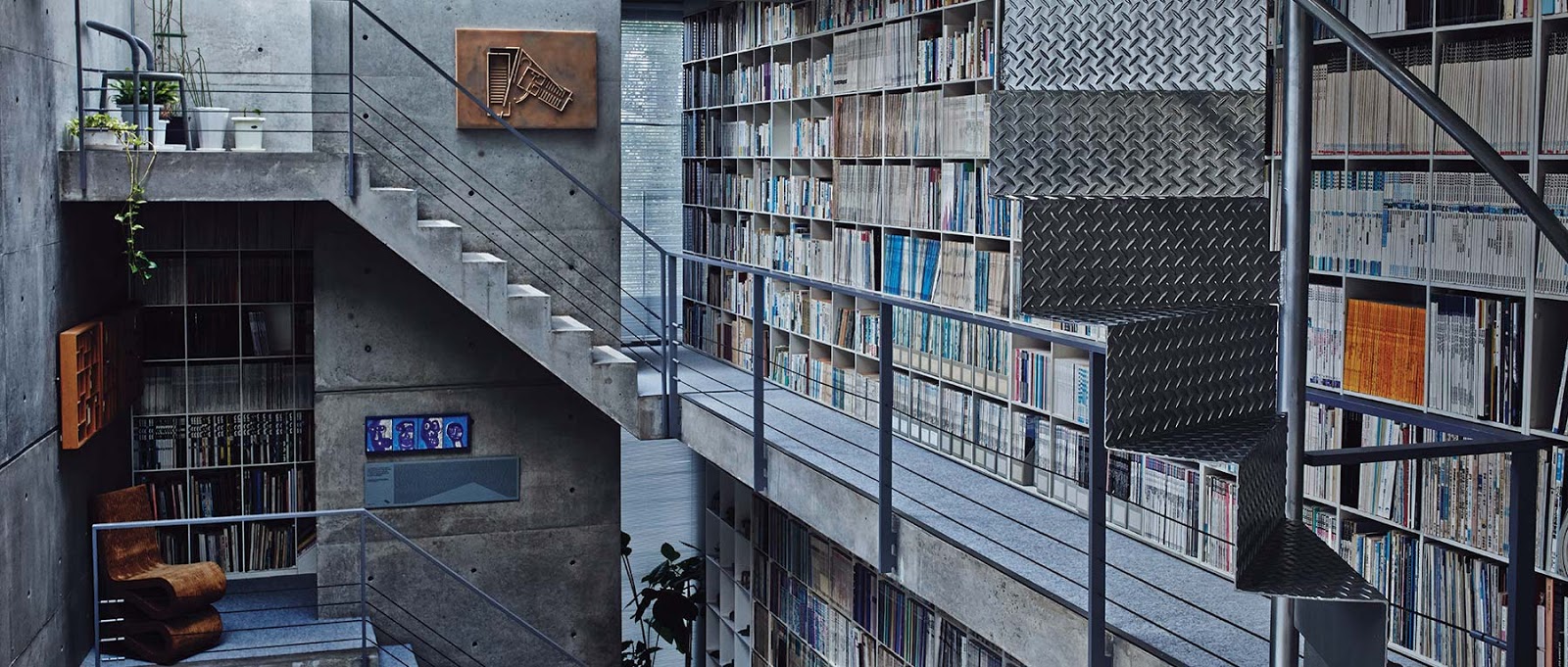
Tadao Ando, Studio in Osaka
At the end of the exhibition, there is a video of Ando’s studio and we see people walking up and down the four flights of (again concrete) stairs. I wondered how comfortable it is to work inside these concrete walls. This is the question that must be answered by all architecture – it looks nice, but is it functional and is it a design for a space I want to be and to live with? As Ando’s transformation of Paris’s 19th century Bourse de Commerce into a museum is underway, I guess, I will find out the answer to my question very soon.