Saturday, January 22, 2022

Baselitz. The Retrospective @ Centre Pompidou

Georg Baselitz, Fingermalerei-Adler, 1972

There's no mistaking the world that breathes life into Georg Baselitz's creativity. From the very start of this exhibition, we are confronted with an artistic output infused with war, violence, trauma, and a national identity that is everywhere pushing and pulling at personal identity. Baselitz's paintings are inseparable from the history of postwar Germany. The canvases are huge, oversized even, and yet, like Anselm Kiefer's installations across town, there is nothing monumental about them. it is though size is the measure of the pain and suffering that gave birth to Baselitz's paintings, rather than the ego that executed them. 

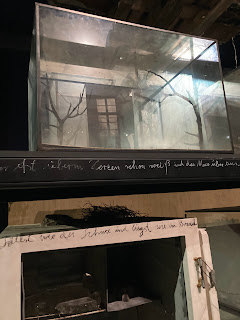
Georg Baselitz, Exhibition Installation
Centre Georges Pompidou

I am not one to dwell for too long on the biography of an artist as it usually doesn't offer particularly astute insights into the works in front of me. But, Baselitz's paintings are an exception. Born in the former German Democratic Republic, near Dresden, with a father who served as a Nazi soldier during World War II, Baselitz's biography has given him material to paint for a lifetime. In so many of his works, including the early fragmented bodies and the later inversions, the bloodied, deformed, tormented or oppressed body is usually struggling within a hemmed-in space. In nearly all of the paintings, this torment is depicted through a furious brushwork that is too often labelled as expressionist. To me, it's so much more than expressionist. Baselitz's paintings are frenzied, showing an urgency, either as a screaming out for help from the deformed and incapacitated or dismembered body, or as an indication of the artist's pressing urgency for solutions.

Georg Baselitz, Mann im Bett, 1982

I was particularly drawn to those spaces on the canvas where nothing is apparently represented. A painting such as Mann im Bett (1982) is typical of Baselitz's proficiency at creating balance in a canvas in which the figure is never or rarely centered. The isolated and scared individual in this painting is pushed to the top of the canvas, curled into a fetal position, in agony. And yet, the energy of paint on the rest of the canvas fills the empty space around the body with vitality and hope. My friend Loren and I discussed at length the negative space created by Baselitz's depressed, distorted and maimed bodies. The spaces where bodies are not are so rich, replete with a different kind of intensity on the canvas thanks to Baselitz's handling of paint.

Georg Baselitz, Gold drauf und drunter, 2019

This theme of the negative or "unused" space of the canvas becomes writ large across the whole painting in those works occupying the exhibition's final room. In a convincing conclusion to the exhibition, the figure is a shadow, a silhouette, or a dying body behind a curtain. Moving on from the deformations and distortions, the final bodies are not simply abstracted—we can still see the outline—but bodies receding, washed away by Baselitz's process of layering, working over to create intensity in the spaces and places that are otherwise empty. The text accompanying the exhibition mentions that Baselitz inverted the figure as a way to explore the problem of painting in the 1960s. However, there is another way of looking at these painfully emotive figures: the inverted and doubled figures lead to the veiling of the body, the slow disappearance of the figure from the painting altogether. This is, after all, Baselitz's fascination with mirrors, shadows, reflections, and their connection to the camera obscura. It is as if Baselitz asks again and again, how can I represent the violent and murderous world in which I live? And in response, we are given paintings that claim the representation can only ever be an image, an upside down mirror image.

Georg Baselitz, Dresdner Frauen, in Installation
Centre Georges Pompidou

Of course, the doubling and inverting, the images of eagles falling out of skies and otherwise pretty pastoral scenes of the finger painting period speak about the turmoil of German history, the devastation of a country blown to smithereens at the end of the war. The minute he starts turning heroes upside down, whether they be war heroes or a man-eagle drinking beer at the beach, the canvas becomes infused with tragedy and poignancy. And even when he represents a world rebuilt after the war in Germany — in the Women of Dresden—the figures are cut with a chainsaw, the deformed faces are hacked out of wooden blocks with an axe. There is nothing warm and reassuring about Baselitz's memories of the German past. I think this is what makes Baselitz's work great: these works are about personal individual history and German history, the two intertwined, inseparable in the mind of the artist and the artworks he produces. 

Georg Baselitz, Die Grossen Freunde, 1965

Adding to the allegorical dimension of works that are simultaneously about an individual inner turmoil and a frenzied search for meaning, identity, stillness, is the debt that Baselitz owes to the history of German art. Where the most obvious references in his work probably come by way of Abstract Expressionism from across the Atlantic, they are, as I say, also deeply rooted in the German imagination, the German aesthetic. In them we see the vibrant colour of die Brücke artists, the adherence to structure of the moderns, the commitment to the feverish world of emotions of the expressionists. There are also the debts to German woodcutting, to Romanticism—always—as the benchmark for a way out of the drama marking a world in the midst of change and upheaval. And as the exhibition text said, there are the references to the grand history paintings of Géricault, the art brut of Dubuffet, the distortions and dream world of the surrealists. Thus, their reach for inspiration is as extensive as their historical significance is profound. 

Friday, December 31, 2021

Anselm Kiefer Pour Paul Celan au Grand Palais

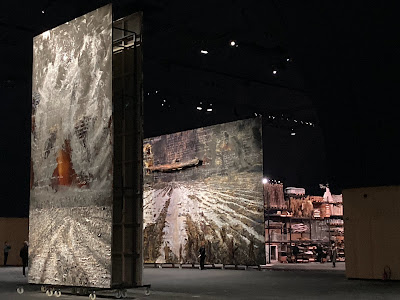
Installation view of Anselm Kiefer pour Paul Celan
Grand Palais

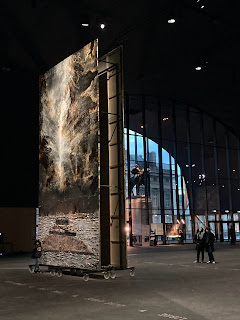
It's difficult to know how to put Anselm Kiefer's installation at the Grand Palais' ephemeral space  into words.  Pour Paul Celan might be inspired by the poetry of the German language writer, but there's something about these works that allows them to exist in a realm above and beyond the mere human world of expression and emotion. Kiefer is attracted to Celan for his creation of a language in the silence and blind spots of language. If Celan speaks what cannot be spoken, writes what cannot be written, in this series of massive works, Kiefer paints something that cannot really be painted. The works are material objects that don't so much represent as give visual and textual articulation in a space where the ability to find form through materials no longer exists. These works are unlike anything that we know art to do.

Anselm Kiefer, Denk dir - die Moorsoldaten, 2019-2020

On entering the hangar-like space, visitors step into a dark world, filled with enormous, monumental canvases sitting on moveable bases. I was fascinated by the contradictions immediately thrown up by enormous canvases on wheels—all of the intransigence of the past layered onto their surfaces is undone by the suggested transience of their place in an ephemeral space. This undercutting of the monumentality of his works is, of course, typical of Kiefer's tendency to undo his most definitive claims. Indeed, we find it repeated at every level of every work in the exhibition.

Anselm Kiefer, A la pointe acérée, 2020-21

Looking across the floor of the space to works such as A la pointe acérée, the gold shines out from the centre of composition, like a successful alchemical experiment looking over a field of snow and dirt and ash. Words fall down the side of the huge canvas, where words, landscape and a mythical promise merge into one. This is Kiefer's characteristic bringing together of elements that cannot coexist anywhere but on his canvases.


In typical Kiefer style, it's difficult to call these works "paintings" because they are not exactly paint on canvas in the way that we think of it. Rather, Kiefer adheres any number of ephemera to the canvases, ranging from dirt to clothes, shoes, gold leaf, glass, straw, axes falling out of the sky, rocks and lead books. In one of the first pieces we come across, a shopping trolley full of burnt coal or rocks sits at the centre of a cyclone of celestial ash above a field of fallen soldiers' gold-dipped clothes. Through the attachment of these conceptually and materially loaded objects, the work tells a deep, complex history. As Celan writes, death is the moment of reawakening, creation is forever connected to destruction. Further, beyond the story of Celan's poems, beyond the narrative representation of his poetry, the world's of Kiefer's canvases go deeper, have multiple layers and levels of meaning, metaphor, and references to myth and history. 


Even on a single canvas, when Kiefer paints, what would seem to be the most transparent of mediums, he cakes it on and forms it like clay to tell a story about what happened that is anything but straightforward or linear. Stories are told about the violence of history, about soldiers traipsing through mud, losing their shoes and their limbs. There are stories about forgetting, about being buried, being saved, being protected and being buried. The works in the exhibition are intended to be a bringing together of German and French history, but at the end of the day, this exhibition is about so much more. It asks how do we remember our past, how do we bring our knowledge, even as it has disintegrated, into the present, to redeem our future? Do we remember in the interests of creating a different future?

Anselm Kiefer, Monh und Gedächtnis/Poppy and Memory, 2020-21

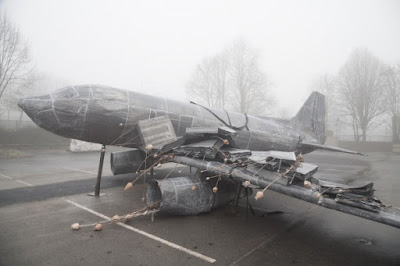
In a signature Kiefer installation, a lead plane, still standing, but without windows has become a bed for dead poppies and a shelf for lead books. The significance and symbolism of the work is infinite: a lead plane without windows that might never have flown, covered in books, objects that remind us of a country that burnt its books and its Jewish people. Without books, planes, people, what's left to us is a blindness and an ignorance. We have let go of knowledge that we should never have forgotten. The plane may not be going anywhere, but its presence reminds us of a past that is still with us, recalling all who died on and beyond the battlefields. Remembrance, death, and the promise that it never happen again is everywhere alive in the graveyard that is this exhibition. 

Anselm Kiefer, Arsenal, 2021

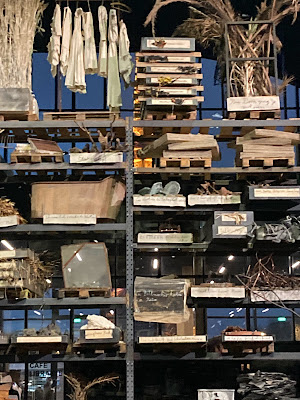
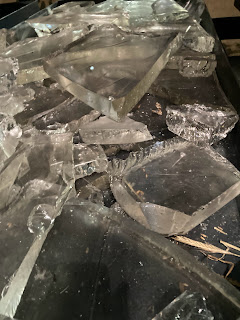
In one of the most intriguing installations, shelves of matter and material are displayed as the "arsenal" of the artist. At face value, I assume we are meant to understand the shelves to be filled with Kiefer's ammunition, but the objects are so much more. The structure both reveals Kiefer's tool box and takes the form of an archive of a past that reaches well beyond his own. It is a display and a documentation of the (left over) materials of his artistic practice, comprising many battered objects and desecrated materials that we have seen in earlier sculptures. The objects collected, organized, archived, and sometimes put in drawers range from garden chairs, through the model of a wedding dress, a box of bicycles, shards of glass, ash, dirt, lead sheets, and a wealth of other dusty, dirty ephemera. But the installation is also a materialization of memory, of a past that we have already forgotten, a past that stretches into the depths of the twentieth century. It is a past that belongs to all of us, a past that we have nevertheless deemed no longer useful. On the one hand, we no longer have enough space in our world for the rubble of our material past, for glass shards and dead flowers. On the other hand, for Kiefer, this past is the very substance of who we are.  

Anselm Kiefer, Arsenal, 2021
Detail
Anselm Kiefer, Arsenal, 2021
Detail

In a world in which the past is so quickly erased by the swipe of a finger, or the closure of a window on a screen, Kiefer's practice is about stuff, about material, about the weight of a past that will not go away. These shelves hold the substance of memory in all its multiple and metaphorical meanings. As my friend Loren said as we stood, looking up at the shelves of broken treasures with the Eiffel Tower twinkling in the background, it is as though Kiefer carted the weight of history from his studio to the Grand Palais. As Loren observed, these monumental installations are so far and above the significance of one person's memory, even of Germany or France. It is as though Kiefer has collected the detritus and reignited the history of human kind. We see the remnants of a world left to decay and disintegrate through the passing of time. In this sense, the installations are of an unimaginable magnitude.


Understandably, the first response on entering the space is the overwhelm of the size of these works. It is difficult to deny that we are seeing the work of a towering artist's ego, someone whose work dwarfs that in other exhibitions around town. Kiefer certainly makes art that takes over enormous spaces. But in this gesture towards the life of the universe, it's as though his work becomes the greek myth itself, like something religious whose plots and themes are speaking the truth of our existence form ancient to classical and into the twentieth century. Of course, the Holocaust has ruptured any hope of continuity. Thus, it is as though the work is happening outside of any concern for Kiefer as an individual artist. While the Nazi Holocaust was at the centre of every painting in Kiefer's earliest days, today, the bigger the artwork, the more ethereal and mythically relevant the "paintings" have become. In the same way that the concern for violence and destruction spreads further and wider than any one genocide, so the works are about something more than him as an individual artist. Nevertheless, it's difficult not to think of Anselm Kiefer labouring in his studio over the months of Coronavirus lockdowns and restrictions, the artist constructing an understanding of history, culture and being in our time. 

Monday, December 27, 2021

Georgia O'Keefe @ Centre Pompidou

Georgia O'Keefe, Grey Blue and Black Pink Circle, 1929

It was a great pleasure to visit the Georgia O'Keefe exhibition at the Centre Pompidou. Particularly because a number of people had said that the exhibition wasn't very interesting. Sometimes low expectations can lead to the most enjoyable exhibitions! 

Georgia O'Keefe, Series 1 - no. 4, and Series 1 -  no. 3, 1918

For me, the most surprising discovery at the Pompidou exhibition was that O'Keefe was an abstract painter. In my—and no doubt many others'—minds, O'Keefe was a painter of flowers bursting into bloom in the shape and form of vaginas and other female body parts. But really, O'Keefe was an explorer of colour and light, shape and definition of form through colour from the earliest works on. We see an ongoing interrogation of colour as light to create dimensionality, often in forms that become abstract thanks to their push at and beyond the picture frame. It is true that O'Keefe's paintings recall the female form, but they are also about much more: O'Keefe brings a connection between abstraction, the woman's body and nature to the development of modern art. On the one hand, as we know, the paintings represent a mass of skin and blossoming flesh, ripe for the picking. In this, the connection to surrealism is also very apparent. Like the surrealists, however, this obsession with the woman's body also connects to a dreamlike tendency. This can be seen especially in surrealist works painted in the 1920s and 1930s by artists such as Ithell Colquhoun. Thus, on the other hand, we are under no illusion of the reality of O'Keefe's sensuous forms. 

Georgia O'Keefe, Jimson Weed/White Flower No. 1, 1932


Beyond O'Keefe's skilful use of colour, the exhibition shows her deep understanding of colour. I was in awe at her sophisticated grasp of the relations between colour, how different colours interact on the canvas, how the introduction of white or black changed the mood and tone of the representation, how shape informs the perception of colour. This is not surprising given that she was actively painting over decades when these questions were being asked by painters in her midst. However, what is surprising is how the exploration of colour comes together with a very precise and careful use of her medium of paint. She is also interested in transparency and opacity, shapes to look at and look into, as well as the more abstract and pure philosophies of colour and paint. Thus, O'Keefe is, in many ways, doing much more than her contemporaries.

Georgia O'Keefe, White and Blue Flower Shapes, 1919 

I was also delighted to see the connections between O'Keefe's paintings and explorations in lens-based media that began to flourish in her lifetime. Her focus on the shape and contours of the natural world, the turning of leaves into abstract patterns in light and shade (and for O'Keefe, colour) are consistent with what photographers around her were doing. The flowers becoming abstract may be recognized as Mapplethorpe before his time, but they also resemble some of the images that were being produced in abstract photography. From Man Ray's surrealist photography to postwar German realism by artists such as Karl Blossfeldt, O'Keefe's painting is absolutely of its time. In addition, O'Keefe's painting is incredibly cinematic. I kept finding myself thinking about the images of 1920s and 1930s avant-garde filmmakers: in closeup, exploring the object in detail as it burst out of the frame. This idea of motion inside and outwards from the four sides of a frame, the explosion, the moment of waking up in the process of coming to life was of course the concern of the filmmakers in her midst. I couldn't help using the language of cinema when I was thinking about how to describe her work. The soft petals, skin of the woman's body, in "close up," represented the very desire of the film theorists for more than the human eye could see. The same can be said of the undulating landscapes that double as naked women. In particular, their capture of the sensuousness of the body was considered to be the raison d'être of the cinematic camera.

Georgia O'Keefe, Sky Above Clouds/ Yellow Horizon and Clouds, 1976-77

In addition to the photography and cinema connections, O'Keefe's concerns were familiar from what Mondrian was doing. Even though her work is not about line and breaking the boundaries of geometrical form, it's about flatness. In this, particularly in the later landscapes, O'Keefe's work is about perspective and seeing the world anew. And when the flowers and other natural forms burst out of their frames, they challenge the threshold in a different, but related way to Mondrian. The abstractions of landscape that the exhibition called the Cosmos were all about interrogating perspective through a fascination for areas of colour.

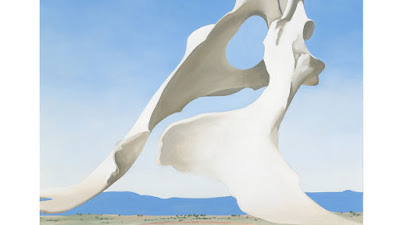
Georgia O'Keefe, Pelvis with the Distance, 1943

Ultimately, with all of these references, it's difficult not to see O'Keefe's art as steeped in European traditions of painting. Which, in turn, make this retrospective at the Centre Pompidou a well overdue event. It's a great shame to think that without her famous photographer husband bringing her work to the public eye, these great paintings may have gone unnoticed altogether.