Sunday, July 17, 2016

Jannis Kounellis @ Karsten Greve & Centre Pompidou, Paris

See original image
Jannis Kounellis, Untitled,1981

Having loved the Jannis Kounellis work on exhibition at Galerie Karsten Greve and the Centre Pompidou as a part of its Arte Povera exhibition, I am so disappointed not to have seen the Kounellis installation at the Musée de la Monnaie in March. Kounellis’ work is powerful and memorable, and appears to have a renewed relevance given current trends in migration and immigration.

Kounellis’ own story forms the motivation of works that speak loudly, but not overtly, about the challenges of migration, the alienating experience of arrival, the ongoing struggle of immigration, and the ultimate necessity of the journey. Although the works are not displayed at Karsten Greve in the narrative of a journey, I wanted to see an untitled oil on canvas from 1963 as both the dawn and re-imagination of the journey across the sea. The hope and possibility on the horizon of a gentle blue sea, looked over by brilliant, if soft, yellow rays of sunshine, show an optimism that is not everywhere apparent in Kounellis’ sculpture. 
See original image
Jannis Kounellis, Untitled, 1969
The works that appeal to me the most are those for which Kounellis has used steel, the material of apparent stasis, fixity, oppression and exploitation. And what makes these works fascinating is that the material of steel goes through a transformation when he uses it to represent movement, journey, and the theme of the moment: migration. In a more recent work downstairs at Karsten Greve, a military hospital bed is covered by a requisition blanket. Underneath the blanket are steel pylons and at its head, more steel plates. The evocation of warmth and comfort of the bed are mixed with exile, hardship, and narratives of endurance. These all clash with the beauty of the stalwart steel “bedheads.” The work is so confusing because it is at one and the same time filled with pathos, nostalgia and the lyrical tones and rhythms of treated steel. In turn, these rhythms remind us of the gentle waves of the sea in the oil painting.
Jannis Kounellis, Untitled, 2000
In one of my favorite pieces, an image that has haunted me ever since, unevenly plaited hair falls through two holes in a steel plate: the absence of the head to which the hair belongs on the other side of the plate is its power. We imagine the imprisoned, trapped, presumably woman, who is held in bondage. The plaits are both a way of tying the absent body to the steel plate, and reveal a care taken by the person’s captor. In this untitled piece, steel hides life, enables struggle and we assume, eventual freedom. In keeping with Arte Povera’s challenge to the consumer society and the culture industry, I presume both the steel and the hair are found materials, raising further contradictions. Because the hair is so personal, and belongs to an individual, it is put into further struggle with the ideology behind it. Ultimately, I want to say that the intimacy of the hair wins the struggle, but as soon as it triumphs, the smooth, almost sumptuous surface of cold blue steel seduces the viewer away from the cause of the individual. This is complicated work that doesn’t always leave us with a clear conscience.
Jannis Kounellis, Untitled, 2010. Detail.
The sea, human, and steel are fused in these provocative pieces to represent memory in its colorful wanderings. Simultaneously, they speak of entrapment, confinement, and the imperative to keep moving even when it’s not possible. It is these contradictions and impossibilities that make Kounellis’ art so attractive. The exhibition of Arte Povera at the Pompidou Centre confirms that so much of this appeal comes from the materials used by the Italian mid-20th century movement. The natural fabrics and materials are, in and of themselves, gorgeous, sensuous. And yet, the artists never let their materials rest in a comfortable place. They are always pushed into political and ideological discomfort.

Tuesday, June 21, 2016

Paul Klee, L'Ironie à L'oeuvre @ Centre Pompidou

Paul Klee, Mai Bild, 1925
This  huge exhibition of Paul Klee, L’Ironie à L’oeuvre is the most calming exhibition I have been to in a long time. If you are in need of an end of the week de-stress, this is the top floor of the Pompidou Centre is the place to go. Rarely is modern art with its fragmentations and abstractions so quiet and gentle as it is on Paul Klee’s canvases.

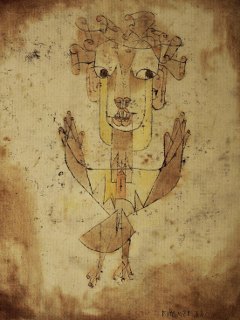
What I loved most was the fact that the paintings and drawings were often incredibly angry and ascerbic, and while filled with fragmentation and division, they are also yet executed with lightness and joy.  In form, the work is very delicate: each stroke and line is made of water colour, and they are painted often on cardboard or paper pasted onto cardboard to accentuate ephemerality. In these materials, there is a sense of transience to the works and, at times, it feels as though they are going to disintegrate soon, as though they will crumble in the hand if touched. Indeed, the Angelus Novus (1920) a work barely known in its time, but that was made so famous by Walter Benjamin's discussion of it as the Angel of History in his Theses on the Philosophy of history, is so fragile that it is put in a darkened room and will be returned to the lending gallery before the exhibition is over.    
 
Paul Klee, Comedian's Handbill, 1938
Every work and every series of works is filled with contradictions: the shapes and patterns are always geometrical, but not mathematical or precisely drawn. In other contradictions, the sense of the childlike - but not childish - that is everywhere in the air at the time Klee is painting, becomes merged with the mechanical, with the machines that are also beginning to appear everywhere in his historical moment. And Klee is also able to bring the lightness, joy and play together with the critique of war spawned by modernity in his midst. Indeed, there are many ironies here. 
 
Paul Klee, Highways and Byways, 1928
What’s also striking is the singularity of Klee’s work. Klee does something quite different from other painters of his time, though there are many references and resonances. It’s possible to identify his contemporaries in the geometricality, for example, the use of line in its contrast with shape and colour. There are also obvious references to work of Alexander Calder in the magic and game-like nature of what Klee depicts and the way his mind works. But then the colours used by Klee are always different from everyone else’s. And the aggression, or what I would call the male-ness of the images that is so prominent in his contemporaries, is absent from Klee’s painting. His images are small, delicate, and I want to say, they are feminine in their tenderness.
Angelus Novus Paul Klee
Paul Klee, Angelus Novus, 1920 

And yet, that said, the most compelling of Klee’s works are those produced side by side with cubism and constructivism. Though the latter can be seen in the works produced when he was in Egypt, a time that he was more interested in exploring the colours and textures of the desert. That is, it’s is of course ironic that the influences of the most contrived artistic forms appear in Klee’s paintings when he was closest to nature. I also wondered whether the paintings’ continual verging towards two-dimensionality in Klee’s later years a push to abstraction that mirrors the artistic response to outbreak of World War II, or is it his own individual search? Because of these apparently irreconcileable contradictions, while the exhibition is very calming and peaceful, we come away with a lot of questions and I, for one, was unsettled as well as restored.

Tuesday, June 14, 2016

Hubert Robert, Les Décourvreurs d’antiques, 1765
It’s been months since I went to the Louvre on a Friday night. I went in last night and fell in love all over again. The exhibition, Hubert Robert (1733-1808) A Visionary Painter comes at a strange time for the museum as it changes exhibition policies, expands its reach into Metz, Lens and Abu Dhabi, and renovates the entrance under the pyramid. For all these reasons, this wonderful exhibition of one of France’s most exciting eighteenth century painters comes as a treat.

This huge exhibition is glorious from beginning to end. The architecture sketches that open it are fascinating because even in these first works we see the concerns that will preoccupy Robert for a lifetime beginning to emerge. Buildings that are not realistically proportioned, seen from impossible perspectives in the interests of highlighting movement through space, as well as the display of features—in the case the statue of Marcus Aurelius on the Piazza del Campidoglio. And from the very beginning we see Robert’s fascination with light, with space, and the built environment, his meticulous foregrounding of space as the primary subject of painting. And from the earliest rooms, we see the people as sketches, going about their daily life on the steps, in the foreground, in the squares, figures that will become the raison d’être of his work.
GYuBER ROBERT view of the Capitol Square in Rime. About 1770
Hubert Robert, View of the Capitol Square in Rome, 1770
These images are about light, framing, perspective and the merging of imagination and reality. Robert left for Rome aged 22 and stayed for eleven years. What he sees and learns in Rome will stay with his painting for the rest of his life. Yes, the paintings get bigger—to the point of the monumental—but their basic concerns remain consistent until his death aged 75 years in Paris.

I was amazed by the use of light in Robert’s paintings. Even more than the luminosity of the German romantics, Robert saw in painting the qualities of the cinema: light creating shadows and making the spaces of the built environment. There are images such as the Vomitorium du Colisée avec une femme et un enfant, 1764 that effectively do what Daguerre’s architectural studies were doing, only seventy years before Daguerre. In this image we foresee what might be a cinematic image at the stop of the stairs. The woman and the boy down below are not watching the so-called screen, but it is, nevertheless, an image about watching and performance, another motif that recurs again and again throughout Robert’s career.
Hubert Robert, Personnages dans une baie à Sainte Pierre de Rome, 1763
I was also fascinated by Robert’s creation of space through paint and light; again, we will find this in Daguerre as the apparent father of French photography in the next century. There is always another frame within the frame – look at Personnages dans une baie à Sainte Pierre de Rome, 1763. Here we see another trope: the painter in the corner, painting the scene that then, of course, cannot be the scene that we see. Robert the painter, looks on and sees a painter painting. The layer upon layer of distance and depth are the precedent—or at least the visualization through a similar language—of distance and depth. There is always a foreground, middleground and background, as well as this an extension into the verticality of space.
See original image
Hubert Robert, The Burning of Rome, 1771. 
I have barely begun to discuss the vast exhibition. The fascination Robert had with tourism, with antiquity, with the coming together of the past and the present, with the Enlightenment inspired by Antiquity, all of these disparate concerns are brought together on a single canvas. Look at Les Décourvreurs d’antiques, 1765 and its appearance as a cinematic image, bringing together the most ancient and modern of representations. In the image, we see the visualization of the watching, performance, ruins as objects to be ogled at, statues brought to life, always animated by light, by tourism. 

See original image
Hubert Robert, Corridor de la Prison de Saint-Lazare (1794)
The fact that there is so much to say in response to Hubert's work is also an indication of the size of this exhibition, a vastness that can only do justice to the reach of Robert's painting. Even though all the works embrace life and brilliance they are also imbued with the strand of Romanticism that is melancholic, that is overcome with a nostalgia for a past that has gone forever. And yet, at the same time, he brings the past into the present, surrounding antique statues with people who use them to fasten clothes lines. In addition, the paintings may be filled with monuments as ruins, but the ruins are made breathtaking by the sun and water and light around them. Unlike his German counterparts, Robert doesn’t capture a certain moment of crepuscule, the moment that signifies loss. Often he paints in full sunlight to capture the drama of nature as it impacts the built environment. To me it is also filled with the surreal. Even when the revolution comes to influence his work, in for example Corridor de la Prison de Saint-Lazare (1794) is more like Goya than it is Friedrich or Turner with its concern for real life. Unlike the Romantics in Germany or England, Robert’s sublime moment is always framed, given context within man made structures that are perfectly recognizeable.