Saturday, July 2, 2022

Tatiana Trouvé, Le grand atlas de la désorientation @ Centre Pompidou

Tatiana Trouvé, The Guardian, 2022

I am such a fan of Tatiana Trouvé's The Guardian sculptures that I would travel around the world to see one of these quietly, contemplative chairs resting in a corner of an exhibition. The handful included in the current Pompidou exhibition are gorgeous. It is all I can do to stop myself sitting down, sinking into a wicker seat to rest my weary legs. As I stand there, I want to rifle through the open bag on the chair, throw the cardigan around my shoulders and read the interesting books. That is, having cleaned away the cigarette box used as an ashtray to make way for myself on the seat. 

Tatiana Trouvé, The Guardian, 2022

In the Pompidou exhibition, as always, The Guardian examples sit quietly, unassumingly, at the edges of the room, to the side of the other works. I waited and watched other visitors, only to see them ignore the seats filled with someone's belongings. They chairs are so understated and discrete, to the point where they don't ask to be looked at like art works. And yet, they are art works. They are intricately crafted from bronze, marble, onyx, brass and sodalite. The sculptures are fascinating and inviting when we recognize the work that has gone into making hard, inflexible materials into lusciously soft fabrics and objects. 

Tatiana Trouvé, The Guardian, 2022

The sculptures are also compelling because they are simultaneously life like and not. Their placement against the wall, aside from the other works makes them appear to me as if they belong to the attendant who has just slipped out for a moment. There is always a book, a bag, a personal item, usually cast in sensuous marble, sitting on the seat. They show more than the traces of human presence, tell of beings more real than ghosts of the past. These are the chairs of people who have just popped out, with all the signs of "I'll be back" left on the seat. They speak of an immanent presence. They are also about the people and things that are invisible: the sculptures themselves are invisible to some visitors, as if they are or were occupied by an invisible guard, those tireless museum workers whose presence allows us to be in the company of fragile art works.

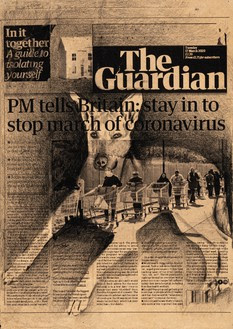
This exhibition also includes a wall of Trouvé's lockdown drawings that she made on the covers of the world's leading newspapers. Trouvé draws her bed, her dog, her wardrobe, her everyday life in her studio over the top of the dramatic headlines that accompanied us through the months from March to May (2020). The superimposition of the everyday over the devastating news of death and disease, the recounting of numbers and alarming headlines often acting as warnings, makes obvious sense. This is how we all lived in lockdown; our ordinary lives and a world in crisis outside our doors overlaid each other for months on end. As I browsed the warnings of war, death knells and governments on their knees, I was astounded at how far away it all seemed. When I think about how consumed we all were by statistics, masks, government restrictions, and vaccines, and yet, today, most days, it doesn't even cross my mind that we are not even one year out of a global pandemic. 

Saturday, April 30, 2022

The Delight of Contemporary Art @ Pinault Collection, Bourse de Commerce

Maurizio Cattelan, Others, 2011

I took my friend Harriet to see the new exhibitions at the Bourse de Commerce last night. As we walked along the outside of Tadao Ando's concrete cylinder, laughing at some of Bertrand Lavier's objects in the display cases that have been there since the building's days as the Bourse, marvelled at the fresco depicting trade in the colonies, and the magnificent reflections of the early evening sun shining through the latticed roof of the dome, I thought that this magnificent building should be the mandatory first stop on every tourist visit of Paris. Visiting the Pinault collection is pure pleasure. It is, perhaps, the most comfortable and welcoming modern art museum in a major city. It's difficult to describe how delightful it is to wander the exhibitions and the building itself.

Charles Ray, Boy With Frog, 2009

We stopped in front of a Lavier piece of two crystal vases accompanied by the text "only one of these vases is real" to have a long discussion with two other visitors about which they thought was real. Being the know all, I was convinced as soon as I saw the display that the two vases were identical, and Lavier had simply included the text to keep us guessing. As Harriet pointed out, if only one was real, what kind of real would that be? In fact, whether or not the vases were real or fake was not the attraction of the display, but rather, the point of the piece was its play with our heads and temptation into animated conversation with strangers. This level of visitor engagement is maintained throughout the exhibitions on the first and second floors. 


Ryan Gander, With /.../.../..., 2019

I remember a friend bemoaning that she didn't really understand the Urs Fischer statue in the collection's opening exhibition. However, I am pretty sure that a lot of the art on display at the Pinault is not that difficult to "get".  Ryan Gander's stuttering Animatronic Mouse who has gnawed its way through the gift shop wall, or Marizio Cattelan's pigeons looking down from the third floor railing are exactly what they appear to be. The mouse and the pigeons are intruders into the precious world of art, making fun of its seriousness, showing us all that laughter and wonder are valid responses to art. 

Roni Horn, Dead Owl, 1997

The two temporary exhibitions also encouraged a frolick with art, eliciting physical and emotional responses. Roni Horn and Felix Gonzalez-Torres' exhibition on the ground floor created a lovely dialogue between the two artists. My absolute favorite piece was Horn's Dead Owl, 1997. The two fluffy white owls are both adorable and creepy. Their soft silken feathers make them like dolls sitting on their perches. But the title reminds us, they are dead, stuffed animals. The owl was photographed in Iceland, a country for which Horn has an ongoing fascination. But as an American, I am sure, Horn is aware of their symbolism within Native American culture as harbingers of death. Making the owls even more cuddly and curious, but simultaneously, unnerving is the fact that when standing in front of them, our eyes never rest. We constantly flit between one photograph and the other, comparing them, looking for differences, as if expecting them to reveal the answer to a puzzle. Of course, walking from side to side, the eyes of both owls never leave us, following our every move. Being watched by art works is always the most unsettling experience in a museum.

Charles Ray, Oh! Charley, Charley, Charley, 1992

There is a large Charles Ray exhibition in the level two galleries, complementing the Centre Pompidou's spring exhibition. Ray also has three pieces under the dome in the main circular gallery: a child, himself and an old, reconstructed truck. Ray's works are also unnerving, but unlike my experience of the Pompidou exhibition, my resounding response to the pieces on display at the Pinault was his obsession with naked male bodies, especially his own and those of young boys. It's true that a lot of his works re-conceive religious and classical sculpture, they also play with the traditional display of sculpture. In addition, Ray manipulates spaces and size and makes our movement through the gallery visible through the changing size of the sculpted figures when seen from different perspectives. But these works are not only working on an intellectual level. Ray has an obsession with pubescent male bodies and sexual fantasies, and you don't need an art history degree to get that!

Friday, April 29, 2022

Richard Serra, Transmitter @ Gagosian Le Bourget

Richard Serra, Transmitter, 2020

Last weekend, I ventured out to Le Bourget with my friend Sylvie for an initiation into Gagosian's space in a former airplane hangar. It's quite a trip out to the northern suburbs of Paris by train, and then bike for a few kilometres to the small airport. On arrival, it was a different world, until of course, we stepped inside Gagosian's space. It was like being back in the centre of Paris, surrounded by familiar white walls, skylit space and hip, surly gallery staff. I had anticipated a much bigger space, and surprised to see that the gallery was not so much bigger than Gagosian's London galleries.

Gagosian @ Le Bourget
Serra's sculpture itself was magnificent, of course. The dizzying, nausea-inducing lean of the Corten steel was intense, and the journey of discovery through corridors, opening out onto two circular enclaves where the visitor was invited to rest and relax, only to be pushed out through the sense of instability was unsettling. We wanted to stay, but on discovery that there was nowhere to sit because of the awkward lean of the steel, we were left with no choice but to keep moving. The narrower the corridor, the faster we moved.


As the only visitors to the gallery, Sylvie and I had fun with the echoes and reverberations of sound that must have been Serra's intention, though it's difficult to know if he sculpted the steel knowing the visitor would create echoes and voice modulations. But surely, a work titled Transmitter is designed to create a sound scape? The sonic element made the piece a departure from other Serra sculptures I have experienced: the steel curves, ribbons, caves and canyons becoming a device for transmitting data through sound waves lift sculpture to a whole new level. I could almost feel the sensations of being in a chasm, then a gorge, then in a clearing in the wild, alone, isolated within the space. 


The echos were long and resonant, changing tone, volume, and density as we moved through different spaces, again, dependent on the curve of the steel, the width of the corridor, the lean of the steel opposite where we were standing. As is always the case inside Serra's sculptures, I felt my body transformed, my senses brought alive. It was an incredible experience. Sadly, the wonder of discovery mixed with the disorientation that comes with physical movement in a Serra sculpture was cut short. As we were having fun with our voices, feeling the reverberations as though we were lost in the outback, the young man from the gallery's front desk came running to find us. Apparently, it wasn't permitted to make such noises in the gallery. The irony was not lost on us: as we were engaging with a work titled Transmitter in an airplane hangar stretching the length of a city block, the only visitors in the gallery, that we were asked to lower our voices. I would have thought that our physical responses to the works was exactly the point of it?

And so, not to be defeated by what seemed like the illogical orders of the gallery, Sylvie and I moved up close to experience the weathered, changing surface with other of or senses.
I ran my fingers across the rough metal until they reached its seams, and when I removed my hands, they were orange. We stood back and watched the light streaming in through the roof as it changed the colour of the sculpture from orange to brown, to tan, to a deep dark black when seen from certain angles. Ultimately, the physical relationship struck up between Serra's sculpture and the visitor is magnetic. When our bodies move around, through, up close and away from Transmitter, our senses are so enlivened that, like filings to a magnet, nothing can break the pull and the revelation of being in its presence.