Showing posts with label Steel. Show all posts

Wednesday, December 28, 2022

Carol Bove, Vase/Face @ David Zwirner

Carol Bove, Vase/Face, 2022

Steel is one of those materials that surrounds us. Yet, despite or perhaps because of its ubiquity, we tend to ignore it. At best, we dismiss it as dull, sterile, uninspiring. Steel is the fabric and function of industrialized life, and therefore, it bears no more thinking about. Once we have seen John Chamberlain's crumpled steel sculptures, and learnt of the expressive possibility of the material, we probably won't look at steel in the same way again. Chamberlain's steel sculptures fly in the face of everything that steel is meant to do. It is meant to be stalwart and unflinching, cold and repellent. And yet, for Chamberlain, steel creates puzzles, it is an enigma, an idea without weight. 

John Chamberlain, Opera Chocolates, 1994


Carol Bove's current exhibition at David Zwirner's Marais gallery does something different again. Something that we would never expect steel to do. Bove makes steel into a warm material, filled with emotion, a sense of play, a material that even has the innate tendency to exude tenderness. In Bove's sculptures, steel is everything it is not meant to be. 

Seeing Carol Bove's new steel sculptures on exhibition around the corner from John Chamberlain's familiar crumpled cars at Karsten Greve makes Bove's work even more peaceful, delicate, and emotionally charged. The cynic might want to say that Bove couldn't possibly do anything new with steel, that Chamberlain took steel to its ultimate beyond. But Bove's work is different, made in a different moment, speaking to a different world. Unlike Chamberlain's, Bove's sculptures are not in conversation with abstract expressionism and the fraught energy of brushstrokes by the likes of De Koonig and Kline. Her curious lengths of manipulated tubular, painted steel might be in conversation with painting. The pink, yellow and orange pieces, bent, turned, folded and scrunched together might be hung on walls, but unlike Chamberlain's, Bove's sculptures do not use the language of painting. Rather, they remind us of animated stick figures and squiggles, always about to jump off the walls and change their shape. If Chamberlain's meticulously worked, spray painted piles of steel make sense in an era when images were influenced by a need to move away from representation, Bove's connect to an era in which images are technologically determined.


Carol Bove, Vase/Face, 2022
David Zwirner

Again in a refusal of the deterministic nature of the image today, Bove makes works that are intensely physical and material. They are strikingly sensuous - not something that can easily be said about steel. The smooth matte paint, evenly applied, bears no trace of gesture or the artist's thoughtful application (unlike the rainbow of colours sprayed and painted over Chamberlain's). But the surface is given the appearance of velvet. It is all we can do to stop ourselves from reaching out to touch them. 
Carol Bove, Vase/Face, 2022
David Zwirner

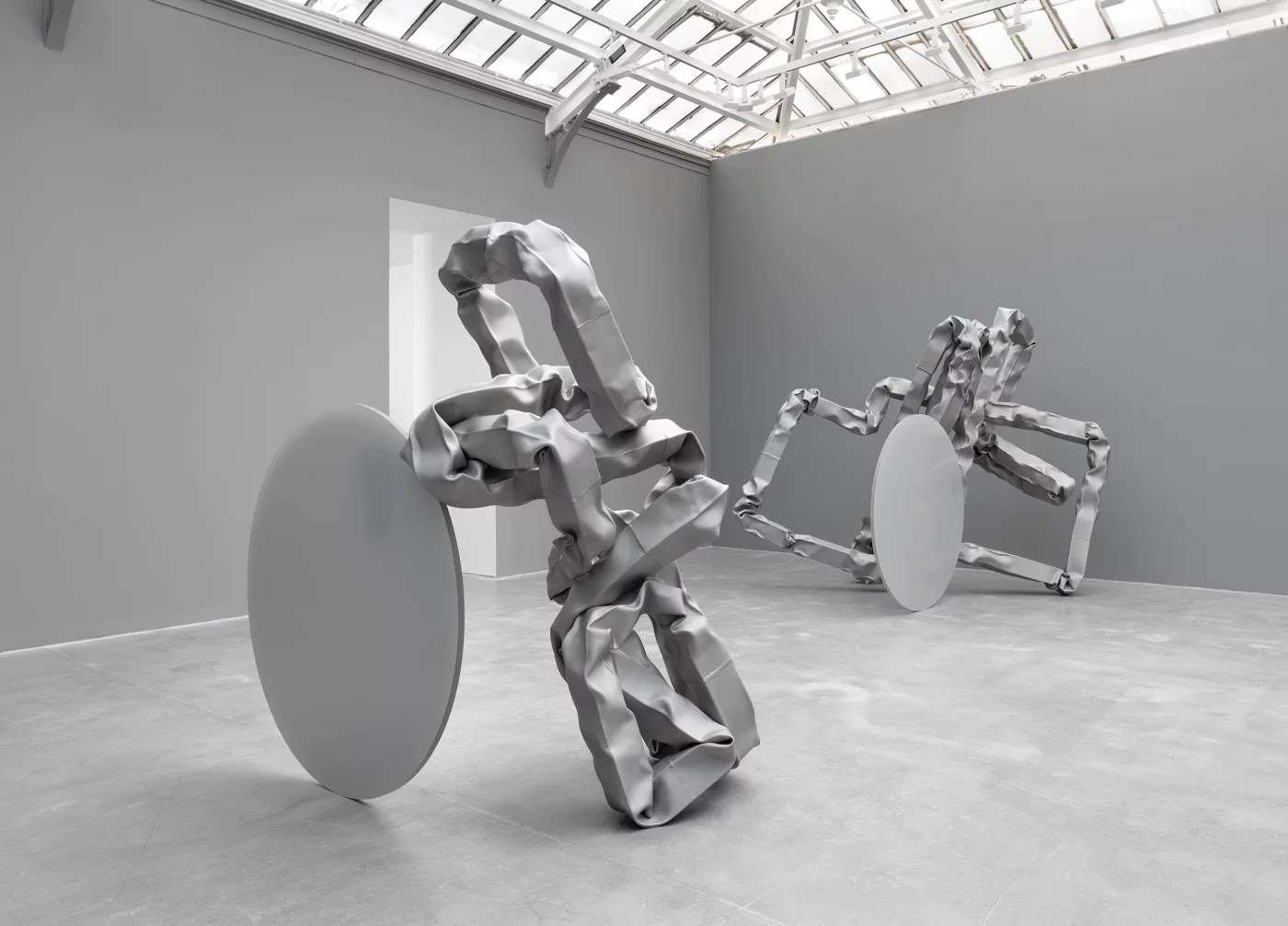
In Zwirner's main gallery, the sandblasted steel tubes are contorted and crumpled, folded over huge glass disks, as though hugging or stroking the human-sized circular shapes. The grey walls, floor and wrought iron glass ceiling create an environment in which everything is possible. The challenge to the materials of both glass and steel through creating relationships between them that are more like friends in a grey space, turn sculptures into living, breathing beings that shift and change as we walk around the gallery space, seeing them from different perspectives. There is no doubt after visiting this exhibition, that neither grey, nor steel, can be said to be the unyielding and uninteresting phenomena that the world claims them to be. 

Carol Bove, Vase/Face, 2022
David Zwirner

If Chamberlain creates a physical experience inviting us to navigate the twists and turns of newly manipulated metal scavanged from scrap heaps and abandoned cars, commenting on capitalism, car culture, the hard edged industrial world that has gone awry, Bove's is a world in which our eyes and our emotions come into conversation. Her works don't so much shape space as Chamberlain's do. But they do push our senses to limits that they have not otherwise been challenged to go. 

Monday, December 14, 2020

Robert Rauschenberg, Nightshades and Phantoms @ Galerie Thaddaeus Ropac

Robert Rauschenberg, Purr (Night Shade), 1991

Robert Rauschenberg did a lot of experimenting with metal the 1990s. The works currently on exhibition at Thaddaeus Ropac, Night Shades and Phantoms, are among the most haunting made in this time, perhaps because of the predominance of black, white and grey. Their bringing together of industrial materials, painting and intellectual issues that preoccupied artists at this time, also make them of their era. That said, there is nothing outdated about Night Shades and Phantoms, and neither are they any less mesmerizing than they were in the 1990s. 

Robert Rauschenberg, Marsh Haven (Phantom), 1991
Robert Rauschenberg, Office Break (Phantom), 1991

In many of the works, Rauschenberg brings together two or three photographs screen printed onto the metal supports, creating surfaces filled with a multiplication of bifurcations and trifurcations. Beyond the surface, there is tension between the metal and the image printed and/or painted on its surface, often of nature or cloth blowing int he wind. The transience of the fabric, animals and plants is always in tension with the apparent industrial intransigence of metal. In the images of the Phantom series, doors and windows, shadows and trees float over the surface of the mirrored aluminium, appearing and disappearing, depending on where we stand. There are also tensions and conflicts between the layers they create, layers of images jostling on and as the surface. Indeed, the works are all about surface. They are about the properties and fabric of aluminium put to an unusual use, as support for images that are filled with walls, windows, curtains, doorways, and signage. 

Robert Rauschenberg, Bounders (Phantom), 1991

Rauschenberg's process creates more conflicts and clashes. Photographs printed or screened onto metal supports produce a merging of multiple mass produced images into a one of a kind. Rauschenberg took the photographs with a Polaroid camera driving across the US, and thus, ended up with single images without negatives taken in places on his trail. Reproduction of any kind was out of the question. The hand made, carefully crafted images often have a stroke of paint on their surface, a brush of tarnish on aluminium, the single artistic gesture to seal their uniqueness. The transience of the process is likewise repeated in the appearance of "phantoms"; the ink can be so faint that the images begin to look like pictures pulled away from the surface, leaving the outline of an object such as a fire hydrant or an animal wandering across an open window.

Robert Rauschenberg, Driveway Detour (Night Shade), 1991

I also kept hearing the images. The sounds of aluminium are always loud, and wandering through the exhibition, the clanking of machines, cranking of mechanisms, the movement of pistons in Nightshades in particular consume the gallery spaces. In this they reminded me of Bruce Baillie's Castro Street. The Phantom images, on the other hand, whisper. 

Robert Rauschenberg, Drums (Night Shade), 1991

Indeed, the multi-sensory evocations of Rasuchenberg's work are what ensure that they are not outdated; the images are so much more than representative of a moment in history when the industrial and the natural did battle over the same environment without consciousness. Rauschenberg's ability to make metal so eloquent and nuanced is another among the many reasons for the works' ongoing potency.


Wednesday, March 25, 2020

Christian Boltanski, Life in the Making @ Pompidou

Faire son temps : Christian Boltanski au Centre Pompidou
Christian Boltanski, Depart,  Life in the Making
There will be no surprises in this exhibition for visitors familiar with Christian Boltanski's work. Boltanski is an artist who has been preoccupied with similar issues for fifty years, and he found a language in which to express those ideas very early in his career. Moreover, since the 1990s, the innovation has not always been in the works themselves, but in the way the installations are exhibited. In fact, the most interesting iterations of his work have often been the unique and interesting spaces of exhibition. 
Christian Boltanski exhibition at Paris Centre Pompidou - Pictures ...
Christian Boltanski, Les Regards, 2011
On entering Life in the Making on the top floor of the Centre Pompidou, I felt as though I was entering a mausoleum. The temporary exhibition walls are painted a dark grey, the lighting of Boltanski's black and white images is minimal, if it exists at all, and the mechanically sounding heart beat - no doubt the artist's own - drums through the entire space. To the point where the presence of the thumping heartbeat becomes subliminal, working on a deeper level of consciousness, underlying every step, and no doubt, leading to headaches for some visitors. As we move through the exhibition spaces, the black and white family photographs lining the walls plunge us into the familiar Boltanski world of memory, pathos and hopelessness. Given the sounds and images, I was puzzled by the exhibition's title, Life in the Making. Because nothing here resembles life in the present, in the making, or the pleasure of simply being alive. Rather, in familiar Boltanski fashion, everything points to death.
Image result for christian boltanski faire son temps
Christian Boltanski, Autel Chases, 1987
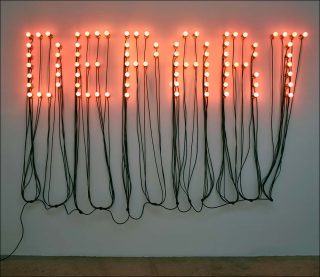
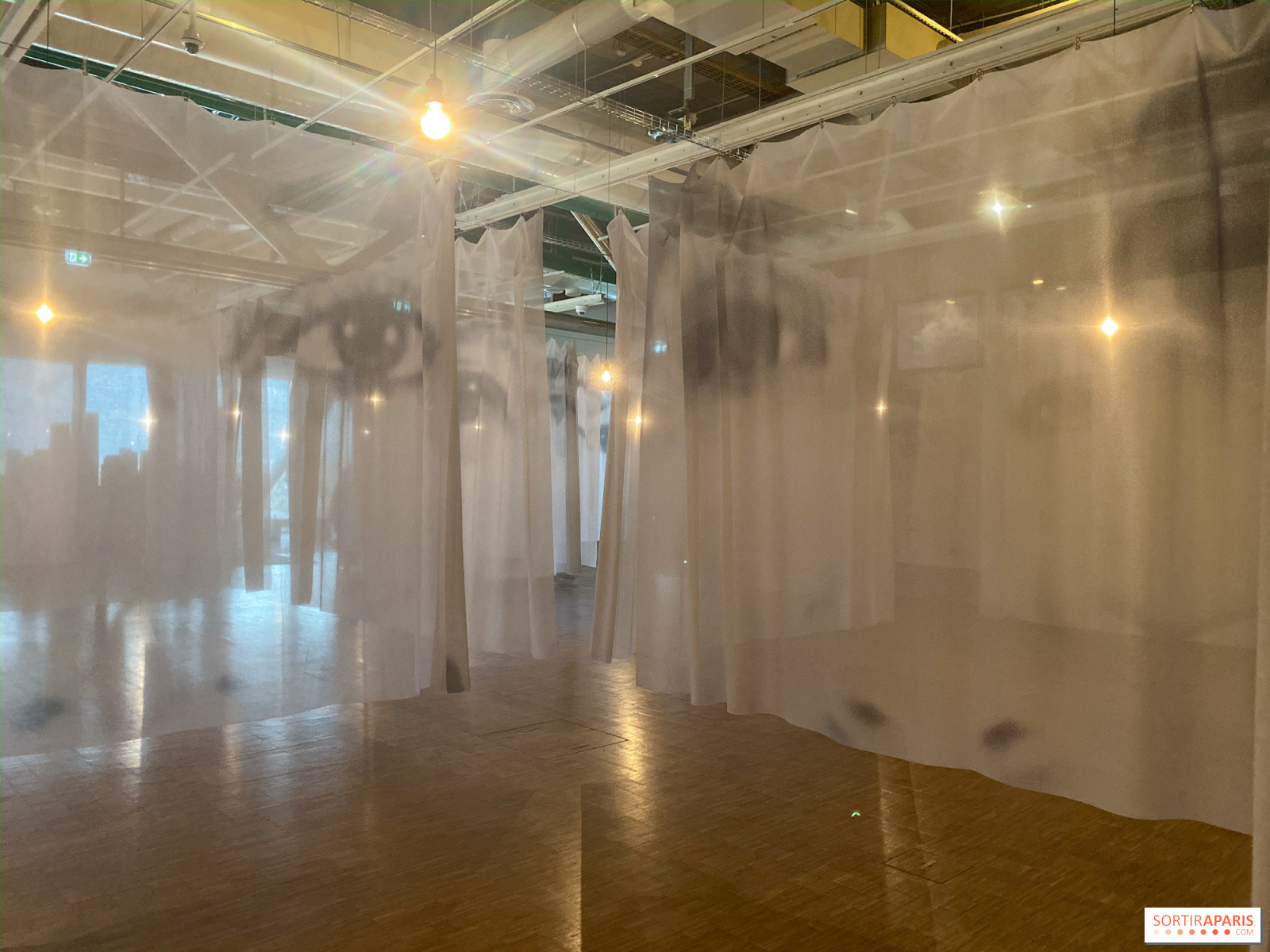
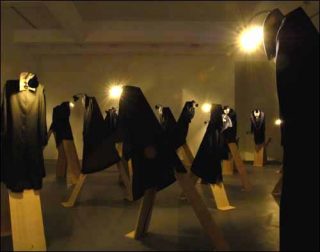
An enormous pile of black clothes, le Terril Grand-Hornu, 2015 resembles the charred remains of the unfortunate people to whom they might once have belonged. A single electrical light bulb hangs above the tip of the pile, barely illuminating the signifiers of death below. It's impossible to see any kind of life after death inside this dark, depressing world. Even when death is far from the work, it's memory haunts our thoughts and imaginations. Thus, for example, in his well known use of images of school children, in a work such as Après in which photographs show anonymous faces of girls smiling as they play in Hamburgerstrasse in Berlin, the blown up, indistinct, anonymous faces printed on very thin, torn veils are haunted by the fact that the girls must be dead. The children may not be  dead, but Boltanski reproduces their portraits in such a way that they remind us of ID photographs of Holocaust victims, or sufferers of other kinds of violence; they are votives encouraging us to mourn.  
Christian Boltanski, Prendre la Parole, 2005

Or in the row upon row of columns made from rusted steel boxes, each with a small photograph on its front, we cannot help but imagine that each box contains the ashes of the person depicted or naming the box. Or perhaps their valuables have been placed in the box, as if in a vault, for safekeeping. Either way, there is no suggestion that anyone is coming back to collect their belongings. 
Christian Boltanski, Les Registres du Grand-Hornu
1997

Boltanski grew up with a father who, as a Russian Jew, had escaped deportation by hiding underneath the floorboards for over a year. The profound effect this had on Boltanski's father is potentially taken up throughout the son's art across decades. The icons and symbols of the death camps are everywhere recognizeable, even if they are not present, in the works: piles of clothes, great numbers of blurred, anonymous faces with blackened-out eyes in photographs printed on flimsy cloths, black mirrors and veils, as well as sound installations that evoke practices of witnessing death and trauma. Of course, the exhibition and the museum are now closed in keeping with the government shutdown. However, should further reiterations of Life in the Making be staged elsewhere, Boltanski's work might just be seen as an omen for the end of the world that appears to be approaching through the silent city streets of our time. 

Saturday, August 31, 2019

Michael Craig-Martin @ Gagosian Britannia Street, London

michael craig martin sculpture gagosian london exhibition sculptures artworks
Michael Craig-Martin
Installation View @ Gagosian Gallery London
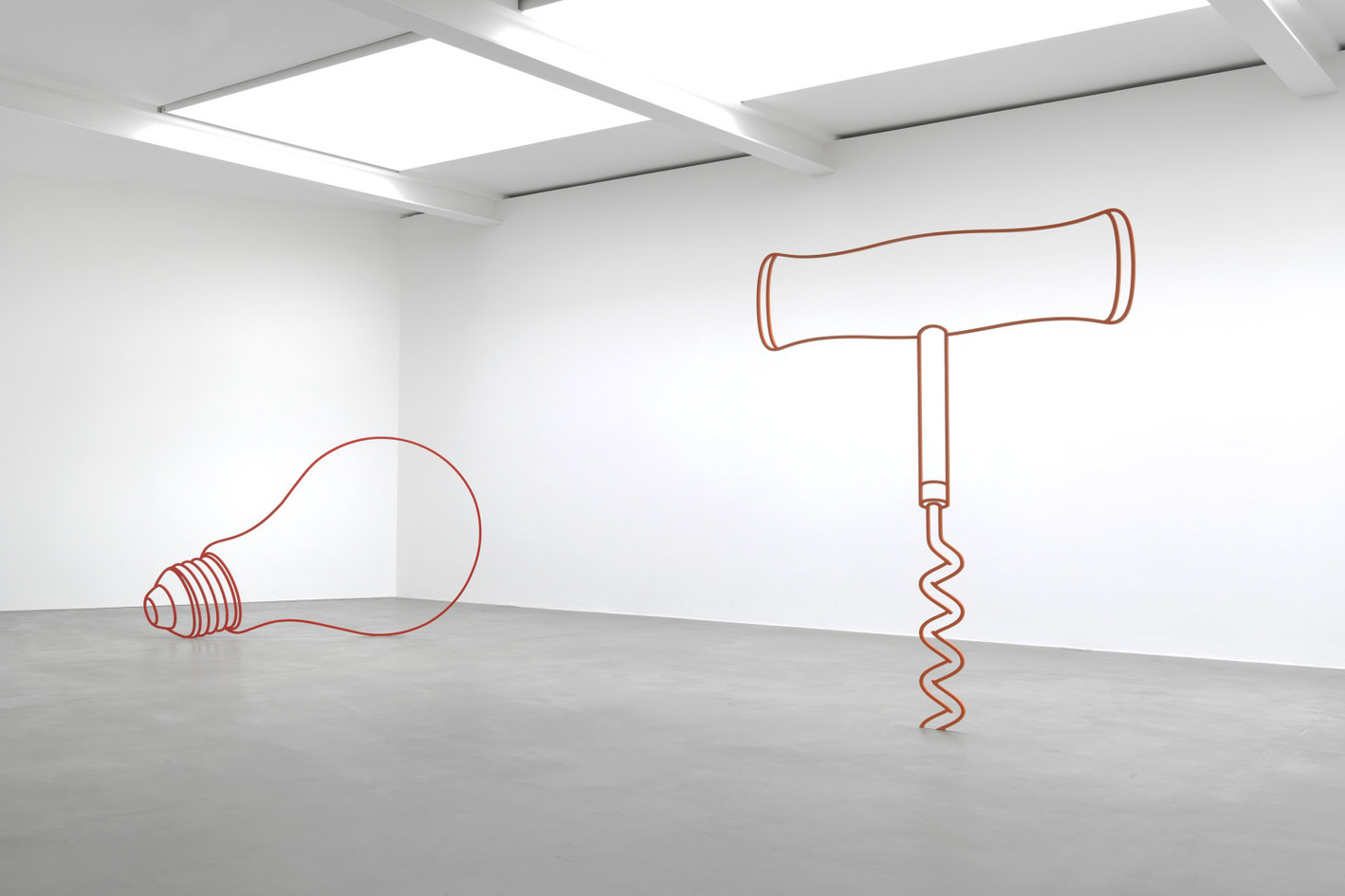
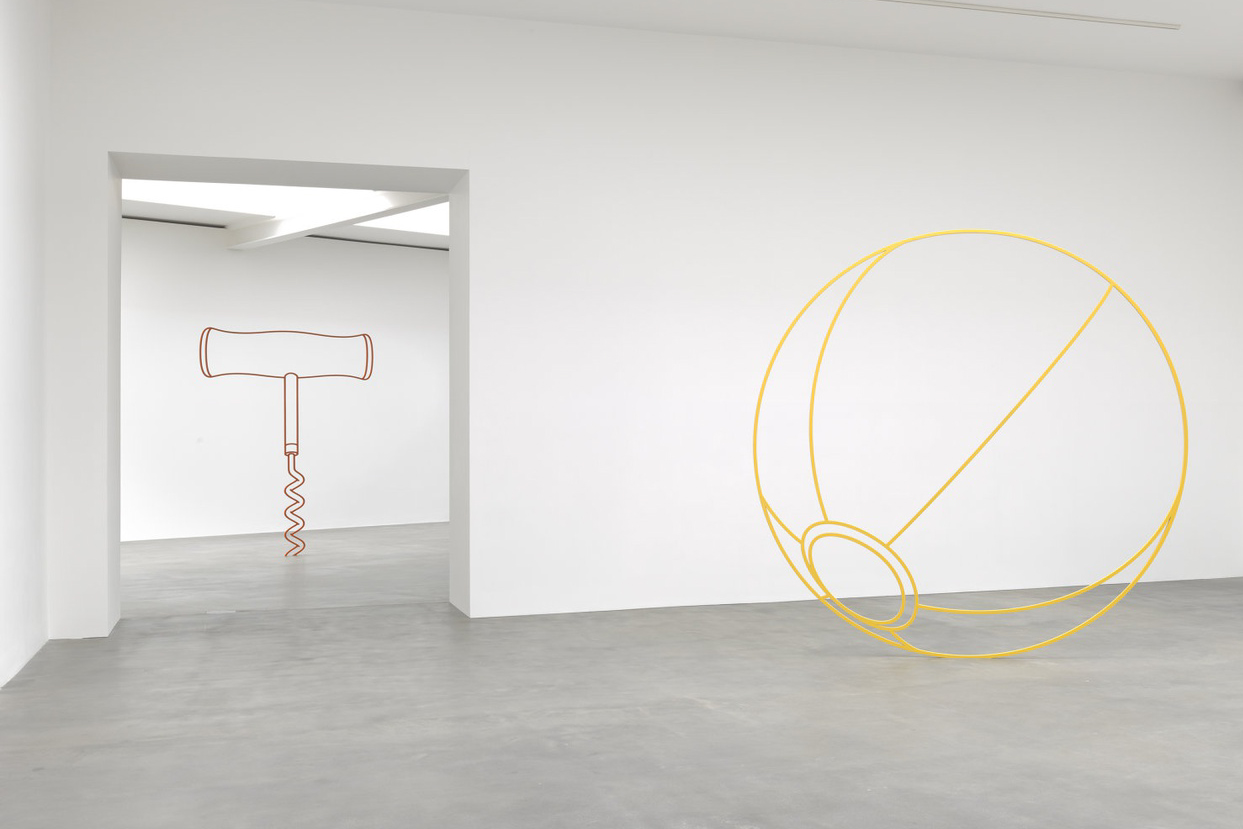
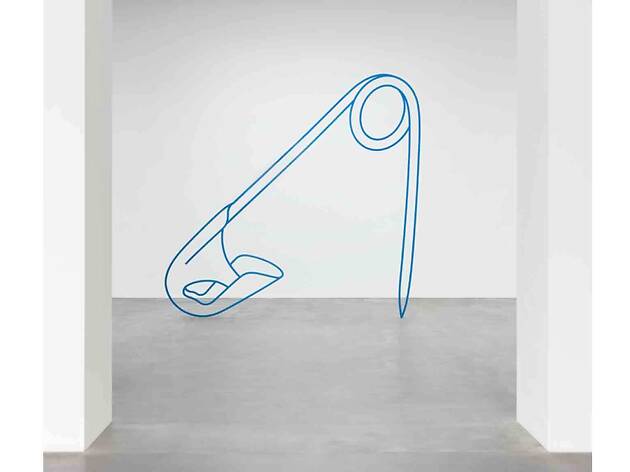
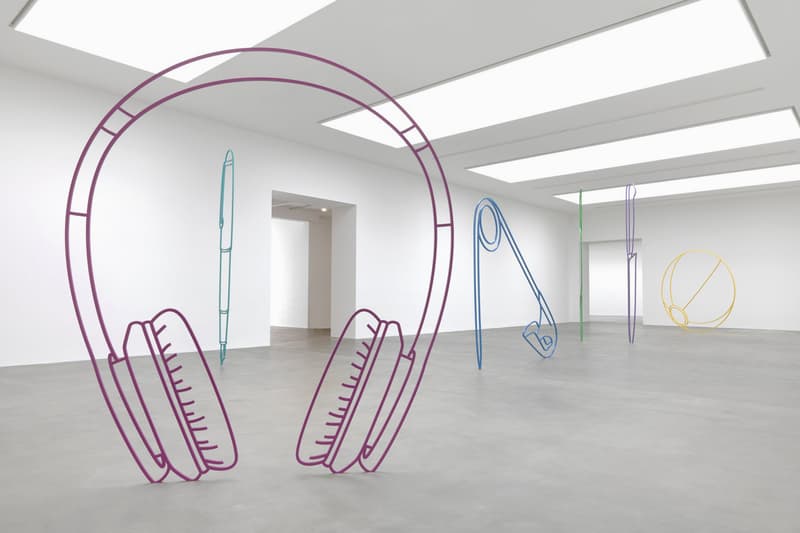
This exhibition sees Michael Craig-Martin's oversized steel object outlines indoors for the first time. The multi-colored works gleam brightly in Gagosian's King's Cross spare white warehouse space. Reviewers of the exhibition were disappointed that Craig-Martin did very little new. However, as I was previously only familiar with his paintings, I found the sculptures intriguing. It's difficult to describe them. The gallery blurb calls them monumental, but that doesn't capture their delicacy and technical precision. I prefer to call them outlines in steel of household objects. They embody none of the complex meanings of monumentality as a term, and indeed, are doing something different from sculpture as we know it in the public realm.

michael craig martin sculpture gagosian london exhibition sculptures artworks
Michael Craig-Martin 
Installation View @ Gagosian Gallery London
I was fascinated by the fact that the objects made of steel stood without other support on their almost razor thin edges. My first thought on entering the space was that the works must be about balance. Then, the fact that they are made of steel, one of the most hardy and stalwart materials of the twentieth century gave them a nice irony. And, my next question was, why did the artist use steel? What does steel enable the objects to do that other materials wouldn't?  These are hard edged, potentially gaudy, not quite replicas of household objects.  When we look at them they are two dimensional, like coloured drawings. Then as we approach, we find we can also walk through them, suggesting that they create multi-dimensional space. They themselves may not have dimensionality, but they are representations of three-dimensional objects that mark out three-dimensional spaces we inhabit. Thus, their illusory quality adds another level of irony. Lastly, and perhaps their most intriguing quality: the works are sculptures as oversized representations of something else (household objects), taking them into discourses of monuments. And yet, they completely undo all references to monumentality thanks to their hollowness and their two-dimensionality. Effecrtively, the works are both representations and not representations.
Michael Craig-Martin: Sculpture review
Michael Craig-Martin, Safety-Pin, 2019
The sculptures speak about the uselessness of art, and though we desire to do something with them - walk through them, look at them and make sense of them, the objects are also useless. They could not be used as a safety-pin, an umbrella, a corkscrew and so on. As works of art, for all these reasons, they are simultaneously sculptural representations and abstract. In addition, the pretty colours make them delicious to look at, creating or perhaps speaking about the desire for the object to be consumed.
michael craig martin sculpture gagosian london exhibition sculptures artworks
Michael Craig-Martin, Installation view @ Gagosian
Apparently, the same kind of works have been installed outdoors on the grounds of gentry estate complexes. They have been placed in the gardens such that they become extremely disruptive because, first, they are oversized and these stately gardens are always made in an era when everything is designed to be the size of the human. And second, Craig-Martin's sculptures are exaggerated contemporary where all the other additions to such gardens are always old and weathered. The colours, the size, the steel material, everything about them is wrong for the environment. By comparison, in the gallery space they don't necessarily dialogue with their environment or each other, but rather, speak more to concepts of sculpture, painting and drawing. 


Friday, June 7, 2019

Thomas Schütte, Three Acts @ Monnaie de Paris

Thomas Schütte, United Enemies, 1993 & 1994

It’s difficult not to overemphasize the political importance of Thomas Schütte’s sculptures. His unrelenting discourse on the machinations, exercise and hypocrisy of power is so vividly brought to life across a body of work which inhabits and then turns the knife on this same discourse. It’s a brilliant and unique oeuvre to which we should all be paying more attention. That said, I was surprised that the current exhibition at the Monnaie de Paris, Trois Actes, didn’t make more of Schütte’s ongoing contestation with the discourses of power as they are played out in political and cultural institutions and the public spaces they fashion.


Thomas Schütte, Mann im Wind, 2008


Visitors must walk through the courtyards to enter the exhibition, and rather than stopping to interact with Schütte’s monumental warriors, it’s best to start inside to familiarize oneself with his varied and extensive oeuvre. The gradual discovery of his artistic trajectory ultimately gives the monumental bronzes an extraordinary impact that they might not otherwise have. In the first rooms of this exhibition, we meet limbless, contorted aluminium women’s bodies with gaping holes where we expect to see their sex and their heads. The stage is set by this confrontation with violence and manipulation before moving into a small corridor-like room in which grotesque mask like ceramic busts are placed high up on the wall, resting on steel shelves. The exhibition flyer discusses the busts for their reminder of those of Roman Emperors and the satirical drawings and prints of the 19th century Honoré Daumier. However, these works are much more than a reach to familiar images of the past.
Thomas Schütte, Wichte, 2006

The Wichte (2006) are ceramic fired busts of gnomes with grotesque and deformed faces. Of course, they are also beautiful because they are coloured in blue and sea green, black and grey. They are also shiny and sensuous. Each gnome with its misshapen face reveals the character of the person it represents, at least this is the claim made and the narrative told by the bust of the Roman Emperor. He is as noble and perfect as the kingdom over which he rules. In reality, Schütte reminds us, faces are filled with inexplicable emotions, realities that make them human, and in this case, the dignity of dispossession. Like all of Schütte’s sculptures, the Wichte are also about display. The steel of their plinths is included in the materials of the sculpture. Thus the plinth or shelf, its placement, and where we stand in relationship to the sculpture is as important as the object itself. We look up to men of importance and power. But here we find little people placed high up, inviting us to strain our necks to see them, demanding our attention. Unlike the rich and the powerful whose busts are placed on plinths in museums all over the ancient world, we are not able to see figures creatures in their entirety; they are too high to contemplate fully. Ironically, however, men of small stature look down on us, from above. They are given the power of evasion and, simultaneously, of looking.

Thomas Schütte, United Enemies, 2011.

The United Enemies (1993-94) for whom Schütte is most well know, even though they were rejected and criticized at the time of their making, are frightening, curious, painful and touching all at the same time. Schütte re-makes them again and again over the course of his career in multiple media. They appear in the 1990s as plasticine and clay figures, put on display under glass domes. He represents these same figures in photographs, and then most recently, in 2010 they become giant cast bronze and steel sculptures who hover like wounded warriors through the courtyards at Monnaie de Paris. These figures also have deformed faces, but by the time they are cast as giants, we are so used to their unusual faces that we are captivated by their misshapen and broken bodies. As warriors, they tower over us, threatening with their power, and yet, they are tethered together, forever united but struggling to separate. They are prisoners to each other, the enemy. In the courtyards, the sculpted fabrics wrapped around metal bodies are hoisted up, exposing their peg legs, like amputated soldiers who nevertheless manage to walk. They are resilient, but fragile in their deformity and vulnerability.


Thomas Schütte, Dritte Schwester, 2013

One of the most powerful pieces on display is The Third Sister (2013); a woman weeping. This doesn’t sound so exciting, but the bust is made of steel. Tears fall down her cheeks from closed eyes. Sadness, suffering, melancholy and death are not such strange figures for a sculptor to capture, but steel, bronze, glass and aluminium are also not the materials in which such fragile human emotions and states are conventionally cast. The execution of the impossible—capturing tender emotions in inflexible metals—is breathtaking to behold. In another contradiction, inside the display cases around the edges of the Monnaie de Paris’s main room, glass faces removed from their heads lie on wooden plinths turning the display case into a mausoleum of which the glass door is left hanging open.
Thomas Schütte, Fratelli, 2012
Size matters for Schütte: the size, and also, where the figures are placed, if they are elevated, or if they tower over us will determine how we look at them. Moreover, the size and material of execution is often surprising, and at the very least it often adds further conflict to an already dense creation. Four busts from 2012, Fratelli, are oversized patinated bronzes on steel plinths, arranged in a circle. We have no option but to stand inside the circle if we want to see their faces. We stand surrounded by the brothers who, though wearing the coats and cloaks of popes, are threatening us with their facial expressions. They are intimidating because they are bigger than us, they are four and we are one, staring with bolts for eyeballs, smirking, and if they could talk we imagine them hurling abuse our way.
Thomas Schütte's wounded warriors @ Monnaie de Paris
Schütte’s Trois Actes includes no busts of great men or heroes, but these are its real subjects. Our mind wanders to all the statues dotting the streets of London especially, but also Paris, and we imagine their legs cut off like Schütte’s wounded warriors. As much as he represents the deformed, the outcast, the socially rejected, Schütte also makes big, noble and honoured men very small. In one of the most poignant, a soldier carries his face, making him anonymous, a nobody in the fight for someone else’s life. The great men of history manage to stand, but are always maimed on their pedestals. There is also a religious element to all these statues. I was reminded of all the Christs on the cross and other icons that are worshipped and fawned over, even though no such images are present. Nevertheless, all the weeping and wailing, the ambiguous gender of the masks, heads, faces rubbed out and multiple images of the same, repeated figures, or bodies being tied together. All of them are simultaneously critique of the ones we worship as well as an elevation of the ones we do not.


Sunday, April 29, 2018

Sydney Biennale Favorites

Ai Weiwei The Law of the Journey, 2017

I was drawn to the chapter of the Sydney Biennale on Cockatoo Island by the press pictures of Ai Weiwei’s The Law of the Journey (2017). The installation looked curious and topical with its references to the refugee crisis, but I couldn’t have anticipated the power of the work awaiting me. I find Ai Weiwei’s work to be highly conceptual and therefore, at times, it can leave me cold. But this wasn’t my experience of The Law of the Journey, also making for a pleasant surprise.
 
Ai Weiwei The Law of the Journey, 2017
The 60-meter-long inflatable rubber boat stuffed full with identical anonymous inflatable figures made in a factory in China that also makes the vessels for transport of migrants and refugees crossing the Mediterranean is breathtaking. It is so much more than an intellectual concept. Approaching the boat from a side room, we are overwhelmed by its sheer size. The PVC vessel towers above us demanding our attention to the magnitude of the problem that it represents. As we walk along the sides, it’s as though we are transported across the seas with the occupants. Some of the figures lean in, others lean out, others over and still more crouch down as if seeking protection from a giant wave. The figures are identical—rubber and faceless, clearly fabricated from the same mold. While they were all male in form, I didn’t get the sense that the work was gendered, that the refugee crisis is by definition a male crisis, but rather, the repetition and unidentifiable figures reinforce what the artist says in the publicity material: this is a generic crisis.


Ai Weiwei The Law of the Journey, 2017

As visitors walk around the monumental installation, along the edges of the platform on which the boat sits, quotations from well-known writers from different centuries and different parts of the world remind us of our connection to those who suffer on these journeys. Kafka is quoted: “We are as forlorn as children lost in the woods. When you stand in front of me and look at me, what do you know of the griefs that are in me and what do I know of yours.” And Nawal El Saadawi, “I kept falling like an object thrown into a limitless sea, without shoes and without a bed, slashed by the waters when it starts to sink, and by the wind if it starts to float. Forever sinking and rising between the sea and the sky, with nothing to hold on to except the two eyes.” Even if we have not been to sea, have not fled war, violence and civil unrest, we all have the experience of being cast adrift from the familiarity of everyday life.
Ai Weiwei The Law of the Journey, 2017 
High on a viewing platform at one end of the installation we see hundreds of figures in the bottom of the boat, figures lying down, their heads conjuring images of children caught in the bottom of the boat. The artificial lighting placed high above on the ceiling of what was once a shipbuilding workshop gives some figures a copper colouring. While the transience of the humans in search of another life is emphasized through the inflatable forms, the copper toning of those in the light gave them a permanence, like cast bronze statues. From certain angles, the light givesw the impression of the sun shining on the figures at the end of the day, the tired bodies rocking with the boat on the waves. The new perspective given by height and illumination was, for me, an invitation to contemplate the ongoing phenomenon of dangerous sea crossings by people looking for a better, safer, life.
 
Yukinori Yanagi, Landscape with an Eye (2018)
Another installation that I found particularly compelling was Yukinori Yanagi’s Landscape with an Eye (2018) in which a video of a giant eye is suspended in the old power generating room of Cockatoo Island's industrial complex. Inside the iris, footage of H-Bomb tests invest the eye with a whole new level of meaning: vision is transformed into desire and destruction for war, power and coercive manipulation. It was also interesting to note how difficult it was to see the piece because the space was dark and not immediately welcoming. Next door in the Rectifier Room, Absolute Dud (2016), a one-tonne replica of the atomic bomb dropped on Hiroshima on 6 August 1945 hangs from the ceiling, a force waiting to explode. The two pieces take on an enormously complex significance: a Japanese artist is presenting these icons of Western destruction on an island originally used for convicts. And the story digs deeper when we see that the two pieces about the misuse of energy and power are displayed in power supply and conversion rooms, that is, in spaces where energy is itself transformed. The layers of meaning in these potent works feel as though the explode all façades, even as they quietly communicate with their environment.
Yukinori Yanagi, Absolute Dud (2016)
Though there was a lot more than these installations to see on Cockatoo Island, I want everyone to catch the ferry to the other side of the Parramatta River and see these two as an imperative.