Saturday, December 23, 2017

Risiera san Sabba @ Trieste

Outline of the destroyed crematorium at Risiera san Sabba
on the other side of that wall was the kitchen

Today I visited Risiera San Sabba, a former rice husking factory that was taken over by the Nazis and used as a concentration camp in 1943. It is one of the few death camps in Italy, in prime location to put a stop to the resisters and political dissenters from Slovenia and Croatia as well as Italian soldiers and Jews. The haunting turn of the century red-brick building was taken over by the Nazis as a facility for detaining and killing political prisoners—predominantly Italian soldiers and members of the resistance—a transit camp for Jews before they were sent off to Auschwitz, and a store house for confiscated goods. In spite of the fact that it sits in the centre of a residential area, at the time little was known of the operations taking place inside the former factory.
Concrete walls recently built
Steel flooring covers areas where buildings once stood
Perhaps the most chilling aspect of the complex is the outline left on the side of a wall by a crematorium that the Nazis ignited before they evacuated so as to erase all trace of their hideous crimes. I can’t think of another example of attempted erasure in a death camp that speaks as loudly of the presence of crimes committed therein. It is even more frightening to experience the proximity of the extermination facility in the courtyard just meters away from where prisoners were held in detention. A display in the museum established on the other side of the wall that would have abutted the crematorium tells of how the captors turned the music up so loud that the local people didn’t hear the screams of the victims as they were sent to their death. Today, it’s unimaginable that the people in the surrounding town would not have known what was going on inside the former factory. However, in between the testimonies and documents on display there is a strong sense of choosing not to know. The reasons for turning a blind eye were complex and ranged from a form of denial as self-protection and to silent complicity.  
Cells used to hold prisoners
Italy’s own fascist dictatorship in power at the time is hardly mentioned in the museum displays, and it’s a silence that can't be overlooked. There was no doubt in my mind that the politics of Italy must have contributed both to success of the facility and to the fact that it took over 30 years before the process of reparation for the crimes was begun. And then, even in 1976 when the trials were staged, the results were highly unsatisfactory with the precise number of deaths never acknowledged, and only one person apparent guilty of thousands of deaths. This was thanks to the fact that the perpetrators were German being judged in Italy and the messiness of the legislation in the region that was the jurisdiction of the Reich in 1943-45.


On a cold and dark late afternoon in winter, as I wandered through the cells, a building without air and light where up six prisoners were packed into a space 1.20m long and 2m high with only a couple of wooden planks for beds, it was like stepping into 1940s. In the bitterly cold space—in every sense of the word—I felt surrounded by the insanity of Nazi’s thinking and the brutality of their actions. A single rose attached to one of the wooden pylons expressed the sadness of what words can’t articulate. In an ante-room for the crematorium, known as the death room, were bodies were dumped before being incinerated the texture of the walls and the stones underfoot have been left as they were found. The rough cold to the touch surfaces give way to profound memory of the crimes they have witnessed. At various points along the walls, small displays of possessions such as glasses with broken frames, a silver fob watch with no face, a comb with most of its teeth missing, identity papers of the dead, were heartbreaking.

Commemoration sculpture by Marcello Mascherini, 1958
Visiting concentration and extermination camps is never an enjoyable experience, but there are a number reasons why Risiera San Sabba is imperative viewing. First, it has a complicated history that is woven into the political and social complexity of the Trieste region, including the fact that it was not under Italian rule at the time. As a result, the identification of perpetrators and justice for the past has taken over sixty years to unfold. This comes as both testimony and warning to the fact that violence and ethnic cleansing are never self-contained events. Rather, they tear apart the social fabric of more than one country for generations. Second, the ills of industrialization are writ large on these walls where the history of the facility converted from one kind of factory (industrial killing) to another (rice husking) is made visible. And lastly, the emptiness and absence of the past is made unusually present through the visitor's experience at this haunting site of destruction.

Sunday, December 10, 2017

Joana Hadjithomas & Khalil Joreige in Prix Marcel Duchamp @ Pompidou Centre

Joana Hadjithomas and Khalil Joreige, Palimpsests, 2017
The good news about the selection process for the Prix Marcel Duchamp is that there’s very little to argue about with the choice for winner. But this is also the bad news because of the four 2017 finalists (now on display at the Centre Pompidou), as is often the case, the winner’s work is above and beyond the conceptual and artistic merit of the others. This year, there’s no question that Joana Hadjithomas & Khalil Joreige’s installation is the worthy winner of the prize. The other three entries are, however, disappointing. Maja Bajivec, Charlotte Moth and Vittorio Santo’s work doesn’t have the complexity and challenge that we might expect from the leading contemporary artists working in France today.


Joana Hadjithomas and Khalil Joreige, Palimpsests, 2017
Hadjithomas and Joreige present a series of pieces representing the process of what is known as “coring”: when a machine pulls out (in the shape of an apple core) the sediments that lay beneath construction sites in Athens, Beirut and Paris. The result is a fascinating collection of film, installation and sketches. The stones unearthed from beneath the three cities in which they live are suspended in resin tubes and hung from the ceiling of the exhibition space. They were very beautiful, some of them even had these silver faces that made them look like gem stones. It was striking to note also how what exists beneath these cities with extremely different histories, politics, cultures, values, symbolic significance and vastly different situations on the world stage are almost identical when reduced to rocks suspended in resin.
Joana Hadjithomas & Khalil Joreige
Installation View
The rocks are supposedly remainders of buried cities, the subterranean world that exist beneath each of the three cities. Thus, in the tubes we see a physical manifestation of the past, the excavation of what has otherwise been forgotten and “erased” in the name of progress. The text accompanying the exhibit claims it represents a digging into the past in order to explore the present. However, to me, the works do more than that: they show traces of the unknown, ignored worlds that have been covered over by the sameness of progress. In addition, the extra-large vials preserve the past: they store traces of worlds that cannot be seen in the anticipation of a future generation. Maybe someone in the future, archaeologists will be able to decipher geological finds. It’s also quite easy to imagine the tragedies and other human stories that might be fosilized in the stones, but that are not yet legible. No doubt the new technologies of the future will enable legibility.

A film that accompanies the hanging tubes represents the difference between the cities rebuilt, that is, what is laid over the top of the ruins and underground cities: they are whole new worlds that have little concern for the past. Around the edges of the gallery we see excavation and geological drawings and photographs, together with narratives about the cities, the processes of building, coring, erasing and exposing the past as it has been surreptitiously wiped away. The artists’ giving of a story to these events is so speculative that it becomes abstract, almost like poetry. 


Images courtesy of Centre Pompidou

Monday, December 4, 2017

William Forsyth x Ryoji Ikeda @ La Grande Hall, La Villette

Image result for ikeda at la villette
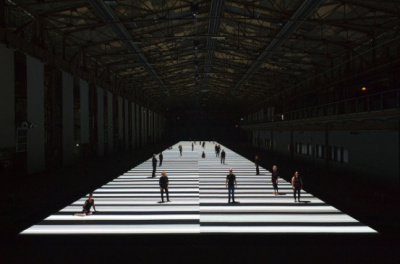
Ryoji Ikeda, Test Pattern. 
I have seen a number of Ryoji Ikeda’s installations over the years, and in this current one in the Grande Hall at La Villette he reaches a whole new level of creation, affect and meaning. On entering the Grande Hall we hear a strange technically produced sound by which we are pulled into the most spectacular of Paris’s former slaughterhouse spaces enclosed by a glass and cast iron structure. The visuals of the work laid out across the floor of the hall are a highly complex “test pattern” in which Ikeda has translated the everyday images that bombard and surround us into electronic form. The result is a fluctuating series of black and white lines, bands, grids moving unpredictably in a test pattern that is simultaneously hypnotic and slightly disturbing. It is like stepping onto an enormous pulsating barcode. The sound is likewise culled from the everyday and translated into a dramatic technobeat. Together, the sound and image form a complete environment that envelops us, overwhelms us and simultaneously soothes us. To stand in the middle of this highly structured chaos is like being in the middle of an endless ocean of sound and images. Or, as my friend with whom I visited the installation remarked, it’s like being on acid.


My visit to the piece was made even more compelling by a young dancer who improvised a performance over the test pattern. His movements were led by the sound and the light as they swept up and across the floor. Even non-professional dancers will intuitively move to the beat as they walk across and around the environment. Indeed, this physical engagement with the light and sound is imperative because only then can we experience the unpredictability of the music and light patterns. No sooner do we find the beat than it changes. Ikeda’s work is this mix of the most sophisticated mathematical computations, engineering design and an old-fashioned culling from the popular cultural environment. What impressed me most was its appeal to everyone: with the involvement of professional dancers, Sunday strollers, parents and children, old and young alike, this work unlike others of his I have seen was a community event.
 
William Forsythe, Nowhere and Everywhere at the Same Time no. 2
Across the hall is William Forsythe’s Nowhere and Everywhere at the Same Time no. 2. In this piece hundreds of pendula hang suspended from the tracks of an automatic rig at ceiling height. We are invited to enter the space and move among the pendula, but are warned not to touch or disturb them. Until we are inside the forest of pendula we don’t realize that it is actually very difficult to avoid the hanging weights. Because they constantly change speeds and move in different, unpredictable directions. Presumably through a computer designed algorithm, the pendula change the speed and arc of their trajectory according to the shifting speed and direction of the tracks above from which they are suspended. Thus, the experience is unsettling: we begin casually strolling through the pendula, and then, suddenly their speed changes and we have to run, jump, twist and contort our bodies to evade them. This sense of their command over us created a kind of ominous feeling when inside the installation. Watching others from the cast iron balcony above it was possible to see how they evoked anxiety, a heart rush, panic, all in the attempt to avoid touching them. There was literally nowhere to go dor refuge from their predatory movements.

Image result for william forsythe nowhere and everywhere at the same time
Forsythe inside Nowhere and Everywhere at the Same Time no. 2
Brighton Festival

Once again, the inanimate objects dictate (not simply influence) the movement of the human body: we have no choice inside their system that is ungraspable to us. Forsythe as the vanguard choreographer is here committed to exploring the form and limits of human movement. And while it is fascinating to find see our bodies move in ways we do not expect if we follow the dictate of the pendula, it would also be interesting to see Forsythe himself dance inside the installation.  Because it is on tour around Europe and has been to the US, there may still be opportunity to experience this.