Showing posts with label Film. Show all posts

Thursday, October 29, 2026

Stan Douglas Parallax @ Jeu de Paume

Stan Douglas, Hastings Park, 16 July 1955, 2008

The fall shows are now well underway, and I began the season with a visit to the Stan Douglas exhibition at the Jeu de Paume. The title of the exhibition, Parallax, so perfectly captures the spirit and conceptual problems explored by Douglas in his photograph and moving images. Shifting vision and perspectives are everywhere within individual images as well as in their relationship to the way that history is told. Douglas is a master of the parallax.

Take the image that accompanies the exhibition's publicity material, for example, Hastings Park, 16 July 1955. The photograph shows a crowd at the races, and most striking of all is the isolation of each figure. Those in conversation either do not have the attention of their listener or whatever they are saying draws disapproval. The man in the bottom left talks to the woman on his left who is either disinterested or unimpressed, a man in the upper left pulls a face and the woman to his left has a similarly ambiguous response. In the middle, a woman in a blue dress communicates with a man to her left, but his mind is elsewhere. Everyone is dressed up for a day at the races, but being together is not their priority. Being at the races in 1955 is about getting dressed up, placing bets, and being seen. 

Stan Douglas, The Secret Agent, 2012
Installation view @ David Zwirner, 2016

In this show and in Douglas's images in general, we find split and double screens, public spaces representing histories appropriated into private memory, photographs presenting as film developed over time, the skewing of reality through canted frames and events continuing beyond frames that deliberately leave us wondering. In The Secret Agent, a six channel video installation, Joseph Conrad's novel displaced to the terrorist events in Portugal in the summer of 1975, perspectives change over time. The installation includes three sets of double screens, each showing a different perspective of the "hot summer." Administrators, the street, and everyday life events such as a cat walking down a street, go about their business paying little attention to the threat of terrorism. Like all of Douglas's videos, over time, history unfolds in the articulated spaces of each screen, ultimately revealing the difficulty of breaking away from social structures without an event such as a terrorist attack.

Stan Douglas, 2 March 1914, Penn Station's Half Century, 2021 

There is always something visibly artificial in the photographs: up close we see the outline of objects, the human figures standing out from their background which are often abandoned or empty places and spaces. The large format photographs look like images made from film footage, taken out of a series, not just a frame, to give the impression of events unfolding over time. This plasticity also draws attention to the impossibility of the photograph, not just its illusion and its deception, but its impossibility. This is presumably Douglas's desired effect, created through the synthesis of multiple images — taken at different times — emphasizing fabrication.

Stan Douglas, Birth of Nation, 2025

In one of the most exciting works in the exhibition, Douglas re-visions history through a re-presentation of D.W. Griffith's Birth of a Nation, 2025. In a five channel video with the Griffith film as the central image, Douglas alters, mirrors and replays the original film from different perspectives. He focusses on the sequence in which Gus is wrongly lynched for Flora's death. Douglas includes two new black characters, Sam and Tom, both freed Confederate captains, who are visions of the white men's racist imaginations every time they encounter Gus. Douglas accentuates the technical achievements of Griffith's film—pioneering narrative coherence through parallel editing, close ups, slowing down the image for important emotional resonance. In his multi-channel, multi-perspectival version, Douglas uses the same strategies to accentuate the racism, misrecognition, and to expose what official history does not show. The final frames of the video on the bottom left are in colour, showing Douglas bringing the past into the present. As viewers, we are left reflecting on the racism of today.

Stan Douglas, Abbott and Cordova, 7 August 1971, 2008

Most of Douglas's photographs are conceived within a series of images, and one disappointment I had with this otherwise stunning exhibition was that there were often only single images from the series. That said, there were other rewards for a French audience. In a photograph that had particular resonance for Paris viewers, Abbott and Cordova, 7 August 1971 is an eerie image looking down at an empty street with people on the fringes. The title refers to the "Gastown Riots" in Vancouver when police charged peaceful demonstrators in Maple Square, Vancouver. The protesters had gathered in response to increasing tensions between police and hippies. Although present, but not emphasized by Douglas, similar to current events in France, police were overly aggressive. Arrests and injuries from violent confrontations with the police are clearly not only a thing of the past. 


Thursday, August 20, 2026

Ana Mendieta @ Tate Modern

Ana Mendieta, 

It's difficult to look at Ana Mendieta's art without seeing her death foretold. The current exhibition at Tate Modern does not mention her fall from the 34th floor of her apartment building in New York, widely believed to have been at the hands of her husband artist Carl Andre. I mention this because the work, made of blood, feathers, fire and earth is fiercely feminist and relentlessly searching for the expression of woman's connection to the ancient land and nature. As it is presented in this exhibition, Mendieta's art tells of a woman fighting to be heard amid the din of voices wanting to silence her. 

Ana Mendieta, Old Westbury, 1978, Recreated 2026

If ever there was an exhibition of a single artist's work to convince of the value of seeing the artist's development across a number of years, Tate Modern's presentation Mendieta's astonishing work shows this. The human form drawn, burnt, painted, traced and planted is always that of her own small body. More often than not, the shapes and images are vaginal, leaving no doubt that her primary concern centered on woman's place in the world, her body as an extension of nature, merged together in a spiritual harmony that has no place or need of men. In her sculptures, performances, films and drawings, trees, leaves, and the earth show the absence and silence of woman in a culturescape overwhelmed by men, as well as the violence committed on both her and nature. 

Ana Mendieta, La Concha de Venus, 1982

In, for example, La Concha de Venus (1982) the patterns of the earth give us the unmistakeable form of a woman and in the Silueta Series among othes, the woman's body is both the absent form and the clitoris of the earth. Absence is also found throughout Mendieta's oeuvre, so often the body being marked by a shadow, or a trace, a silhouette or just a negative space. And in these works, the silhouette or shadow is always removed from the body, the woman herself missing from the scene. Because she is absent, the violence is not explicit, but it is unmistakeable. 

Ana Mendieta, Silueta Series, 1973-1980

While the form remains constant, the materials, location, the medium are always shifting. Perhaps most exciting in this exhibition are the screening of a number of Mendieta's short films. In them we see her transforming, emerging, drawing, always in motion, always in the process of creating or exploring the synergy of woman and nature. In one she slowly drags her blood soaked arms down a white wall creating traces like ancient hieroglyphs along the wall. There are clear references to archaeology, ancestral ritual and neolithic cultures, very old traditions both relating to her native Cuba and her American life. The works often resemble tombs and gravesites where fire and water and snow are in a process of the exchange of life force with woman's body. And we see spaces and places where silence, absence and invisibility are remembered—or not—as forms and traces are washed away. Like the woman's body. Erased.

Ana Mendieta, Film Still from Blood and Feathers, #2, 1974

Walking through the exhibition, there's a grief in all of the works, particularly for those aware of Mendieta's premature death. That said, Tate Modern and the curators are to be congratulated  for not drawing attention to her "fall" from a window, not adding any more sensation to her death that it already attracts. Because what Mendieta has to say in her art about the fragility and vulnerability, the oppression of woman, the violence to the environment and women alike, needs to be where our attention is focussed. It is an extraordinary oeuvre and exhibited with care and creativity by Tate Modern.  


Monday, July 13, 2026

L'exposition générale @ Fondation Cartier pour l’art contemporain

Installation Fondation Cartier pour l'art contemporain

After years of scaffolding and construction sheets covering the east side of the Place du Palais Royal, the Fondation Cartier pour l'art contemporain finally opened last October. Before upgrading from its digs on Boulevard Raspail, the Fondation had celebrated architect Jean Nouvel work his magic in a stunning renovation. Before thinking about the building, a few words on the exhibition.

Joan Mitchell, La Grande Vallée VI, 1994 and
Damien Hirst, Cherry Blossoms, 2020

The inaugural exhibition itself is vast and leaves little time for reflection as there are so many works. On display is a single work by each of the artists held in the Fondation collection. If not all the artists are represented, most are. Many people will be familiar with the works from past exhibitions at the Boulevard de Raspail gallery—a Damien Hirst Cherry tree painting, a Ron Mueck woman, a Sally Gabori abstract painting, Matthew Barney's Cremaster. There were also works that I had not seen before, for example, a wonderful selection of David Lynch's drawings, jottings, scribbles and scrawls. Some of them were clearly conception sketches for films—some very familiar shapes and ideas from Blue Velvet , Twin Peaks, Eraserhead—while others looked like reflective jottings made while on the telephone. It was a real treat to see Lynch's mind at work in the drawings.

Sarah Sze, Tracing Fallen Sky, 2020

Another work that fascinated my friend and colleague Oksana who joined me for the afternoon was Christian Boltanski's Ephémère (2017) in which linen cloths play and dance, inside moving fragments of projected light projected. As the cloth blows in the wind, light flickers and jumps, and then moving inside, it is like being inside an experimental film. Sarah Sze's installation, Tracing Fallen Sky (2020) was fascinating as it could be seen from above from a higher floor and below on its floor. In it, objects and monitors, and a model planet create a whole world that, in keeping with the innovative sight lines is also always moving. 

Christian Boltanski, Ephémères, 2017

The most exciting thing about visiting the new space was, however, discovering the building, its history, and Jean Nouvel's redesign. The building at 2, place du Palais Royal, was built in 1852 as a hotel to accommodate visitors to the 1855 Paris Exposition. By the 1880s, the ground floor shops had expanded to the point where they took over the entire building along rue de Rivoli. The Palladian architecture made for a grand bourgeoise building in the heart of Paris, showcasing the prosperity of the Second Empire of Napoleon III. As part of the renovation project of Barron Haussmann, the Grand Hotel du Louvre was designed as a luxurious symbol of developing industrialization and economic prosperity in the city.

Looking up and out

Jean Nouvel's redesign has maintained the symmetry and perspective of Palladio's interpretation of classical architecture and made it contemporary through introducing moving parts, reflections, windows onto the city offering unexpected perspectives. A walk around the vast building is filled with surprises and extraordinary perspectives. Particularly, looking up from lower floors at the building's arcade along rue de Rivoli, at times glimpsing the windows of the Louvre opposite, and at others, watching people pass was a wonderful sight. This is another paris museum for which visitors will spend a lot of time admiring the architecture as well as the art. But what is most noticeable, is how easy the space is. Big spaces (like the Louvre) can be exhausting to navigate, but at the Fondation Cartier, there was never any sense of being frazzled by other people. It is also large enough that there were very few people around and on a hot day, the chilly air conditioning made it relaxing and enjoyable.  I am looking forward to the Fondation Cartier's first exhibition, especially to see how they use the space to showcase their amazing collection. 
Monday, May 18, 2026

Normes Corps @ Palais de Tokyo

Cathy de Monchaux, Studio, Wounds, and Battles. Desire is the Reiteration of Hope, 2026 

I am always on the hunt for exhibitions without hoards of visitors and inspired by the promise of empty halls, I went to the Palais de Tokyo last Friday night.There is a large diversity of work on display throughout the building, loosely cohering around the theme of bodies on the margins. I was struck by how often the works challenged, reappropriated, or simply drew to attention the ways in which the design and construction of public space rarely pay attention to those who are not able bodied, or are without power in the social and cultural world. A lovely installation by Benoît Pieron, for example, sees street lights filled with confetti in liquid, reminding of snow globes. Rather than having lights guide our path or keep us safe in a dark street, Pieron's installation has us fascinated by the shimmering movement of the lint. A bench next to one of the light posts encourages us to look at, rather than, be guided by, light. Behaving in a way not prescribed by the organization of public space, Pieron challenges it through inversion.

Benoît Pieron, Vernis à Ombre, 2026
Installation View

Many of the works left no doubt that public space is commanded over by men. Among the exhibits is a film by Pauline Curnier Jardin and the Feel Good Cooperative made together with street workers during lockdown in the EUR quartier of Rome. Made to mark the "celebration" of Christopher Columbus's discovery of the United States La Colonne della Colombo shows sex workers in the quartier imagined by Mussolini to celebrate fascism. It was empowering to watch their appropriation of the space—which today is actually a quartier of ghettoization—to celebrate people who are otherwise downtrodden. In full costume, seemingly happy to perform for the camera, the street workers indulged both live and film audiences in a carnavalesque, thus subversive, romp filled with humour and wit.

Pauline Curnier Jardin, La Colonne della Colombo, 2023

Another striking film shows aging women in prison, communicating with each other, creating community through the walls, much to the chagrin of a young male guard. Qu'un sang Impure (2019) is clearly drawing on Jean Genet's Un Chant d'Amour (1950) as we see the women passing gum, exhaling smoke, and expressing desire through the walls. However, unlike Genet's film, neither the women nor the film are restrained. The arousal, masturbation, and ecstasy of women often assumed to be sexually barren, is full throttle and confronting. We do not see genitalia though there is explicit masturbation, leaving nothing to the imagination. It is, once again, refreshing and liberating to see people so often cast out by those who dictate cultural and social desire, ignoring the norms and conventions. 

Pauline Curnier Jardin, Qu'un sang Impure, 2019

For me, the most striking in the suite of exhibitions was Studio, Wounds, and Battles. Desire is the Reiteration of Hope by British born artist Cathy de Monchaux. Doing justice to the intricacy and vastness of her work is almost impossible. Unicorns and other mythical creatures, pregnant women, bodies wrapped in what might be bandages or simple cloths, tightly wound to imprison, immersed in forests of intricately formed landscapes, a snake with skin covered in mouths that could easily be mistaken for vaginas, and the fantasies continue. Each piece is meticulously hand made from wire, paper, plaster, leather, rubber, velvet, woven, tied, wrapped and studded. The sculptures are spellbinding, and we don't know whether to be amazed, repulsed, or to recoil from their intimacies. Also included in the display of her work is a room whose walls are filled with drawings, ideas, early works from her studio. In it, we find an artist taken up with a forthright argument about women, the environment, and the entrapment of both in history, culture, and the world that we live in. It was exciting to discover de Monchaux's impressive work. 

Cathy de Monchaux, Maud's Pink, 1999

This is only a taste of what is on display at the Palais de Tokyo in Normes Corps. What a breath of fresh air to be at the Palais de Tokyo, not only to see some interesting, some brilliant, some puzzling art. The quiet and all but empty halls of the Palais de Tokyo were sheer pleasure after battling through crowds at some of the major exhibitions around town. And in spite of the relative calm, the art was filled with an energy that filled me with inspiration. It was also delightful to see so many young people in the museum, not only looking at art, but chatting, relaxing, and also enjoying the peaceful and generative atmosphere. 


Sunday, March 15, 2026

Clair-Obscur @ Bourse de Commerce


Peter Huyghe, Camata, 2024

Pierre Huyghe's video installation, Camata, 2024 fills the gallery beneath the Bourse cupola for the latest exhibition. Set in the Chilean Atacama desert, the film watches as three solar-powered mechanical arms move around a skeleton from the early twentieth century left lying on the desert floor. Cameras are placed on each arm, one moving on a semi-circular track around the skeleton, one outside the track simply observing, and one inside, probing, peering, and engaging with the skeleton and various glass balls, amulets, and a mirror. Of particular fascination is the film's editing which is done in real time by an AI algorithm. When Camata was shown in the Palazzo Grassi in Venice, the algorithm was determined by human movement within the exhibition space, but it was unclear if this was also the case in Paris. In addition to being mesmerizing to watch as mechanical arms move around, in and out of close up, themselves fascinated by the skeleton, Camata creates sophisticated dialogues between technology and human, life and death, processes of surveillance and objectification. Similarly, given the age of the skeleton and its enigmatic story, human time is thrust into tension with technological time in the film. A discourse on celestial time also emerges as we watch day turn into night through changing light in the sky, the appearance of stars, and the waxing and waning of sun and moon. Added to these already complex times is the seeming unpredictability of the editing created by algorithms. In keeping with Huyghe's concern for the inexplicable, for the blurring of boundaries between machine and human, Camata sits somewhere between science fiction and a scary reality in which machines very quickly take on human qualities. 

Sigmar Polke, Axial Age, 2005-2007

Also challenging boundaries between human and celestial, as well as having interesting things to say about time, is Sigmar Polke's cycle Axial Age. The installation consists of nine panels made with varying techniques and media from Antiquity through contemporary, including acrylics and toxic, artificial pigments. The result are a series of transparent panels resembling discoloured stain glass windows, "graffitied" by time. The panels bring to mind sacred images, speaking to an era that has been desecrated, and simultaneously, rescued from the dustbins of history.

Philippe Parreno, La Quinta del Sordo, 2021

Philippe Parreno recreates Goya's black paintings in, La Quinta del Sordo, 2021, a film that underlines the darkness of Goya's paintings. As the camera moves into tight closeup, the viewer feels intimately connected to the melancholy faces and the frescoed works. Sound is key to Parreno's re-presentation, as the environment of the recreated space dominates the soundtrack. We hear mechanical sounds, crying, light gurgling water, moaning. Once again, the past (images) and the present (sounds) come together on these sensuous walls, seen lovingly through Pareno's camera. As the film progresses, the light changes, becomes progressively brighter until the camera and light together remove the images and reduce the paintings to surfaces. Then we see shadows of leaves from a tree outside a window falling on an abstract painting. Parreno's film was actually one of the only ones in the exhibition which is directly and obviously about light and darkness, as it quite literally brings the ghosts of the past out of the shadows, into the light of the present. 

Robert Gober, Untitled, 1991
Robert Gober, Untitled, 1990 

I was also thrilled to see a few pieces by Robert Gober in the first floor galleries as he is not an artist that we often see in Europe. Gober's unique installations of amputated limbs, in the case of those on display here, trapped in a suitcase, descending in a glass case are always emotionally moving, and simultaneously, somewhat scarey. A work in beeswax and human hair shows a pillow merged with a torso, one side a man, the other a woman. The disfiguratioin of both bodies and objects, the loss of boundaries between the two, making the piece surreal, and provocative. Gober's surreal objects show the sad, desperate deformation of humanity. 

Alina Szapocznikow, Fiancé folle blanche, 1971

There were lots of other works in the exhibition, many of which I could and would love to write about here if space permitted. But I will just mention the few pieces by Alina Szapocznikow, a Polish sculpture whose work was new to me. Szapocznikow made incredibly powerful depictions of women's entrapment and enchainment to male sexuality. A work such as Fiancé folle blanche, is reminiscent of a small statuette that could be placed on a wedding cake. For all its critique of heterosexual relations, the woman is as happy in her naked pose with a penis as her support, as the penis is happy with her embrace. There is no sense in which the woman is a victim to the male organ. But still, we can't help wondering if she had any choice.

Clair-Obscur is another sprawling exhibition loosely cohered around a theme that itself moves from clarity to obscurity across three floors and a range of media at the Bourse de Commerce. And like previous of the Pinault collection's themed exhibitions, Clair-Obscur contains some exceptionally strong works and others that pale, mainly due to their uncertain relevance to the exhibition. Similarly, because a number of the films are long, and reveal themselves over time, it is an exhibition that is difficult to appreciate in one visit. That said, the richness of some of the works make for a rewarding few hours.

Saturday, January 3, 2026

The House on Utopia Parkway, Joseph Cornell's Studio Re-Created by Wes Anderson

View of exhibition from opposite side of rue de Castiglione

Gagosian has outdone itself, yet again, with an exquisite exhibition in its rue de Castiglione window. Filmmaker Wes Anderson has recreated Joseph Cornell's studio in which he lived and worked until his death in 1972. The studio was in the basement of his mother's house in Queens where he lived. Cornell was known in his neighborhood as the solitary figure walking the streets of Queens and sifting through odds and ends in flea markets and antique shops. He was obsessive, and meticulous, a man who created beautiful worlds that meant everything to him. He may have been a recluse and somewhat of an oddball, but as a collector, an archivist of memories and emotions, and creator of curious worlds inside boxes, his work also enjoyed an enormous influence on mid-century American art. 

Installation View Gagosian Gallery, rue de Castiglione

Anderson's installation—done together with some of his longtime collaborators—is not the studio itself, rebuilt and transposed to Paris, but a recreation. Some of Cornell's possessions are too fragile to move, and others not available, so Anderson remade these objects as close to the original as possible. That said, a number of Cornell's most well known boxes, themselves now archival objects, are in the display. I must say, knowing the sheer amount of junk that Cornell kept in the basement, I was expecting his studio to be messier, more like Francis Bacon's than Cezanne's orderly arrangement of objects. But, of course, Cornell's studio as represented in this exhibition, was scrupulous, with every object in a box, labelled, ordered, neatly stored and within easy access. In addition, Cornell's tools and materials—glues, brushes, pliers, and metal wash basins—looked as though they were waiting to be used. 

Joseph Cornell, Rose Hobart, 1936

For me and my students, Cornell is known for his found footage film, Rose Hobart (1936) one of the earliest examples of surrealist collage on film. Cornell took images of the actor Rose Hobart from a B-movie adventure, and re-edited them into a hommage to the actor, replaced the soundtrack with Brazilian samba, slowed it down, and projected his 19 minute film through a blue filter. The film says everything about the eccentric Cornell who was fascinated from a distance with the exoticism of film, the eroticism of the star, and his drive to creatively reconceive the world as the rest of us saw it.

Installation view with reflection of Gucci sign

The most glorious thing about this exhibition was how the installation became a repetition of Cornell's boxes. Viewers peered in through the gallery windows at all the objects, drawings, and everything in its place in the same way that we would before his boxes. Along with some of Cornell's most well-known boxes—Lauren Bacall and the medicine cabinet—there were film cans, photographs, drawings, boxes waiting to be filled, pictures from books, books with the pictures town out, pieces of wood, iron, biscuit tins, scrap books, little bottles, jars, baskets—all the bits and pieces that would eventually make their way into Cornell's boxes. As I peered through the windows of the gallery on a bitterly cold January 2, hoards of tourists walked past, their legs and feet reflected in the window together with the exquisite tiles of the arcade. Further complicating the view into Cornell's studio is the reflection of the Gucci hoarding on the building construction on the opposite side of the street. This Gucci kind of consumerism would be the antithesis of everything Cornell valued: his love of things thrown away, deemed to be of no value to anyone else, but of great value to him. The forgotten, that which has been left behind by capitalism and the drive to entertain - like the genre actor Rose Hobart—was his treasure trove. 

Installation view @ Gagosian Gallery

Cornell never left America, in fact, he rarely ventured far from New York. But, he was the sort of person who had a voracious appetite for the world, for things, for adventure. National Geographic magazines, Baedekers, well-read and loved books, films watched, these were the source of Cornell's fascination for the world. He knew Paris from the movies, fellow artists, and from encyclopaedias, books, and magazines that he found in junk sales, so I am sure, he would have been tickled to see his work on display through a prominent city window. That said, I can't imagine that he would have felt comfortable on rue de Castiglione, just up from the Place Vendôme with Napoleon looking down on him. What Cornell would have thought aside, well done Wes Anderson and Gagosian, for inviting us to peek into the past, so lovingly recreated, as Cornell did his boxes, amid the freneticism of contemporary Paris. 

Monday, August 18, 2025

Corps et âmes @ Bourse de Commerce / Pinault Collection

Duane Hanson, House Painter, 1984-88

It was wonderful to be back at the Bourse de Commerce in the final days of their summer show, Body and Soul. The place was teeming with visitors, in fact, I have never seen it so full on a Friday afternoon. It seems that visitors to Paris have discovered this, one of Paris's newest cultural pearls. Because of the crowds, I skipped the rotunda sound installation in which visitors sat in silence watching bowls floating on water. Instead, I followed the fascinating exhibition of Ali Cherri's sculptures in the twenty-four vitrines around the perimeter. Cherri's provocative sculptures begun from recycled archaeological finds—broken limbs, scarred bodies, decapitated heads—made for unsettling viewing. In this installation, Cherri brings the past into the present and reminds his viewer of the imbrication of spoils of war, history, and culture. 

Ali Cherri, The Toilet of Venus (The Rokeby Venus), after Velázquez, 2022

Two films by African American artist Arthur Jafa were among the most powerful works in the exhibition. Downstairs Love is the Message, The Message is Death (2016) is a collage of clips showing the history of African American life in the twentieth century. Weaving together recognizeable figures in often quoted images such as Martin Luther King, Angela Davis, Barack Obama —all of whom claim a message of love, tolerance, inclusivity—and footage of anonymous men, women, children being beaten, dragged along the street, and terrorized by the police. Love may well be the message, but the language of death is the only vocabulary American society knows when speaking to African Americans. Kanye West's Ultralight Beam overlays the images, successfully moving the viewer from the emotive power of cultural icons through the horror of police brutality towards African Americans. More than one person (including me) left the screening room in tears.  

Arthur Jafa, AGHDRA, (2021)

Jafa's Aghdra (2021) in the ground floor galleries was more enigmatic, but still overwhelming in a different way. Slabs of what look like broken bitumen (digitally generated) roll around where we expect to see ocean waves under a rising sun, a setting moon in a clear sky. The black sludge or magma travel towards us, threatening to envelop us, and then they rise so high in the frame that they covers the sky. From where we sit, there is no escape once the horror of this stuff threatens to bury us. The message is clear: the sea is not the same phenomenon for everyone. We think of it as a place to go for a holiday and dream and fall in love. For African Americans, the sea is the reminder of transportation and colonialism, enslavement and entrapment to the designs of a perpetrator. 

Philip Guston, Lamp, 1974

Though it was one of my favorite pieces in the exhibition, it was not clear to me how Philip Guston's Lamp, 1974 was related to the themes of body and soul, the exhibition title. While Guston's work from this period is known for its conversation on questions of racism, Lamp is more abstract, discoursing on looking and reflection in absent space. Painted in Guston's signature pinks with flecks of grey, it is a luscious painting in which brushstrokes enigmatically travel around the canvas, thus the room in which the lamp sits. Light spills out of the lamp, but there is nothing to illuminate. The lampshade with its caresses of white and grey, glimmers of peppermint green, verges into being an image on a wall. It is a painting about light in which nothing is illuminated, there is nothing to see in an empty room, thus turning the attention back on the viewer as the one who is looking and looked at. There is a curious red line drawn horizontally through the middle of the painting, like a cord. Is it a trail of blood? Or is it a definition of the wall behind the lamp. It's hard to say. 

Marlene Dumas, Horizon, 2007-2008

In the upstairs galleries, a richness of works is displayed, again with varying degrees of relevance to the title of the exhibition. Standing out for me were works by Marlene Dumas. In a more unusual work, Horizon, Dumas paints the flowers on her mother's grave and thinks of it as a portrait. As if drifting out towards the horizon at the back of the painting, the flowers are framed by the slight hint of a grave. Or perhaps they are in a vitrine, displayed for us to admire as we walk past? The work speaks to questions of death and eternity, suggesting the preservation of life in memory after death. The blue paint is complex and suggests the changing mood of the water into which her mother's memory floats. With Dumas, it's so often about death, looking, and our ultimate blindness.

Corps et âmes, Installation View
Foreground: Niki de Saint Phalle, Nana Noire, 1965


I think I am not a theme exhibition person. With my need for order and coherence, I am always looking for continuity in an exhibition, something much easier to find in an author-centered exhibition. Body and Soul had many breathtaking works—from Man Ray to Mira Schor—but as is often the case, it felt scattered. It's a little difficult to say what exactly the exhibition wanted to show about the body and soul—particularly, as you can see, some of the most impressive works were about the absence of the body. Maybe the problem was the title? If the exhibition had been called something like "Invisible Bodies," it would have made more sense.

Monday, June 9, 2025

Dans le Flou. une autre vision de l’art de 1945 à nos jours @ Orangerie

This exhibition includes many great individual works, but as an exhibition, it goes in many different directions. It also tends to stay on the surface of the many different, and otherwise rich debates around the blur and indistinct. Inspired by, or more accurately, set in motion by Monet's Water Lillies — because it's the Orangerie, the connection must be made — the exhibition sections move from Monet's blindness, through postwar disillusionment with the precision of modernity, the unrepresentability of the Holocaust, the deception of media and technology, and the uncertainty of abstract expressionism, to the "mistakes" of amateur photography, the blur/screen/hazy/disintegrating image can be connected to a whole lot of motivations in the twentieth and early twenty-first century.
Gerhard Richter, Blumen, 1994, CR 815-3

To be sure, as I say, there are some magnificent works in the exhibition. As a Richter fan, I was happy to see a range of his paintings as they are surely central to any exhibition considering blurring and indistinction. Richter's Flowers prompted thought of another theme that could have been added, that of death. Spirits, ghosts, the other worldly and their depiction thanks to photography are a noticeable absence here. The representation of the unseen in the 20th century was inspired by the invention of photography, and it could have been placed as a fulcrum or springboard to cohere the exhibition. As it was, there was a distinct lack of context and comprised a lot of images that shared this element of haziness.
Vincent Dulom, Hommage à Monet, 2024

Some of the individual rooms worked very well. A room called "At the Frontier of the Visible" with works by Vincent Dulom, (Hommage à Monet, 2024), Ugo Rondinone (No. 42 Vierzehnterjanuarneunzehnhundertdreiundneunzig, 1996), Wojciech Fangor (N 17, 1963) was particularly compelling. In this room, the spectator is confronted with the deceptions of the eye. We think of our eyes as seeing things as they are, reality as it is, and yet, as we look at these paintings, they move, shift, vibrate, disappear. In front of these works, we are reminded that vision is as unstable as the world we are looking at. At the same time, each of these works makes a claim for the idea of paint as itself an apparition, something that floats on the surface of a canvas before disappearing. 

Philippe Cognée, Métamorphose I, 2011

If visitors are able to enjoy the exhibition for individual works, Philippe Cognée's Métamorphose I, 2011, is an absorbing and complex work. A large encaustic painting of high rise buildings that Cognée proceeds to go over with a hot iron. The wax melts and with it, the buildings collapse. In a section together with Richter's September 2005, and Thomas Ruff's jpeg ny01.2004, both of which represent smoke pouring out of the World Trade Centre towers, Cognée's painting takes on sinister meaning. Not only does he represent the cities metamorphosing and growing, but the melted wax shows the building and rebuilding of the urbanscape is a destructive measure. 

Gus van Sant, Elephant, 2003
The exhibition closes with a display of fragments from famous films that include some version of the blurry, out of focus, or indistinct. Again, there is no context for the very different examples shown, from Gus van Sant's Elephant (2003) to Hong Sang-Soo's In Water, 2023. Given the centrality of technological images to the notion of the blur, it would have been nice to see more integrity given to these few films by, for example, drawing attention to or at the very least, describing, the very different uses of the blur for these films. All in all, the exhibition is slim on intellectual substance and rich on images, making it disappointing in some ways and a treat in others. 

Thursday, August 4, 2022

Jean Painlevé, Les Pieds dans L'eau @ Jeu de Paume


Jean Painlevé

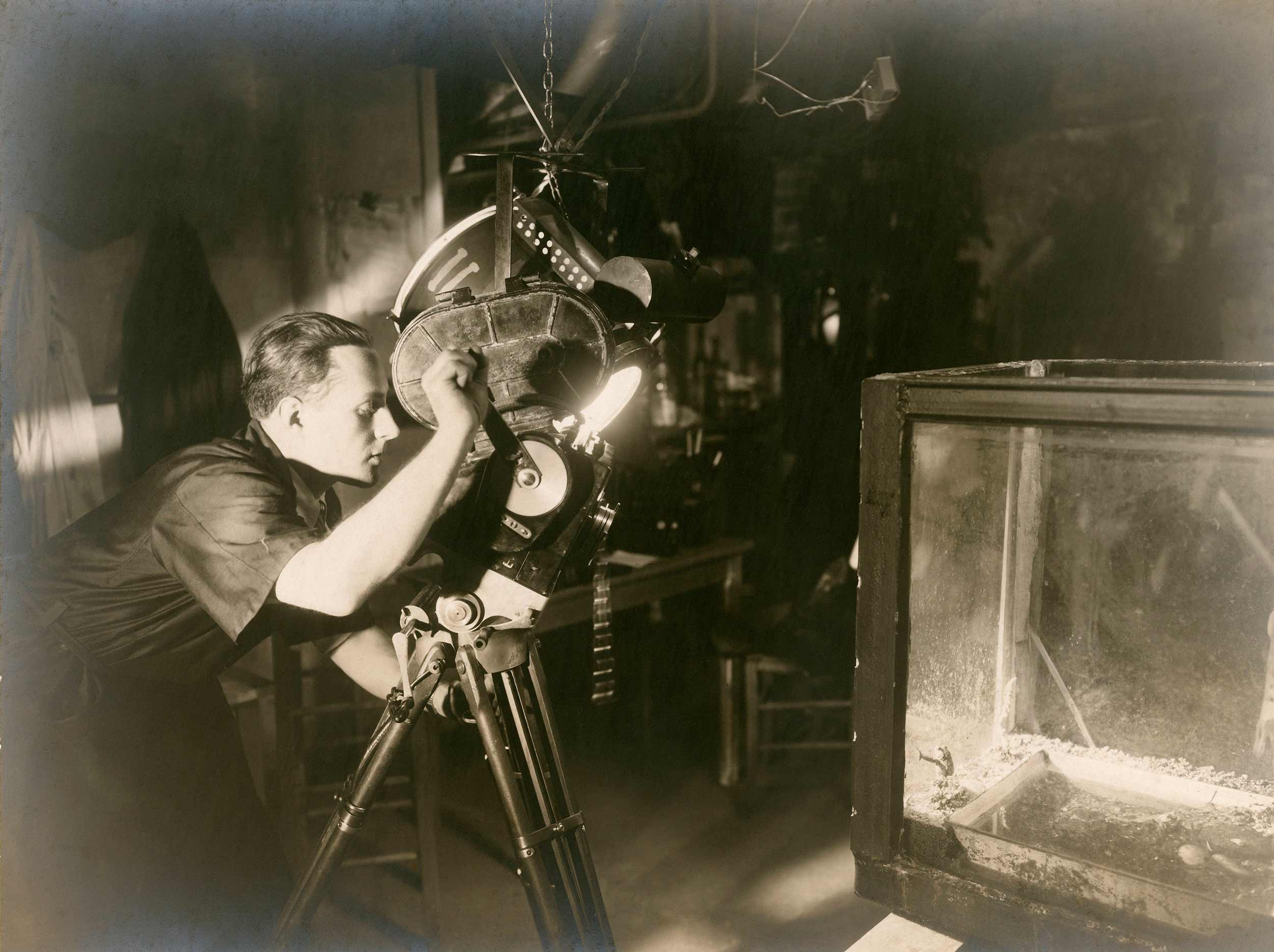
I loved the Jean Painlevé exhibition at the Jeu de Paume, if only for its offer of the opportunity to see these strange films on the big screen. There are a number of short films, many of which will be unique and revelatory to viewers. True to their intentions, the films are educative on many levels. We learn about male sea horses giving birth, watch octopuses mate, examine various oils under microscopes (mainly kaleidoscopic drops exploding like fireworks), and marvel at the effect of light on sea urchins. Some of the documents of flowers and other natural phenomena, accelerated to show slow evolution and natural processes in minutes of film were also fascinating for their resonance with early experimental film and new objectivity photography.

Jean Painlevé, Étoile de mer, vers 1930


Also wonderful was the exploration of the cinema in these films. Painlevé was concerned to educate and convey information, but he was just as focussed on exploring the possibilities of the cinema which, in his time, had not yet been fully revealed. In images that in which sea creatures merge into their environment or flowers /plants bloom, and asteroids move around the sky, Painlevé uses natural events to explore the possibilities of the camera. The beauty of his manipulation of light and dark, the framing, the keen awareness of the cinema's ability to manipulate time and space were all quite breathtaking. Painlevé may have been trained as a scientist, but he also had a keen sense of the way that images work. 

Jean Painlevé, Buste d'hippocampe, vers 1931

More disappointing, however, was the exhibition's contextualization of Painlevé's experiments. The films are presented as objective documentary records of Painlevé's scientific experiments and research. Thus, there is little to no mention of the staging of the films. Because of the way that Painlevé filmed, namely, removing the manipulation of the pro-filmic, we watch sea horses in their life cycles as if Painlevé was underwater with them. The removal of the marine life from their natural habitat, their placement in tanks, the staging and manipulation of the animals, clearly compromised, or at least, contributed to the definition of the kind of documentary film that he was making. This isn't to detract from the splendour of his images, or the amount that we learn from watching the films. Rather, it speaks more my disappointment that there was not enough information on what these films were actually doing.

Jean Painlevé, Détail de la pâle d'une queue de crevette, 19229

Another, related, thing that is not acknowledged by the exhibition is the historical moment of the cinema in which he was making these films. Painlevé was filming at a time when the lines between fiction and documentary, between experimental and documentary were not yet fully drawn or defined. Theorists were still trying to come to terms with what the cinema was about in this moment, and Painlevé was one of the experimenters asking these questions. Thus, his contribution to the very important debates about the cinema is elided in this otherwise fascinating exhibition

Saturday, June 26, 2021

James Coleman

James Coleman, Slide Piece, 1972-1973

I have been reading about James Coleman's work for almost thirty years, but have seen very little of it in that time. The small, but superbly curated exhibition at the Pompidou is as challenging as it is welcome. Coleman's is a provocative body of work that has fascinated some of the most prominent figures in the worlds of experimental film, art and photography studies. And with good reason.

The work is challenging because it doesn't fit into the neatly arranged categories that we give art and visual culture today. Coleman's work characteristically occupies the interface between still and moving images. He also plays with the relations between photograph and cinema, art history and cinema, and more recently, the spectacular visual culture of advertising, television, fashion photography and police imaging. Known for his use of transparent images projected through multiple stacked slide carousels, sometimes accompanied by audio tracks that don't describe what's in the image, Coleman's signature works are also about the tension between image and word. We are sure to come away wondering about the efficacy of words and images as modes of communication.

James Coleman, Retake with Evidence, 2007

In one piece at the beginning, Harvey Keitel stands on a stage, intermittently backgrounded by a plain white stage, archaeological ruins, monumental columns, antique sculptures that might be in a museum. Keitel delivers a monologue from Sophocles that is about as impenetrable as the Greeks get. Keitel is not preened and prissed for the camera, but wears a sweatshirt and perspires under the lights. Sophocles text is focussed on questions of social violence and democracy, but it's the contexts and modes of presentation that draw our focus. Issues of performance, staging, frustration of viewer expectations through fragmentation and repetition are brought to the fore. Even if they don't watch the entire performance, viewers will understand they are watching their own process of watching. 

James Coleman, La Tache Aveugle, 1978-1990

Also towards the beginning is a signature Coleman slide projection with synchronised audio, Slide Piece. The voice describes the most important aspects of the image before us: a drab, nondescript square in Milan. Each time the slides move past the light source, a new description begins. But the image is the same, even if it is a new slide. And the audio simply describes different aspects of this same drab square, honing in on what might be important to different viewers. Over time, our eyes will have moved around the image having noticed a window above the awning, the pylon behind the cars, and other innocuous details. The work gives the idea that what is in the image depends on who is looking, and what's important to that viewer. 

James Coleman, Charon (MIT Project), 1989

In other works, such as Charon, the slides are self-conscious performances of the way that moving images are constructed. Even if the images are not moving. Thus in Charon, a synchronised audio tells stories about the people who are in the image, but again, the slides don't fully correspond to the stories we hear. However, there are just enough details—the presence of a child, a hotel room, a window, a fancy outfit—to keep our desire for a sound/image link alive. Unlike the construction of narrative desire that promises an ending, here it is the promise of audio that goes with the image before us. Again, we are faced with images about the frustrations of viewing the moving image, even if we look at still images. Likewise, a piece such as Charon thrusts the difficulty of an image's communication into the foreground. We are made aware of all the elements that aid (and ultimately manipulate) our understanding and consequent interpretation. We start to become cognisant of the influence of things like the title, the descriptions, the uses to which the image is put, who takes the photographs, who directs the set, who dresses the models. 

James Coleman, (Documenta 11 Project), 2002

In a work such as (Documenta 11 Project), Coleman removes the title altogether. Thus, we are left looking at some kind of transient shape in the light that is presumably moving slower than the human eye can perceive it. And we have no idea of what we are looking at because he has removed the title. That said, the work has a title, even if it has been untitled: it is given (Documenta 11 Project) as title.  The work was commissioned for Documenta 11 by Okwui Enwezor in 2002, a Documenta that had its unique identity. Coleman's work in turn takes on that identity. In other words, we are never left to fall into the illusion of the works.

James Coleman, Still Life, 2013-2016

Even when illusion motivates the representation, we are confronted with the exposure of inauthenticity. In Still Life, Coleman plays with the French translation of dead nature. The poppy has been pulled out of the ground, thus destroyed, and is re-animated by Coleman's camera when the flower makes minuscule movements. The piece is projected on the black wall without a sound. Given the looping of audio tracks in other works, the silence of Still Life is itself somehow frustrating. So used to playing games with the audio/image relations, it's difficult to stand still and watch the flower which may or may not be real, in absolute silence. 

James Coleman, Lapsus Exposure, 1992-1994

Ultimately, this exhibition requires a lot of energy, but it is richly rewarding. Time spent with each work is revealing of our expectations of images, and the relations we take for granted. The bonus reward comes when we stand for long enough and find that we are watching ourselves watching, or at least, we are confronted with the processes with which we engage and the expectations we bring to looking at still and moving images.


All Images courtesy Marian Goodman Gallery © James Coleman