Showing posts with label Istanbul. Show all posts

Thursday, August 19, 2010

James Hughes, Trotsky and Photographic Memories in Istanbul

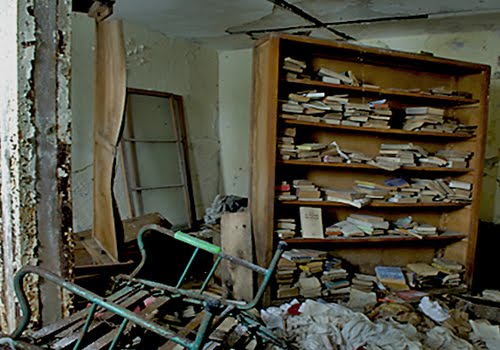
James Hughes, Trotsky House Library
Virtually impossible to find, but worth every minute of the search, and every bit of the associated frustration is the new Istanbul Hatirasi Fotograf Merkezi (Memoires of Photography Centre). The Centre was photographer Murat Pulat’s dream, and in its realization, it has all the elements of a dream come true. When I arrived to see the current exhibit of James HughesThe Lost Abodes of Exile, I was greeted with Turkish coffee and taken through the exhibit by Murat himself. The Centre, an old RUM style house (the architectural style used by the Ottomans) in the bourgeois neighborhood of Kadiköy, stages exhibitions, holds classes and offers support to young, aspiring photographers. 


In 2009, Hughes went to the island of Büyükada in the Marmara Sea of what was then Constantinople, where Trotsky took refuge in 1929 at the invitation of Atatürk. If we are to believe Hughes’ photographs, Trotsky’s house is as he left it in 1933, filled with objects of no use to anyone: books overflowing from Trotsky’s library, a fridge, the frame of a bed, a light fixture, a chair. The collage of windows, ceilings, floors, doorways and decayed structures connect us to Trotsky all those years ago in what is said to be his most productive years.

James Hughes, Dancing House Interior

Hughes’ photos are about surfaces: the colors, the texture, materials and transience of those surfaces that Trotsky touched, looked through and at, the surfaces that protected him, embraced him when in exile from the Communists. I find this appropriate in Istanbul: a city whose surfaces the variety and density, the infinite materials of which — paint, ceramics, sculpture, marble, carpets, all pieced together, like a jigsaw puzzle —  are its hallmark. It is a city whose great jewels are its intricately designed narratives envisioned on surfaces, made of many colors and materials, substances and patterns over many many years. It is as though the complexity and impossibly co-existent transience of Istanbul’s surfaces are transposed to the surface of Hughes’ photographs, surfaces that before his photographs he found in this house, on this remote island.


James Hughes, Living Room
Hughes’ process is apparently distinguished by its brevity, taking the photographs in a matter of minutes. And yet, in these exquisitely rendered floors and windows, ceilings and walls, in varying stages of decay and decrepitude, we go deep into the past, into the memories of other eras, not just Trotsky’s sojourn at Büyükada. The infinite layers of history, color and texture are brought to the surface of the image, through variant exposures to tell stories of the walls and the floors, the windows and the ceilings, layer upon layer, arranged on the surface of the photographic image, three dimensional, and yet so obviously a surface. The world in the photographs is, as Murat explained to me, visibly that of the Pashas, home to the banished rivals of the Byzantine emporers and Ottoman sultans. The house still bears the traces of the rambling villa it once was with room upon room, one space always leading to another. The RUM architecture, the opulence of the tiling, the delicacy of the glass windows, are the wealthy signs of the wealthy families who before Trotsky had wandered these same halls. And so the Sultans’ prisons became showcases for the Empire before they would become a haven, and since then have been transformed into the playground of tourists hoping to glimpse the depth of Istanbul’s history on its surfaces.
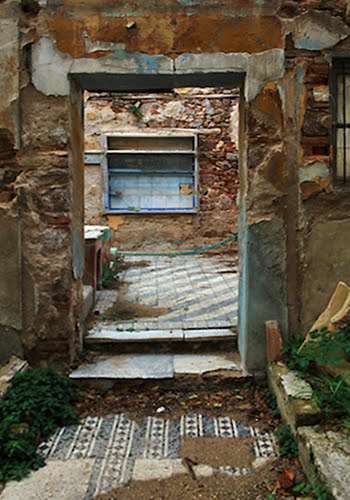
James Hughes, View Towards Kitchen
Hughes’ photographs are so laid out on the surface that the spaces imagined verge into the plastic, almost artificial as we recognize them to be spaces created for the camera. As we look longer at the living room ceiling, or a detail from the kitchen, the images can become abstract, or even a fantasy, of some far off mysterious world, that could never possibly exist, even though we see it before our eyes, just like the beauty of the Istanbul skyline.

James Hughes, Living Room Ceiling
There is also a stillness to the images: as we look out the back door, or through into the kitchen, we see the traces of a life left behind, abandoned. As such the photographs echo death, everything is gone, a time never to be recovered. And in the continued engagement with contradiction, the artificiality and abstraction effected by Hughes’ digital camera reveals his photographs are unashamedly contemporary, even as they also look old, of the 1950s and 60s.

Given my friends’ disappointment at the fashion show on exhibition at the Istanbul Modern, together with the warm hospitality of Murat and his colleagues, even when Hughes’ exhibit is over, my vote for contemporary art in Istanbul has to be the unforgettable trip across the Bosphorous to the Istanbul Hatirasi Fotograf Merkezi. 


All Images Courtesy James Hughes

Wednesday, August 18, 2010

On the Bosphorous, Istanbul at sunset

It is difficult to describe the warmth and friendliness of the Istanbullus, and it’s even more difficult to put into words the breathtaking, but somehow heartwrenching commuter ferry ride across the Bosphorous from Karaköy or Eminönü to Kadaköy. As we travelled from Europe to Asia, across waters that have supported the passing of thousands of years, from Romans to Byzantines, Ottomans to Turks, waters that enabled trade, commerce, and pleasure since the Middle Ages, we slipped with ease into the city’s daily life. Contemporary Istanbullus are not so different from commuters anywhere: they read the evening paper, talk on cell phones, listen to ipods, watch us with fascination, the intruders to their ancient world. They might stare, but never with any obvious disdain. On the contrary, the man who circulates with tea treated us as he did all the other customers, and two men spoke to us one night as we returned home from Kadaköy after dinner: they were interested in where we came from, what we were doing, how six of us from four different countries could possibly know each other. I was nothing but charmed by the locals of Istanbul.


The city’s magnificent skyline is another story. It’s complicated. As the sun sets, as it rises, and even in its midday intensity, the sun is the exclamation mark that asks us to look at this city over and over again. In fact, the sun and the light over the Bosphorous will ensure that we never look away, that for generations to come like those that have been, we will notice the magic and mystery of a restless, forever unexplained world. As the city’s skyline cuts a dramatic figure against the setting sun, on its way from yellow to orange to red, it is not only eerie and mystical, but also, somehow, devastating. In the serenity onboard, sipping tea, watching the waves as they chop against the side of the ferry, we look at that skyline and we remember the centuries of injustice: the power struggles, occupations, religious persecution, even when the city was at its most powerful. And we wonder where these social imbalances are today, in a city that clearly has other things on its mind.

This is a city in which human rickshaws are still a reality, where poverty, homelessness and unemployment are inseparable from a superb cuisine, ornate mosaics, and magnificently domed halls that serve as steam baths for the wealthy. With all its dichotomies, Istanbul is a city that, despite what hearsay may claim, will never be admitted into the European Union. Turkey is a country in isolation, and as gatekeeper of the divide between Europe and Asia, it is neither European nor Asian. It is not Christian or Muslim, neither Western nor Arab, filled with synagogues and churches, wanted by no other, yet in good relations with all. It is said that the growing size of the Turkish flags that adorn poles at every possible juncture is the measure of the shame of the Turks, their shame at isolation and rejection despite the grandeur and longevity of their past. The enormous crescent moons and stars have less to do with strength, power and the age of country and culture, and are said to reflect the Turkish need to hide the shame of the people that nobody wants.


In a city filled with dreams and fantasies that are caught by the haze and humidity as it hovers over the skyline, a skyline defined by minarets, mosques, towers and palaces, it’s easy to imagine day to day life might be difficult. And this difficulty is somehow made visible and audible in the very magic of the sun, sea and clouds as they mysteriously fill the sky over the Bosphorous Strait. There is nowhere in this world quite like Istanbul. And there is nothing in Istanbul quite like being on the ferry from Europe to Asia at the end of the day.