Sunday, May 8, 2016

Thomas Struth Nature and Politics, Folkwang Museum Essen

Thomas Struth at Marian Goodman Gallery, London
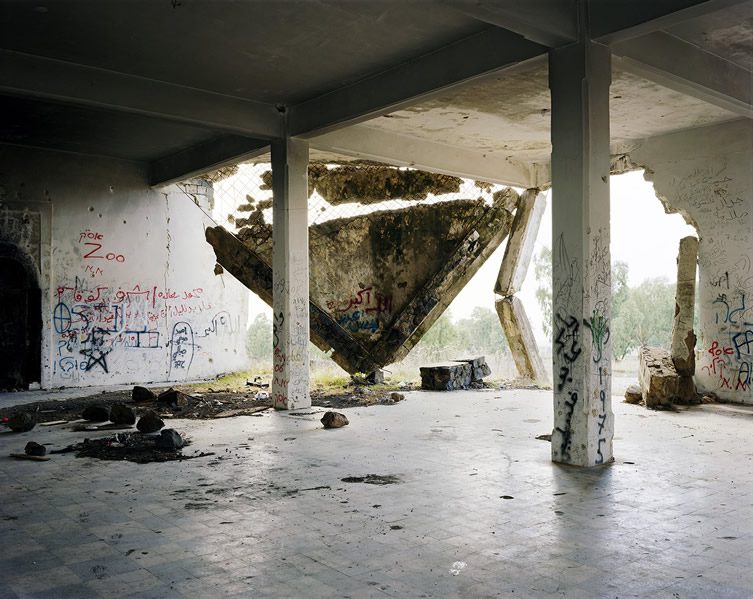
Thomas Struth, Hushniya, Golan Heights, 2011
For my first ever visit to the Folkwang Museum in Essen, I was treated to a small, provocative exhibition of Thomas Struth’s photographs from the past few years. Small because unlike the blockbusters at major museums in the capital cities I usually visit, the Folkwang has curated 34 images in a themed exhibition. And provocative because the images together bring new meanings and perspectives to each individual photograph. Thomas Struth, Nature and Politics which, had I been charged with titling the exhibition, it would be called, Industry and Humanity, presents work that reveals the disastrous results of human constructions that apparently underwrite social and economic progress. Interestingly, this is only revealed across the 34, superbly hung, photographs that comprise the exhibition.
thomas-struth-at-marian-goodman-gallery-designboom-08
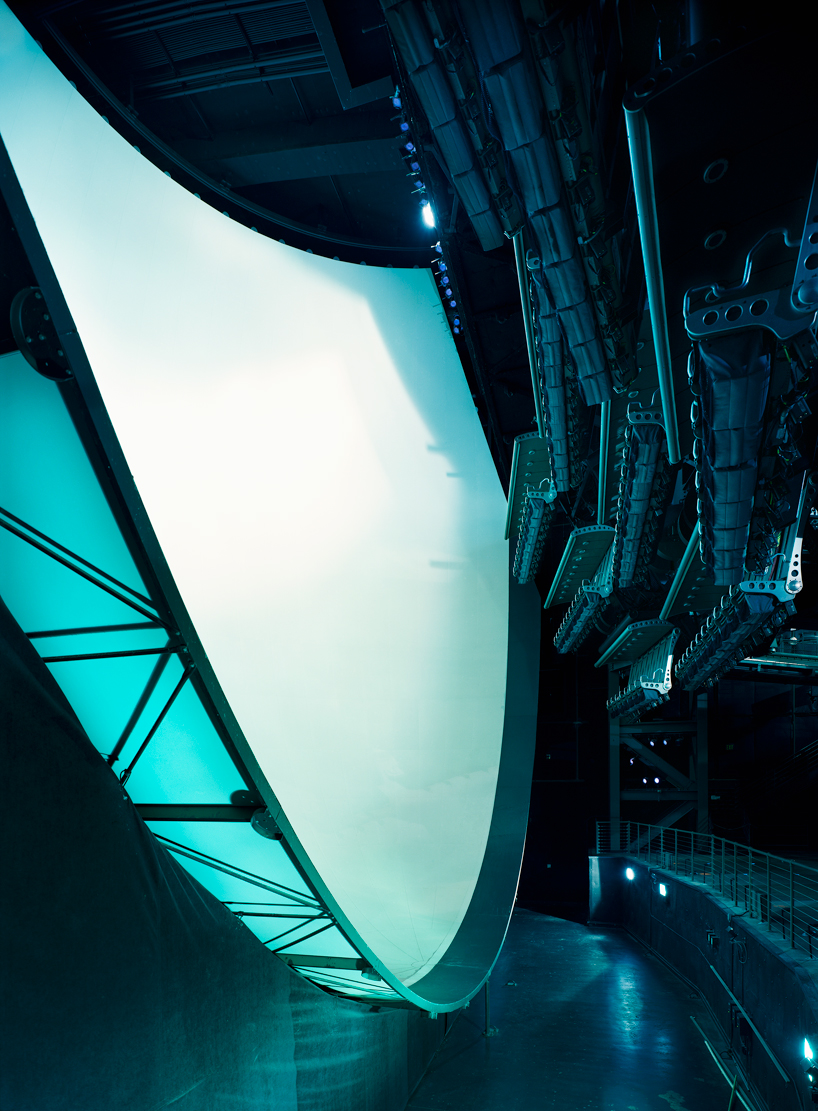
Thomas Struth, Cinema Anaheim, 2013
As I wandered around, I felt myself falling deeper and deeper into human invention and intervention gone wrong. The photographs show, but do not always represent, the dystopia of a man made world, either through violations of nature or the mess of technology. The chaos is communicated through something as simple as the tangled wires of the Tokamak Asdex near Munich. Even though the machine may be functioning perfectly well, the representation would suggest the confused and chaotic state of technology. Even those images in which the represented world is apparently sterile and orderly--take Cinema, Anaheim, 2013, for example—something is not quite right. Standing before such an image for a period of time, we start to wonder what exactly we are looking at. Is that the screen that consumes the image? And are those steel contraptions on the right supposed to function as chairs? This is Disneyland afterall, but there is no entertainment in sight. And then, by the time we reach Curved Wave Tank, The University of Edinburgh, 2010, the green fumes spewing toxicity into a contaminated--though clinical--space, we need no convincing of the destruction of man’s great inventions.   
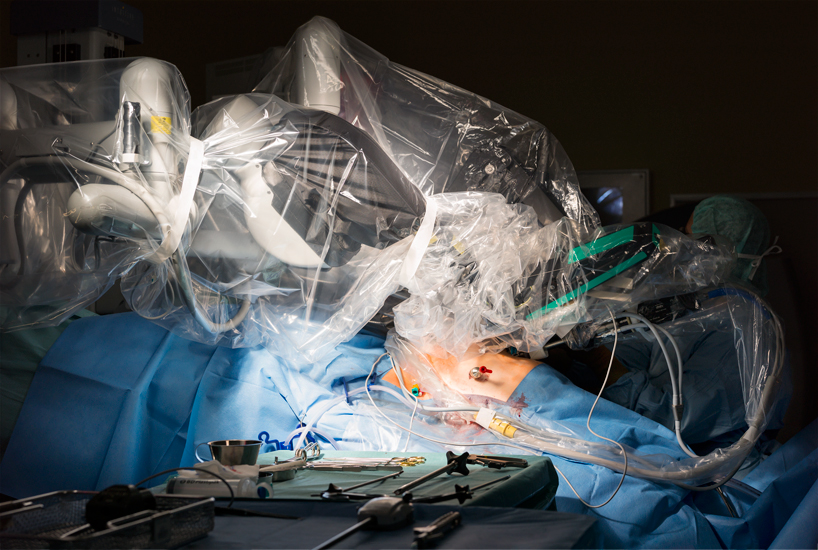
Thomas Struth, Figure, Charité, Berlin 2012
The majority of the photographs give the feeling abandonment. Machines or experiments built and, having outlived their purpose, the people have stood up and walked away. The sense of abandonment and decay of the machines is felt through the absence of humans. Though the presence can be registered through a glove, or an open computer screen, even a vague figure dwarfed by the construction, these are worlds in which humans have lost interest. The museum leaflet refers to the fantasy and desire of industry and manufacturing as it is represented in the images. If I had to identify where fantasy and desire is, I would locate it in this sense of abandonment. That is, the fantasy of creation that ends up as the reality of destruction, unfolds in the narrative that I impose on the photographs, a narrative that isn’t in the image.
Hot Rolling Mill, Thomas Struth
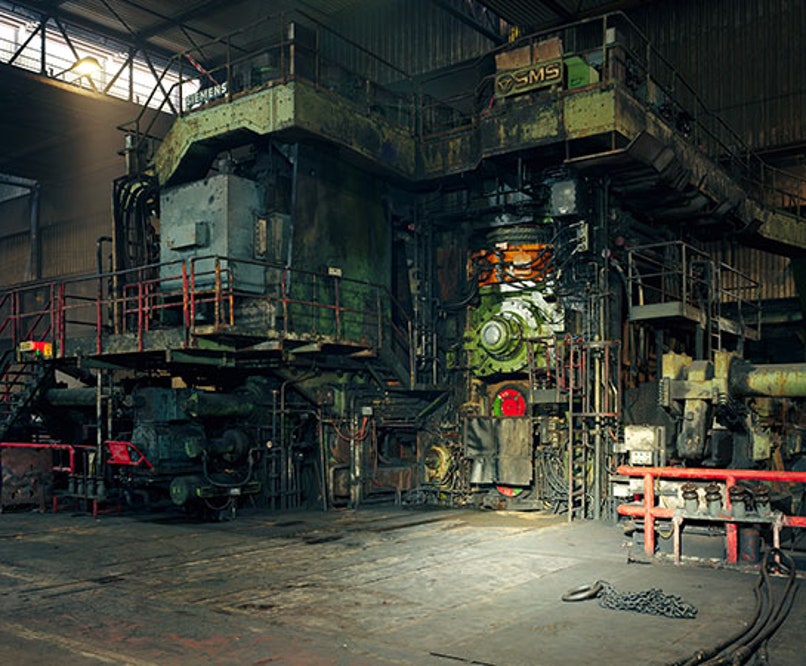
Thomas Struth, Hot Rolling Mill, ThyssenKrupp Steel, Duisburg, 2010

The exhibition also brings together images of locations that we, as general public , have no access to. This, together with the unusual angles, the use of distorting lenses and filters, leads us into places that are strange and unrecognizeable. And when we think we know them, through photographic manipulation, Struth reveals worlds that are everything we imagine them not to be. Hot Rolling Mill, Thyssen Krupp. Steel, Duisburg, 2010 is an example. The machinery in the image shows everything that Thyssen Krupp, the ambassadors for the Ruhr region, claim they are not. Here we see the decay, arcane state of industry, machines rusting over, empty bulwark structures that have the look of being deserted long ago. The slick and shining steel objects produced by this machine that feature in the Thyssen Krupp publicity are nowhere to be found in Struth’s image. When this same photograph was exhibited at the Metropolitan Museum of Art last year, side by side with museum photographs and other interiors, the machine was seen as charming and beautiful. Here in Essen, the same image, juxtaposed with, for example, the inhuman incarceration of the sick at Charité in Berlin, steps into a world gone wrong, a nightmare from which there is no way out. The body technologized by a mass of wires and machines in Charité shows the danger and horror of technology and industry, and there is nothing enchanting about it. Of course, our shock before this image carries over to our perspective of the Thyssen Krupp machinery. And then, around the corner, an image of the Golan Heights shows a roof collapsed, a world falling apart, extends the nightmare to its most obvious conclusion. Even though there is not a trace of technology or industry in Hushniya, Golan Heights, 2011, we know very well how this happened. The frightening narrative of human invention reaches its most terrifying moment in this images that shows none of the inventions.

Saturday, April 23, 2016

Why is everyone so mean to Greece?

View From the Vlatadon Monastery

As I have walked around Thessaloniki this weekend, I kept wondering why is it that the countries with the friendliest, most hospitable people, great weather, great food, and joie de vivre are always victimized by countries that have none of the above to offer? As the Thessaloniki locals showed me smiling faces and every kindness, I couldn't help thinking how unfair it is that their salaries have been cut, their quality of life compromised, and their fiscal problems escalated because of EU policy making. Of course, I know that decisions are politically driven and Greece doesn't have the economic leeway to retaliate, but there's more to a country than the money it makes.
Byzantine Mosaics in Church of Gregorios Palamas

While finances determine the difference between the good and the bad in Europe, if cultural heritage was valued, Greece would be the most respected member of the European Union. As I stood inside the chapel of the Vlatadon Monastery, which includes stones from the place where it is said that Paul preached to the Thessalonians, the monks around me busying themselves for a service, the mosaics sparkling as the late afternoon sun streamed in, I couldn't help thinking of the European Union's blindness. Surrounded by the traces of the beginning of civilisation in the monastery, I was appalled at the treatment of Greece. How could the decision makers not go out of their way to make sure that these treasures for all of human kind are preserved and kept alive for the generations to come?
View from Starbucks
I spent my tourist time in Thessaloniki looking in churches, and mostly marvelling at the mosaics. And when I tired of being dumbfounded at the European Union's punishment of Greece, I was fascinated by the behavior of the people before the icons. People entered the church, walked swiftly around the church, stopping to kiss icons. But not all. They chose specific saints, for reasons which I am not religious enough to know. All of the icons are placed in kissing reach, at head height, quite in contrast to the raised altarpieces and frescoes of the Catholic churches all around Europe. The physical touching of the gold leaf of the icons is not only accepted, but expected. Again, I was thinking all the time of the elaborate constructions put in place in Catholic churches to separate people from the objects of veneration. All of these barriers are indicative, somehow, of the openness and ease of the Greek culture. The people do not stand for hours in adoration of images, distantly looking at the holy, they actually move to touch them. I should add, they don't actually kiss the icons, but rather, make the gesture towards them, always apparently at the hands.
Monastery of Vlatadon

And outside in the streets and on the squares, I noticed the communal use of public spaces. Everywhere I went, there are many and large public benches for people to sit and relax together. Like the churches, public space is used to come freely together, with no roping off, no guards patrolling the grass (I am thinking of the Jardins de Luxembourg here in Paris). Similarly in churches, there were no guards, chairs placed all around, in every nook and cranny, encouraging people to come into the church, be quiet, or not. I sensed a culture of freedom that may be poorer than everywhere else in Europe, but as a tourist for a weekend, it was certainly easier to be there. Irrespective of the economic climate, in Thessaloniki, the locals maintain their embrace of life, their warmth for each other, the importance of being social, their generosity of spirit. Long live Greece.


Thursday, April 14, 2016

Richard Serra, Ramble Drawings @ Gagosian Gallery Paris

Richard Serra, Ramble Drawings, Exhibition Installation @ Gagoian Gallery
This exhibition has been getting five stars around town, which surprises me. I wonder if it’s the Richard Serra factor, or is that critics believe these drawings are at the forefront of contemporary art. Don’t get me wrong, I loved them, but Serra’s drawings are not easy viewing, and their meanings are not immediately obvious. His abstract art requires a large degree of understanding to access.
Richard Serra - Ramble Drawings
Richard Serra, Ramble 4-16, 2015

On a superficial level, on entering Gagosian’s Paris gallery, visitors will be struck by the green that shimmers across the drawings mounted in rows. This optical effect of the lighting gives the impression that lime green powder has been spread over black crayon in some of the drawings. However, their composition in lithocrayon, paintstick and black pastel powder defies all possibility that the green exists. As I wandered around the gallery I then experienced a persistence of vision carried into the frames of those without colour. A wave begins to move from frame to frame. The lighting in the two downstairs galleries is quite different, the main gallery exposed to the light coming through the sky light, while the light in the first gallery is muted by curtains. This, together with the individuality of each image, means that each otherwise black crayon on paper drawing behaves like a unique work of art. Each is a different size, a different texture, a different resonance across the paper, and each reacts differently with its environment. Therefore, the impression, that might actually be an indication, is that each drawing is not rigidly structured, but that chance in the process of production has been key to the final product. These first reactions reminded me of the familiar Serra motivation to have his viewer question the space that she occupies, a questioning that takes place in the challenge to vision and the way that vision constructs space in the gallery. After learning that the green was not in the image, I started to question other aspects of my vision.

Richard Serra, Ramble 4-23, 2015
Given how much of Serra’s art is about the process, I was disappointed that the gallery flyer gave no information on what is one of, if not the, key moment of these drawings. Serra has always been interested in the objectness and self-referentiality of his art works, and the drawings are no different. For Serra, as we know from the steel sculptures, matter is the source and motivation of the works. Each work begins with the hand made paper -- accounting for its individual texture, size and finish. Similarly the fact that each is in black is also key to how the RAMBLE DRAWINGS here presented make meaning. Black is the non-color, the only color that refers to itself. Up close we see that the black crayon brings out the thick texture of the paper, so it becomes an interaction between the two. That I then see a lime green powder, on some, but not all, therefore immediately sparks curiosity.
Richard Serra, Ramble 3-53, 2015

The process as I understand it is one of lithography. Serra presses the crayon between two sheets of paper over a steel plate. The result of the pressed crayon on the sheets will determine which will be thrown away. Serra never knows in advance which sheet will be jettisoned. So this element of randomness in the process underlines the “ramble” in the title of the exhibition. Perhaps. The addition of the powder and further modification is dependent on the image produced. Again, the process could be said to express the aleatory of the title.
Richard Serra’s giant steel work Ramble.
Richard Serra, Ramble, 2014 
All this said, the title of the drawings reminds me that there is nothing random or aleatory about them. Their title surely casts them as relations to the enormous steel sculpture installed in Gagosian’s London gallery a couple of years ago, Ramble. The steel slabs arranged in rows, the size of each one different from the next are, typical of Serra, designed to give the impression of chance and randomness, where in fact they are carefully and consciously placed. With Serra everything is precise and thought out in advance, even if there are strains of not knowing in their performance, their reception by a viewer in motion in space. And so, we must assume that Ramble Drawings are likewise measured and methodical, though of course, it is not for us to find their logic and reason.
Richard Serra, Ramble 4-26, 2015


The drawings are sensuous, emotional, expressive, and even if they are not using a paintbrush, we feel the presence of the body, the artist’s body in their production. The hands that are so important in his early work, become felt in the weight of the crayon, or its absence on the paper in the final product. However, we do well to remember that Ramble Drawings work within an oeuvre that has engaged a set of issues over the past 50 years. Irrespective of their medium, the drawings continue that, very practiced, and constantly changing, Serra discourse on form, matter, space, light and vision.  


All images courtesy of Gagosian Gallery