Showing posts with label Italy. Show all posts

Tuesday, September 1, 2020

Turner. Paintings and Watercolours from the Tate @ Musée Jacquemart-André

J M W Turner, The Lagoon Near Venice, at Sunset, 1840

The Turner exhibition at the Musée Jacquemart-André is a pleasure from beginning to end. People used to visiting the intimate rooms of this museum will welcome the current social distancing measures. Never before have I had the opportunity to be alone, or at worst, with one or two others in the room. It was a treat. 

J M W Turner, Blair Atholl, Looking towards Killiecrankie, 1801-2


From the beginning we see Turner painting the weather, the time of day, the seasons, the elements as they are reflected in the air. We see the wind blowing in paint. In those moments that would make Turner's work so controversial in his time, in the places where he left the canvas bare, we see some of his most emotional moments. The watercolours follow Turner's ongoing preoccupation with light, seeing him working over and over to illuminate the whole painting from a single source. Even from the beginning, it is clear that Turner is not interested in objects or human figures, even narrative. They are diminished, overwhelmed by the weather, the natural environment and, of course, colour as light. Turner never goes so far as to remove the human figures altogether, he can't quite take us to a point where he eschews representation, but in the watercolours and eventually the oil paintings, we can see the beginnings of abstraction in art. In Blair Atholl, vue en direction de Killicranckie, vers 1801-02, for example, streaks of light, clouds blown in the wind, their shadows, the gentle movement of water, animate the paper surface. 
Venice: San Giorgio Maggiore - Early Morning', Joseph Mallord William Turner,  1819 | Tate
J M W Turner, Venice: San Giorgio Maggiore - Early Morning, 1819

Then Turner travels to Venice. Like so many artists throughout history, Venice changes everything for Turner. In Venice he sees the light, humidity and the sultry atmosphere reflected in the lagoon in Venise: San Giorgio Maggiore-tot le matin, 1819. In Venice, thanks to the water, Turner learns about luminosity, transparency and he manages to capture the something essential that he has been looking for. Venice marks the shift to abstraction. In front of the Venice paintings, we realize that the water helps him to discover new depths to the relationship between colour and light. Twenty five years later when he goes back to Venice on his world travels, in a work such as Venise: une vue imaginaire de l'Arsenal  vers 1840, the heat, the lethargy, the heaviness of the Venetian atmosphere is everywhere expressed in the orange and yellow of the sun-scorched buildings and their reflections. The straw-like lines of the boats, Gondalas, moorings and processions, indistinct from their reflections in the blue water of La Piazzetta avec la céremonie du Doge époussant la mer, vers 1835 cry out to the viewer, as if we are there, participating in the festivities. The sounds, colours, the air, wind and sun are more important than any figures we might be able to be identified. 
Turner: Yacht Approaching the Coast | Buy Art on Demand by Tate | Tate
J M W Turner, Yacht Approaching the Coast (1840-45)

In the final room of the exhibition we see some of his finest oil paintings. Most interesting is their continued reach for abstraction. The line between sea and shore has become an idea, something that is no longer clearly defined in the image. In works such as Yacht Approaching the Coast, we see the signature of Turner's late oil on canvas paintings: the pulling of the viewer into the vortex of an agitated sea. If Venice guides Turner to the marriage of painted colour and light, it's the seascape at Margate that ultimately leads him to the near dissolution of form and the blurring of all structuring sight lines in painting. 

Saturday, December 23, 2017

Risiera san Sabba @ Trieste

Outline of the destroyed crematorium at Risiera san Sabba
on the other side of that wall was the kitchen

Today I visited Risiera San Sabba, a former rice husking factory that was taken over by the Nazis and used as a concentration camp in 1943. It is one of the few death camps in Italy, in prime location to put a stop to the resisters and political dissenters from Slovenia and Croatia as well as Italian soldiers and Jews. The haunting turn of the century red-brick building was taken over by the Nazis as a facility for detaining and killing political prisoners—predominantly Italian soldiers and members of the resistance—a transit camp for Jews before they were sent off to Auschwitz, and a store house for confiscated goods. In spite of the fact that it sits in the centre of a residential area, at the time little was known of the operations taking place inside the former factory.
Concrete walls recently built
Steel flooring covers areas where buildings once stood
Perhaps the most chilling aspect of the complex is the outline left on the side of a wall by a crematorium that the Nazis ignited before they evacuated so as to erase all trace of their hideous crimes. I can’t think of another example of attempted erasure in a death camp that speaks as loudly of the presence of crimes committed therein. It is even more frightening to experience the proximity of the extermination facility in the courtyard just meters away from where prisoners were held in detention. A display in the museum established on the other side of the wall that would have abutted the crematorium tells of how the captors turned the music up so loud that the local people didn’t hear the screams of the victims as they were sent to their death. Today, it’s unimaginable that the people in the surrounding town would not have known what was going on inside the former factory. However, in between the testimonies and documents on display there is a strong sense of choosing not to know. The reasons for turning a blind eye were complex and ranged from a form of denial as self-protection and to silent complicity.  
Cells used to hold prisoners
Italy’s own fascist dictatorship in power at the time is hardly mentioned in the museum displays, and it’s a silence that can't be overlooked. There was no doubt in my mind that the politics of Italy must have contributed both to success of the facility and to the fact that it took over 30 years before the process of reparation for the crimes was begun. And then, even in 1976 when the trials were staged, the results were highly unsatisfactory with the precise number of deaths never acknowledged, and only one person apparent guilty of thousands of deaths. This was thanks to the fact that the perpetrators were German being judged in Italy and the messiness of the legislation in the region that was the jurisdiction of the Reich in 1943-45.


On a cold and dark late afternoon in winter, as I wandered through the cells, a building without air and light where up six prisoners were packed into a space 1.20m long and 2m high with only a couple of wooden planks for beds, it was like stepping into 1940s. In the bitterly cold space—in every sense of the word—I felt surrounded by the insanity of Nazi’s thinking and the brutality of their actions. A single rose attached to one of the wooden pylons expressed the sadness of what words can’t articulate. In an ante-room for the crematorium, known as the death room, were bodies were dumped before being incinerated the texture of the walls and the stones underfoot have been left as they were found. The rough cold to the touch surfaces give way to profound memory of the crimes they have witnessed. At various points along the walls, small displays of possessions such as glasses with broken frames, a silver fob watch with no face, a comb with most of its teeth missing, identity papers of the dead, were heartbreaking.

Commemoration sculpture by Marcello Mascherini, 1958
Visiting concentration and extermination camps is never an enjoyable experience, but there are a number reasons why Risiera San Sabba is imperative viewing. First, it has a complicated history that is woven into the political and social complexity of the Trieste region, including the fact that it was not under Italian rule at the time. As a result, the identification of perpetrators and justice for the past has taken over sixty years to unfold. This comes as both testimony and warning to the fact that violence and ethnic cleansing are never self-contained events. Rather, they tear apart the social fabric of more than one country for generations. Second, the ills of industrialization are writ large on these walls where the history of the facility converted from one kind of factory (industrial killing) to another (rice husking) is made visible. And lastly, the emptiness and absence of the past is made unusually present through the visitor's experience at this haunting site of destruction.

Friday, February 17, 2017

Michelangelo's Moses, Basilica San Pietro in Vincoli

Michelangelo's Moses
As I wandered around the San Pietro in Vincoli, one of the few churches built by Michelangelo’s benefactor, Pope Julius II, I wondered what the great Renaissance artist would have thought of the current leaders of the free world. Julius was, afterall, a man to inspire fear and rage in all in his midst. And Julius was obsessed with his own self-importance, making most decisions based on the benefits to his ego. A pope who took more than his name from Julius Ceasar could not have been an easy man to work for. But Julius was also a benefactor of the arts. Whether his investments were motivated by an appreciation of culture or an assuredness in the longevity of his own legacy, it seems of little importance today. Irrespective of wrath, his unethical behavior, financial greed and megalomania, at least Julius gave us some extraordinary works of art.

Julius II

For me, Michelangelo’s Moses who sits at the centre of a very reduced version of what was to be Julius’ tomb in the Basilica San Pietro in Vincoli, is one of the great wonders of the western world. Like most great artistic treasures on display in Rome, Moses sits safely behind barriers, in the artificial illumination produced by a tourist euro in the meter. At the end of the day, when the tourists are gone home, and the light comes through the window above and behind him, Moses takes on a steely grey clarity, that has his skin sing in the late afternoon sun for which he was made. Julius lies above him, propped up on an elbow. Even though his figure is somewhat contemplative, it’s as though he had a sudden thought and raised himself up from the dead to deliver one final order. Of course, Michelangelo found him inside the marble alive. As was the custom, in death the pope is given eternal life and salvation on his tomb.
A reproduction of
Domenico Zampieri's The Liberation of St Peter, 
which was destroyed in 1944
However we interpret the image of Julius, it’s Moses beneath him that captures every aspect of our beings. Moses is perfect. Many before me have said this, but it’s true. Standing before him it’s impossible not to be seduced by his beard, the extraordinary detail and clarity of his robes, his arms, and the veins on his arms. This is no ordinary sculpture. Made with the same sweeping beauty as the prophets on the Sistine ceiling, the power of David and the tenderness of the Madonna in the Basilica San Pietro, Moses is heavenly and sensual in the same breath. I know everyone says this, but being with Moses in the flesh, it was as though I was the first to wonder that this perfect being could have emerged from a single rough piece of marble.
Angel of Death
Others have claimed that Moses is a self-portrait, the great artist imbued with heavenly perfection in marble. This claim has been dismissed as often as it is asserted. However, it’s true that Michelangelo’s famous figures always reflect the age that he was when he made them. Certainly, Moses could easily be around 40 years, Michelangelo’s age when he came back to Rome to finish the tomb. Given his own self-aggrandizement, and the placement of Moses emanating and reflecting the light of God in the centre of Julius II’s tomb, Michelangelo wouldn’t appear to acquiesce to the Pope’s rule. That is, if we read these details of the tomb as saying anything about the relationship between the ruler and the ruled. And so, while Julius might be protesting his placement on the tier above in relatively diminished form, Michelangelo’s creation lives on as a force in the imagination long after the one who had authority over the land.

Sunday, May 25, 2014

Bernini alla Villa Borghese

File:The Rape of Proserpina 2 - Bernini - 1622 - Galleria Borghese, Rome.jpg
Gian Lorenzo Bernini, The Rape of Prosperina, 1621-22
Two hours is all we get to before the bells ring and the guards usher us out of the collection of Cardinal Scipione Borghese and family. And two hours is not long enough. Infact, it was frustratingly short. With important Caravaggios, Titians, a Raphael, Piero della Francescas, a Correggio, and the list goes on, two hours was just a beginning. And so, I spent my two hours with the three of the four Bernini sculptures that he made on commission from the Cardinal.


File:Rape of Proserpina - Gian Lorenzo Bernini.jpg
Gian Lorenzo Bernini, The Rape of Prosperina, 1621-22
detail
I don’t know a lot about Renaissance/early Baroque sculpture, but I do know that David, 1623-24, Apollo and Daphne, 1622-25, and The Rape of Prosperina, 1621-22, are masterpieces. The first of the three that I saw, The Rape of Prosperina by Pluto was devastating. I approached it from the left, and as Pluto’s triumph is screamed from his laughing mouth, my body went cold. As Prosperina pushes him away with one hand, the other in the air, a tear running down her face, I felt her terror. His celebration of the enormity of his conquest made me want to kill him. The clutch of his hand on her thigh, pressed into her flesh, must be the most exquisite moment in the history of marble sculpture. It is so sensuous, so erotic, so lifelike. And then as I walked around the sculpture, from the right, I saw Prosperina pushing him away, his laughter becoming a grimace, and I was relieved to see that she was the throes of escaping his grasp. And then I moved still further, to be confronted by the angry barking of the three-headed dog, and the two human figures were caught in the struggle with the fabric of Prosperina’s dress. Bernini thus creates a series of narrative scenes in the single marble group.

Rapeofproserpinadetail.JPG
Gian Lorenzo Bernini, The Rape of Prosperina, 1621-22
detail
 However, it wasn’t the complex narrative as much as the intense emotions caught in the press of Pluto’s hand on Prosperina’s thigh or the creasing of the skin on his face by her hand, the absolute energy and motion of stone figures, that carries the power of the group. Apparently critics in the nineteenth century were harshly critical of his lack of personality, her bad outline, but I don’t care about these details. What moved me, what I took away and hope to see again one day, was the delicate tear falling down Prosperina’s face.

Image
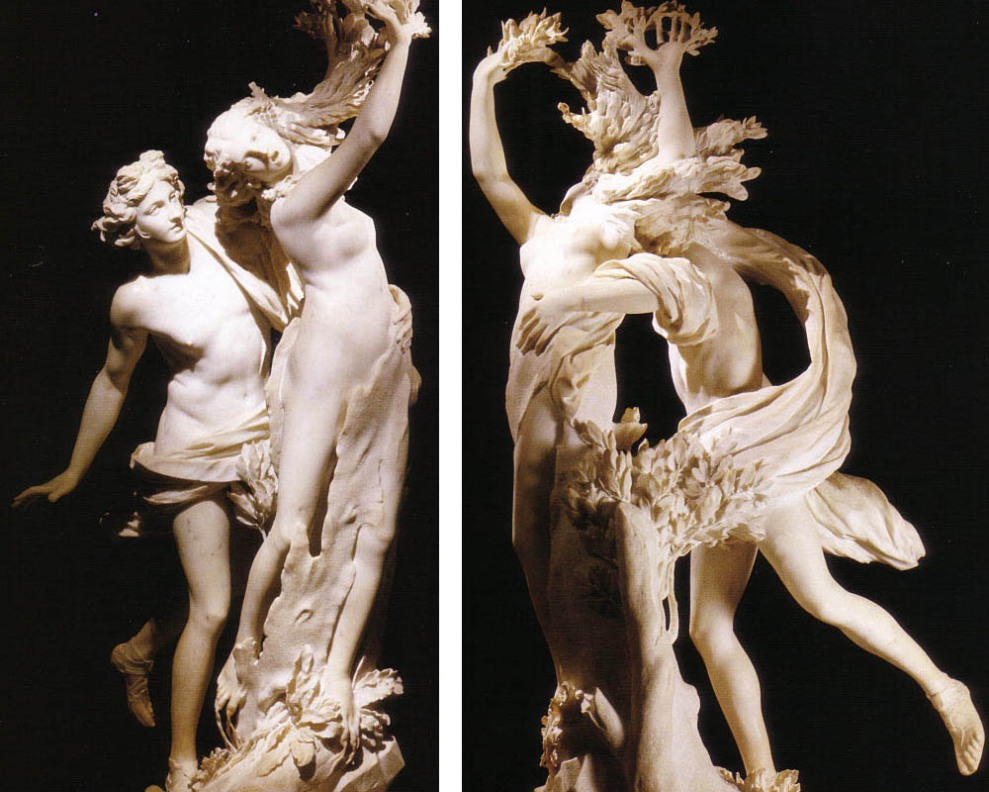
Gian Lorenzo Bernini, Apollo and Daphne, 1622-25
Having completed The Rape of Prosperina at age 23, the Cardinal then commissioned Bernini to sculpt the story of Apollo and Daphne. Perhaps the most beautiful thing I saw in my four days in Rome was the billowing fabric caught in the wind and the rush of Daphne’s escape as she turns into a tree. The fabric, her hair becoming leaves, magically articulates their speed, the passion she needs to escape, the urgency of her motion, the desperation of his pursuit. And the wind filled fabric becomes even more sensuous, more beautiful when we remember that the process of marble sculpting: the young Bernini found these figures hidden in his block of marble. This was his discovery, figures that have the energy to break free of the marble in which they are trapped. Bernini is the hero because he was the conduit, the facilitator of their escape – he found them in the stone and set them free.
Gian Lorenzo Bernini, David, 1623-24
Over one hundred years after Michelangelo’s David, 1504, Bernini gives him a face filled with expression, determination, and once again, a body in the throes of energetic movement. Like the other commissions, David broke new ground because he was in motion, fully energized in the middle of combat. What is so unusual is that David is immersed in his task to slay the giant, but there is no giant in the sculpture.  It is movement that makes these figures so magical. They are three dimensional, moving not only through space and narrative situations, but also through a spectrum of emotions and possibilities. Moreover, their motion not only becomes possible, but also heighted by the presence of a spectator in motion, around the groupings. This incitation to a moving spectator would likewise set new standards and expectations for sculpture in the Baroque period to follow.


Saturday, May 24, 2014

Il Vaticano - di Nuova


Raphael, Stanza della Segnatura, 1509
This morning I went back to the Vatican. Until last year I had tried to see the Vatican museums and the Sistine Chapel for 24 years, and now, the visit has become an annual event. At least, I hope this is the case.  It’s so overwhelming, the paintings so profound and so plentiful, that I find it difficult to describe the experience of walking through the apartments and into the Sistine Chapel. If I can go back once a year, by the end of my life, I might be able to articulate how intoxicating it is to be in the presence of the greatest works of High Renaissance Italian art.
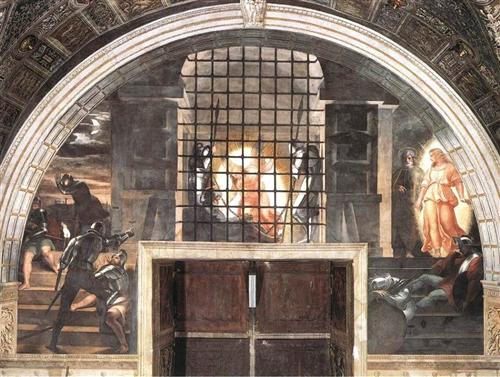
The Liberation of St. Peter, in the Stanza D'Eliodoro - Raphael
Raphael, Stanza dell'Eliodor, 1512-14
This year I went with students and among other colleagues, Tom Henry, who as the Raphael scholar has clearly spent many hours in the Vatican over the years, even going into those papal apartments still in use today. Because of course, Raphael frescoed the walls that house the pope today, including his bedroom. What I loved about listening to Tom as we wandered through this colourful, magical world was his passion for the texturesof life that surrounded Raphael as he worked. It wasn’t just the paintings, but the historical context of their creation that were brought alive, as we wandered through the most hallowed of halls. In this world painting meant something so different to how we know it today, at least, these paintings did. Tom talked of how Raphael was given free reign by Pope Julius II in the Vatican Stanza - Segnatura in 1508-1511, Heliodorus in 1511-1514, Fire in the Borgo in 1514-1517, and Constantine in 1517-1524.The first task for Raphael was to clean the slate: he destroyed all existing frescoes. Raphael was redecorating the apartments, so to speak.
Michelangelo, Sistine Chapel Ceiling, 1508-12
At the same time that Raphael was working in the Segnatura, Michelangelo was down the corridor, on his scaffold, painting the chapel ceiling. Apparently, when the impatient Pope wanted to see the ceiling even though it was only half completed, aware of the radicality of his creation, Michelangelo anticipated reprimand and punishment so he stole away from Rome and all his obligations on a horse in the middle of the night, seeking comfort and refuge, at home in Florence. It reminded me of the struggle over who would own Raphael’s Transfiguration (1516-20), the heavenly wooden panels down the hall in the Pinacoteca. Commissioned by Cardinal Giulio de Medici for the cathedral of Narbonne, the altarpiece never left Rome. That is, until Napoleon set the troops out to claim what was rightfully his, no doubt in the middle of the night. And predictably when he died, the Pope wanted it back again — and didn’t much care for the intricacies of ownership law.

Raphael, The Transfiguration, 1516-20
detail
Another difference is the different status of painting in the Renaissance. Tapestry as a medium was more treasured. They cost more to make, and so Raphael was first and foremost a master because he made tapestries. Paintings were more transitory – afterall, as frescoes they were no more than interior decorations in the rich man’s apartments. Five hundred years ago, painting didn’t carry with it the weight of a price that made it impossible to transport, or the call for encasement in bulletproof, alarmed boxes, constraining it to a lifetime on a pedestal from which it would never escape. Art was an everyday object – if it had to be moved, a messenger, probably a young boy would pick it up and put it under his arm, running it across town. And knowing the Italians as I do, I can’t imagine that he wouldn’t stop for a drink on the way, leaning the painting up against the bar while he drank.

In the Renaissance, art and artists played such a different role in the cultural life of a city and nation. All the sneaking around in the middle of the night, greedy popes and emperors making no excuses for their methods of “appropriation,” all of it seems a long way from the endless paperwork and documentation involved in the exchange of paintings today, paintings that nevertheless pale in comparison to the masterpieces of the 15th and 16th centuries. And similarly, while Michelangelo feared for his safety, painters today think they should be applauded for their most minimal creativity. Though the Renaissance was a time when art was all about those who paid the money to have it made, and had little to do with the artist as entrepreneur, unlike Michelangelo, Raphael was the greatest entrepreneur. Raphael destroyed ceilings, he disobeyed orders, he was the Damien Hirst of the 16th century. And so, even though he didn’t much care for legalities, the cultural capital of his art and the reverence for the artist was perhaps as great, if in a different way, as it is today.

Raphael, School of Athens, 1509
detail
Raphael and Michelangelo may have hated each other, in their fierce competition to be the shining light of the papal dynasty, but whatever their ruses and manipulations, their strategies to get noticed, they had talent. As I stood once again under the most famous ceiling in the world, awestruck at the movement, energy, the sheer technique that enabled this enormous commission to be painted up close, over a period of 6 years, mesmerized by the creative ability that produced this extraordinary work of art, by a man who claimed he was a sculptor, I tried to conceive of how exciting and simultaneously disturbing it must have been on its very first unveiling.
Raphael,School of Athens, 1509
Said to be the brooding Michelangelo with his boots
Both Michelangelo and Raphael completely upstaged every other painter in their midst. Until this point ceilings were stars on a blue background, the walls of a library depicted a standing group portrait of a few learned men. And along came these two geniuses. Not only did they shatter all convention of the ceiling and the library wall respectively, but they completely redefined painting in their time and ever after. Raphael loved women, the good life, excess and attention. Michelangelo was inward-looking, brooding and reclusive, with bad bodily hygiene. And yet the two of them were geniuses that changed everything, forever, when it comes to representation. They belong together.


Raphael, The Transfiguration, 1516-20
As we walked away from the Narbonne altarpiece, The Transfiguration, I felt my heart pull. With some sadness, I felt the separation. I turned around and asked Tom: “did you feel that”? “That” being the sense of loss, the leaving behind a feeling of plenitude, the knowledge and experience of perfection as we turned away from this most beautiful of art works, a beauty that can only be captured by believing that something holy was living inside it. And Tom responded: “mmm, when will I see it again?” It was no different from farewelling a lover.