Showing posts with label Tapestry. Show all posts

Saturday, May 24, 2014

Il Vaticano - di Nuova


Raphael, Stanza della Segnatura, 1509
This morning I went back to the Vatican. Until last year I had tried to see the Vatican museums and the Sistine Chapel for 24 years, and now, the visit has become an annual event. At least, I hope this is the case.  It’s so overwhelming, the paintings so profound and so plentiful, that I find it difficult to describe the experience of walking through the apartments and into the Sistine Chapel. If I can go back once a year, by the end of my life, I might be able to articulate how intoxicating it is to be in the presence of the greatest works of High Renaissance Italian art.
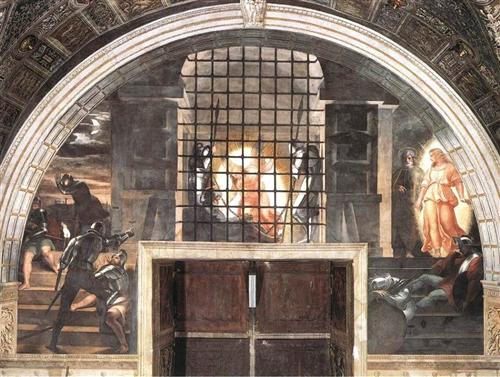
The Liberation of St. Peter, in the Stanza D'Eliodoro - Raphael
Raphael, Stanza dell'Eliodor, 1512-14
This year I went with students and among other colleagues, Tom Henry, who as the Raphael scholar has clearly spent many hours in the Vatican over the years, even going into those papal apartments still in use today. Because of course, Raphael frescoed the walls that house the pope today, including his bedroom. What I loved about listening to Tom as we wandered through this colourful, magical world was his passion for the texturesof life that surrounded Raphael as he worked. It wasn’t just the paintings, but the historical context of their creation that were brought alive, as we wandered through the most hallowed of halls. In this world painting meant something so different to how we know it today, at least, these paintings did. Tom talked of how Raphael was given free reign by Pope Julius II in the Vatican Stanza - Segnatura in 1508-1511, Heliodorus in 1511-1514, Fire in the Borgo in 1514-1517, and Constantine in 1517-1524.The first task for Raphael was to clean the slate: he destroyed all existing frescoes. Raphael was redecorating the apartments, so to speak.
Michelangelo, Sistine Chapel Ceiling, 1508-12
At the same time that Raphael was working in the Segnatura, Michelangelo was down the corridor, on his scaffold, painting the chapel ceiling. Apparently, when the impatient Pope wanted to see the ceiling even though it was only half completed, aware of the radicality of his creation, Michelangelo anticipated reprimand and punishment so he stole away from Rome and all his obligations on a horse in the middle of the night, seeking comfort and refuge, at home in Florence. It reminded me of the struggle over who would own Raphael’s Transfiguration (1516-20), the heavenly wooden panels down the hall in the Pinacoteca. Commissioned by Cardinal Giulio de Medici for the cathedral of Narbonne, the altarpiece never left Rome. That is, until Napoleon set the troops out to claim what was rightfully his, no doubt in the middle of the night. And predictably when he died, the Pope wanted it back again — and didn’t much care for the intricacies of ownership law.

Raphael, The Transfiguration, 1516-20
detail
Another difference is the different status of painting in the Renaissance. Tapestry as a medium was more treasured. They cost more to make, and so Raphael was first and foremost a master because he made tapestries. Paintings were more transitory – afterall, as frescoes they were no more than interior decorations in the rich man’s apartments. Five hundred years ago, painting didn’t carry with it the weight of a price that made it impossible to transport, or the call for encasement in bulletproof, alarmed boxes, constraining it to a lifetime on a pedestal from which it would never escape. Art was an everyday object – if it had to be moved, a messenger, probably a young boy would pick it up and put it under his arm, running it across town. And knowing the Italians as I do, I can’t imagine that he wouldn’t stop for a drink on the way, leaning the painting up against the bar while he drank.

In the Renaissance, art and artists played such a different role in the cultural life of a city and nation. All the sneaking around in the middle of the night, greedy popes and emperors making no excuses for their methods of “appropriation,” all of it seems a long way from the endless paperwork and documentation involved in the exchange of paintings today, paintings that nevertheless pale in comparison to the masterpieces of the 15th and 16th centuries. And similarly, while Michelangelo feared for his safety, painters today think they should be applauded for their most minimal creativity. Though the Renaissance was a time when art was all about those who paid the money to have it made, and had little to do with the artist as entrepreneur, unlike Michelangelo, Raphael was the greatest entrepreneur. Raphael destroyed ceilings, he disobeyed orders, he was the Damien Hirst of the 16th century. And so, even though he didn’t much care for legalities, the cultural capital of his art and the reverence for the artist was perhaps as great, if in a different way, as it is today.

Raphael, School of Athens, 1509
detail
Raphael and Michelangelo may have hated each other, in their fierce competition to be the shining light of the papal dynasty, but whatever their ruses and manipulations, their strategies to get noticed, they had talent. As I stood once again under the most famous ceiling in the world, awestruck at the movement, energy, the sheer technique that enabled this enormous commission to be painted up close, over a period of 6 years, mesmerized by the creative ability that produced this extraordinary work of art, by a man who claimed he was a sculptor, I tried to conceive of how exciting and simultaneously disturbing it must have been on its very first unveiling.
Raphael,School of Athens, 1509
Said to be the brooding Michelangelo with his boots
Both Michelangelo and Raphael completely upstaged every other painter in their midst. Until this point ceilings were stars on a blue background, the walls of a library depicted a standing group portrait of a few learned men. And along came these two geniuses. Not only did they shatter all convention of the ceiling and the library wall respectively, but they completely redefined painting in their time and ever after. Raphael loved women, the good life, excess and attention. Michelangelo was inward-looking, brooding and reclusive, with bad bodily hygiene. And yet the two of them were geniuses that changed everything, forever, when it comes to representation. They belong together.


Raphael, The Transfiguration, 1516-20
As we walked away from the Narbonne altarpiece, The Transfiguration, I felt my heart pull. With some sadness, I felt the separation. I turned around and asked Tom: “did you feel that”? “That” being the sense of loss, the leaving behind a feeling of plenitude, the knowledge and experience of perfection as we turned away from this most beautiful of art works, a beauty that can only be captured by believing that something holy was living inside it. And Tom responded: “mmm, when will I see it again?” It was no different from farewelling a lover. 

Thursday, July 18, 2013

Gerhard Richter, Tapestries, Gagosian Gallery, Davies Street London

Gerhard Richter, Abdu, 2009

I nearly didn’t go to see the latest Richter exhibition at Gagosian while I was in London last weekend. I had limited time and there were a number of exhibitions of artists whose work I don’t know or haven’t seen for a long time. Surely, I thought, Richter can’t be doing anything I haven’t seen before. Standing in the light drenched store front gallery on Davies Street, I saw that he had proved me wrong yet again.
Gerhard Richter, Iblan, 2009
If great painting breaks all the rules, social rules, cultural rules, the rules of art and life, then Richter is still a great painter. In the four tapestries — yes, he’s making tapestries — AbduIblanMusa, and Yusuf (all 2009), Richter brings together painting and weaving, paint and wool, modern art and traditional crafts, the East and the West. I have recently been thinking about what makes Richter’s work political, how it resonates and affects the world outside the frame, how it brings that world into the frame and critiques the world simply through translating it into painting. For an artist whose work is always ambiguous, always slipping just out of our grasp, it’s difficult to reconcile the ephemerality and perpetual motion with the seeming intransigence of reified politics.
Gerhard Richter, Yusuf, 2009
The titles of these four tapestries alone convince of their political relevance, and apparent urgency: AbduIblanMusa, and Yusuf are common Arab names. There’s no need to explain why tapestries titled with Arab names would be a radical gesture by a German artist in 2009. To be sure, Richter is breaking the rules: he gives each work a name, an identity, an individuality. He gives each tapestry an Arab name, an Arab identity. The four enormous tapestries do more than provoke with their titles. In a typical Richter strategy, they bring the past and present together on one surface: the ancient Arab art of carpet weaving is brought together with the technological sophistication of the modern world.
Gerhard Richter, Abstract Painting, CR 724-4, 1990
The process of production is difficult to grasp: again in a familiar Richter strategy, he begins with one of his own paintings, Abstract Painting, 1990, CR 724-4, the same painting that is the springboard to his strip paintings from 2011. Rather than dividing the painting vertically, first in two, then again up to four thousand and ninety six times, he digitally transferred a quarter of the painting to the memory of a mechanical Jacquard loom. That is to say, I assume the transfer is done digitally,  though we will have to wait for the catalogue to appear to have this confirmed. The loom then weaves the digitally transferred painting fragment and produces a Rorschach-like pattern that iterates the original Abstract Painting. How did he even imagine this, I wonder? In usual Richter style, everything about the work is controlled, perfect, and yet, it is a perfection that is imbued with aleatory and unforeseen possibilities.
Gerhard Ricther, Musa, 2009

In the same way that the paintings made with a squeegee will throw up unanticipated colours thanks to the process of application by the doctor knife, so the woven tapestries in this digitally determined process produce colours that surprise. The stretching and pulling of greys, whites, cobalt blue, yellow and red creates mirages, mirrors, and ricochets emanating from the central core. The visual effects, together with the colours are beautiful, the colours of the Mediterranean in one, of ancient Persian carpets, or tribal art and Richter’s own mirror images in others. And all at the same time, Richter is engaging with his favorite concerns of repetition, of translation between media – how one medium can tell us everything we need to know about another.

I sometimes wonder if Gerhard Richter will ever run out of ideas – I guess if he can still reinvent painting at 81 years old, decades after it was pronounced dead and gone, the answer is probably, not in this lifetime. For Richter, painting is an endless, unfathomable and ineffable reality, even as it is realized in woollen tapestries.


Copyright of all Images. Gerhard Richter