Showing posts with label Paris. Show all posts

Sunday, September 4, 2022

Boilly: Chroniques Parisiennes @ Musée Cognacq-Jay

https://www.connaissancedesarts.com/wp-content/thumbnails/uploads/2022/02/cda22_diapo_boilly__0004_calque-2-tt-width-1200-height-675-fill-1-crop-0-bgcolor-333333.jpg
Etude avec cinq autoportraits de l'artiste, vers 1823-1827

Louis-Léopold Boilly was a revolutionary artist, in all senses of the word. His oeuvre sits between two revolutions—those of 1789 and 1848—and so it's not surprising that he often depicts the people of the streets. Unlike painters and portraitists of his and previous generations in France, Boilly had a suspicious view of the bourgeoisie, the police, the army. His real subject matter was everyday life. Moreover, it was everyday life on the streets of the city. 

Most exciting about Boilly's painting was his thirst for new technologies and what they could bring to painting. I knew enough about his work from the pieces in the Louvre to know that he was pushing at the boundaries between painting and theatre, but what is revealed in full scale over and over again in this current exhibition at the Musée Cognacq-Jay is the way that Boilly looked forward to the cinematic image.

Fichier:Louis Léopold Boilly - La prison des Madelonnettes, rue des  Fontaines - P1310 - Musée Carnavalet (cropped).jpg — Wikipédia
La prison des Madelonnettes, rue des Fontaines, 1815-1819

In painting after painting, Boilly plays with what will become the defining characterstic of the cinema two hundred years later. His figures look from different perspectives, in motion, in scenes that give the illusion of motion. In Le prison des Madelonnettes, rue des Fontaines, for example, he juxtaposes light and shadow in the two halves of the painting and each is filled with people and their pursuit of morally good and bad activities respectively. Looking at this work, we also get a sense of a developing narrative unfolding across the width of a painting, statues being brought to life, in two halves that are like scenes whose relationship is only established in the image itself. 

Jean qui rit et Jean qui pleure, vers 1808-1810

Visitors to the exhibition will also notice that Boilly was fascinated with illusion, with effect, with expression as a way to attract a response. There are doublings and mirrorings everywhere in his work. His figures have exquisitely painted faces filled with emotions and expressions, the fabrics of their clothes are so textured that we want to touch them. But the bodies are often distorted, misshapen, slightly out of proportion. It is as if they are being seen through a distorting lens. And then in the final room of the exhibition, there is the object that the whole thing has been moving towards: a camera obscura and a selection of early optical toys—a zograscope, telescope, a pantographe. These are the instruments Boilly used to see the world differently, through new optics, that he then translated into painting. It's easy to imagine that had Boilly lived one hundred years later, he might have turned to the cinema for his artistic expression.
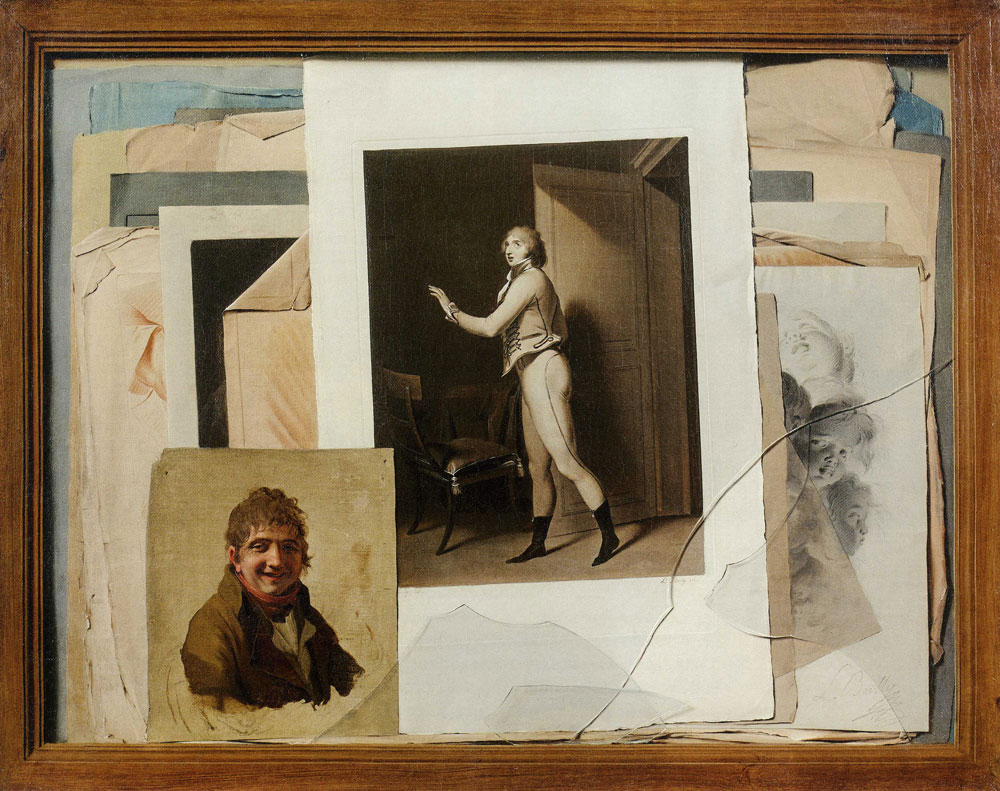
Louis-Léopold Boilly - Trompe l'oeil of a Collection of Drawings, with  Portraits of Boilly and
Un Trompe l'oeil, detail, vers 1800

Perhaps the reason that Boilly is not as well known today is his diversity and range. He moved from portraits to genre paintings, to city scapes, trompe l'oeil, caricatures and still life. Boilly never sat still long enough to develop a reputation for anything. Similarly, he painted the kinds of people that the salons had no interest in: prostitutes, criminals, poor artists such as himself, those mixed up in the hustle and bustle of the train station. In this, his voracious appetite for experimentation and innovation made him so far ahead of his time that no one would have known what to do with him. 

Humour, trompe-l'œil, libertinage... Cinq raisons de découvrir la peinture  de Boilly au XVIIIe siècle, au musée Cognacq-Jay - Panomou
La Marche Incroyable, vers 1797

Ultimately, this lovely exhibition shows Boilly to be a man of his age, but as such, he is a man ahead of his time. Boilly was inspired by streets taken over by masses of people, by train stations and street dwellers. And he was interested in depicting his modern world through the instruments of his time. He blurred the boundaries between mediums where painting and photography (hence the grey of his works) and sculpture are brought to life. His depictions of theatre in the streets, together with multi-perspectival pictures that preface the cinema made him a man reaching for modernity on the streets of Paris, even before it had fully arrived. 

Wednesday, September 23, 2020

Alberto Giacometti, L'Homme qui Marche, Fondation Giacometti @ 5, Rue Victor Schoelcher


Alberto Giacometti in his studio

With very few exhibitions in the summer months, as I often do in August, I visited a permanent collection that I didn't previously know. The Fondation Giacometti opened in 2018, following the transposition of Giacometti's studio to a newly renovated building, two down from Simone de Beauvoir's residence on the periphery of the Cimitère de Montparnasse. 


The small space is beautifully laid out with Giacometti's tiny reconstructed studio - including the walls themselves - just inside the door on the ground floor. Visitors to the 2009 exhibition at the Pompidou Center will recognize the grafittied walls and messy space. The studio is interesting not just for what it shows us about Giacometti and his way of working, but also for its peek into postwar Paris. The tiny, windowless studio reminds us of a time when Paris was populated by people of all different classes, not as it is today, overrun with the urban well-to-do. Giacometti worked in a 20 square meter space with no running water, electricity, or other creature comforts. It was at a time when artists and writers sat in restaurants, brasseries, cafes with friends. For Giacometti, these included 
his brother Diego, philosophers such as Sartre, and of course, all the girlfriends. There is so little space in the studio that Alberto would have done little other than sculpt, paint, draw and think. Even though there was a bed in the corner, the rickety old frame with a thin mattress could not have been conducive to long, restful sleep.

As I have written elsewhere, this is a body of work that is all about being trapped - by the body, by the Giacometti cage, the stages on which the figures are standing, sitting, the frames of the paintings. This sense of being enclosed and incarcerated is encapsulated by the minimal space of the studio, leaving cramped and cluttered working spaces. Looking at the studio and accompanying photos, it's easy to imagine how difficult it was to pass between the stool and the table as both were permanently covered with tools, plaster remnants, bits of wire and other treasures. Just like the figures who are are stuck to their plinths, going nowhere, Giacometti must have been wedged in place as he created.

Alberto Giacometti, Interior, 1954-57

And yet, as we reflect on the art, and particularly, the drawings on the upper floor, we see the dynamism and motion that continues to propel the artist's mind and his art. The sketches reveal a man who was always thinking, drawing, doodling, going over and over again, scraping away, erasing through adding another layer. In addition, the unfinished-ness of so many of the works, Giacometti's inability to let the works go off into a life of their own, contributes to the image of an artist whose mind was in constant motion. 

Alberto Giacometti, Walking Man I, Walking Man II, Walking Man III
Installation View

I have always been awed by Giacometti's work because it is so wildly different from what everyone else was doing around him in his postwar moment. Giacometti was engaged in a process of taking away, always removing, whittling the body down to its most fundamental shape, emphasized by the curvature of the spine, the form of the figure, no flesh, just form. In a realization of the very opposite, I saw at the Fondation how committed he was to Egyptian and Greek sculptural form. For example, in the three Walking Man sculptures, we see the ultimate expressions and explorations of form as they move from erect to bending forward at the hips. Yes, seeing the three in a series, we appreciate the bronze figure propelled into walking motion, but most radically, the figures represent a striding away from the principles of classical sculptural form into a walking figure of experimentation whose body is less than perfect, unsure of itself, unfinished, and yet, still stuck on its plinth,

Wednesday, February 17, 2016

Matérialité de l'Invisibilité: L'archéologie des sens

104, Paris 75019
The title of this exhibition, Matérialité de l’Invisible is somewhat misleading. At least, I found it difficult to determine the relevance of invisibility to many of the works. In addition, the premise of the exhibition is not always clear. It brings together artists working in the NEARCH project, a European Commission supported project that explores the relationship between archaeology and heritage in Europe. But again, the works relate to this theme to differing degrees. The coherence of the exhibition aside, there were a number of very interesting pieces which, together with the creative and energetic space of the Cent Quartre Centre, made my rainy Sunday. An interesting piece by Julie Ramage, titled A Beautiful Town, that deals with the self-identity of St Denis, happens to coincide with the November 13 attacks. Another by Ronny Trocker doesn't have much to do either with the theme of invisibility or archaeology, but was compelling. On entering his Estate, we are met by a screen with a still photo of an unidentified migrant who comes ashore in a small dinghy. On the other side of the screen is a series of stop motion photographs superimposed on film of locals enjoying a day on the same beach. The discordance of photographs and films comes to represent the awkwardness of the migrant on European shores, casting a shadow over the heart of European identity and culture. These and some others stood out as quite effective, while others were not so captivating.
 
A Labyrinthe made of cardboard in the basement of 104
Before discussion of the exhibition, I have to say, a visit to the cultural entre 104 in the 19th Arrondissment is  a must. Walking through what was originally a building constructed for the city of Paris’ undertakers, I was plunged into a world of rappers and jugglers, hip hop dancers and acrobats. Old people and young people, children happily running around. The building is built in the style of the industrial buildings of its era (1870s) such as the train stations down the road, and thus a treat to be inside. Daniel Buren’s windows cast coloured shapes on the ground even as the sun barely made it through the clouds on a rainy Paris day. Perhaps the most appealing aspect of the space is that it is accessible to everyone - all ages, ethnicities, cultural and class backgrounds. I was struck by its ability to do away with the hierarchies of traditional gallery and museum spaces.

Some of the works in Matérialité de l’Invisible were conceptually challenging, and yet the same audience from inside the halls spilled over into the exhibition rooms, looking at experimental films, wandering through conceptual installations, all doing their best to grasp the often elusive meanings. I was struck by the power that art has in a cultural centre such as this. As people discussed what they saw, and children of all ages, as well as senior citizens wandered through the rooms, I was impressed that the setting enabled the possibility that experimental, or at least vanguard, art might have an effect on people’s lives.
Agapanthe: Konné & Mulliez, Amas
For people like me who have an aversion to sugar for all of its chemical substance and toxic effects, Agapanthe’s Amas,  sculptures made of sugar were simultaneously repulsive and beautiful. Sugar wraps itself around everyday household objects, consuming them, taking them over, like a monster. But the sparkle and glitter of sugar as it crystallized around empty cans, candy wrappers and non-descript trash was simultaneously, somehow magical as it overwhelmed every object it touched. The contradiction of sugar as it eats into the fabric of daily life was powerfully represented.
 
Anish Kapoor, Ascension, 2008
The piece de resistance of Matérialité de l’Invisible is, unsurprisingly, the inclusion by Anish Kapoor. Ascension is a tornado-like column of smoke falling down from a ceiling fan, becoming vapour as it reaches the ground. Ascension is captivating, not only for its use of smoke becoming an object, but because more than any other piece in the exhibition, it shows the invisible made visible, and then turned back into invisible. This play with vision and materiality is typical Kapoor, as is his wont to make opposites coexist, impossibly. Thus, inside and outside are one and the same, just like the smoke or vapour is both material and immaterial, at the same time. For the children, the puzzling ambiguity of what the column was didn’t matter. They had fun when they played in and with it, deformed it, marveled at it, and immersed themselves inside of it. The children pointed to another ambiguity of Ascension: it is both image and object, even if it is an object always in integration.

Nathalie Joffre, Apparitions
Nathalie Joffre, Data History Voyage


Another artist whose work I found compelling, more for its conceptualization than it’s aesthetic was that of Nathalie Joffre. In Data History Voyage, she uses three pieces in different media to overlay the narrative of the excavation of an archaeological site she was filming with that of the memory of her computer files. Joffre’s was one of the smartest juxtapositions of science and art that simultaneously embraced questions of memory, history, and their narratives to find the gaps and spaces, the black holes of the past, so to speak. In those black holes--the invisible--disappeared the critical information that would enable a comprehensive history and story of what her film, the film in general, attempts to document. This discourse on the narrative of film leads onto the history of the archaeological site in excavation. The multi-media work bridged the past, present and future, as well as the myriad possibilities of visual media.


Monday, January 25, 2016

L'Eau qui Dort ... is having Nightmares


Michael Pinsky, L'eau qu Dort, 2015

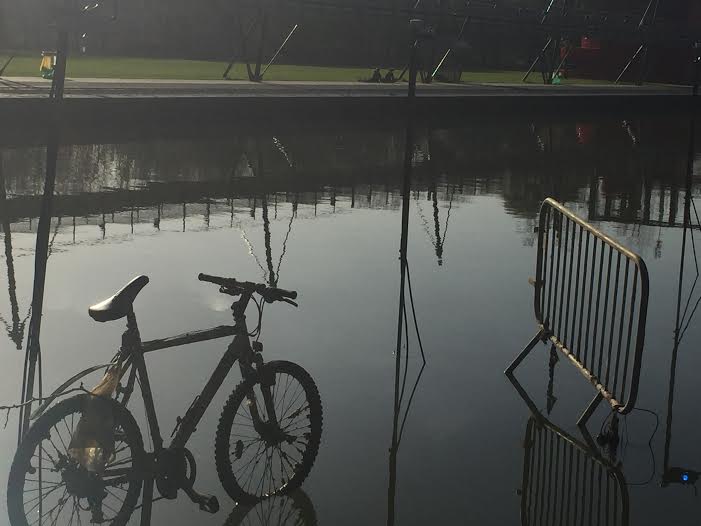
Every fifteen years, since the Canal Saint-Martin was created by Napoleon in 1802, it has to be cleaned. The canal that was once a functioning waterway connecting the Seine to the northern reaches of Paris, looks just like Marcel Carné’s reconstruction in Hotel du Nord (1938) and nothing like its live appearance in Jean Vigo’s L’Atalante (1934). And at the moment, barricaded and empty, it looks like neither. It is undergoing what the French call Chômage. Yes, it’s unemployed and unemployable.

Like most things in Paris, disposal of unwanted household items takes time. Each object must be registered online and garbage collection ordered, before it can be placed on the street with a reference number. Given this process, Parisians sometimes find it easier to dump their worn out safes, fridges, chairs, tables, beds and bikes (both motor and push pedal varieties) in the canal. And why take the shopping trolley back to the supermarket when you can just throw it in the canal? And what better solution for disposing of the spare body parts taking up space at home? Because it’s Paris, each object is catalogued and the list made available for public information on the city’s website.

Michael Pinsky, L'eau qui Dort, 2015
A little further up the canal at la Villette, before the chômage began, the artist Michael Pinsky dredged up the refuse at the bottom of the basin and made an exhibition of the arm chairs, filing cabinets, beds, and the inevitable shopping trolleys, and bicycles that had been dumped. Accompanying the discarded objects that appeared to float on the water as art works, speakers along the edges played the curious music made by young people who used the discarded refuse as their instruments. The sounds were like an avant-garde orchestra, clunking and whirring and scraping, sounds that reminded me of machines, chimes in the wind and household objects in use. As the weather changed and the sun rose and set each day along the canal, the atmosphere created by L’eau qui dort was haunting.

Michael Pinsky, L'eau qui Dort, 2015
As I passed the exhibition on my morning run, I was all at once, enchanted, mesmerized and shocked to see what Pinsky dredged up from the bottom of the canal. I was shocked, not only by the objects he found, but the method that Pinsky used to retrieve them. He simply lowered a line and “caught” these fully formed treasures, it was that easy. The treasures doubled as signal to the degree of waste and unseen pollution spoiling Paris. Every visitor I meet waxes lyrical “Oh Paris, it’s so beautiful.” Those of us who live here know that, like any city, it’s not as it appears on its façade.

Michael Pinsky, L'eau qui Dort, 2015
L’eau qui dort coincided with the Climate Change Conference taking place on the other side of Paris at the end of November 2015. Thus, visitors and passers by were also provoked to recognize the participation of Paris in the devastation being caused to the environment through our own un-thought through actions to litter. In a world in which we are increasingly made aware of the urgency of recycling, creating sustainable environments as a way to return to an integration with our natural habitat, to save the planet for the next generation, Pinsky’s project ticks all the right boxes. It is a wake up call to the irresponsibility of people who pollute the environment through improper waste disposal. As an exhibition, it recycles trash to create an inspiring installation that is really both aesthetically pleasing and unsettling. As I ran along the canal during the weeks when it was in place, the installation filled me with wonder and joy. There was something really mystical and extraordinary watching the out of season sun on the waste of a waterway. And at the same time, it was a bold wake up call to the unseen ways that we all contribute to the devastation of the environment. Together with the three month process to clean the canal Saint-Martin, Pinsky’s project leaves us fully convinced that all those elegant Parisians need to take more responsibility for the health and well-being of their beautiful city.

Tuesday, December 1, 2015

Splendour and Misery: Pictures of Prostitution, 1850-1910 @ Musée d'Orsay

See original image
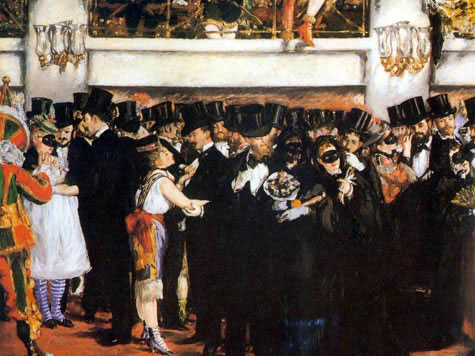
Edouard Manet, Bal masqué à l'Opéra, 1873

I am still digesting the Splendour and Misery exhibition at the Musée d’Orsay. I don’t know whether to celebrate or commiserate its staging as one of the major exhibitions in Paris this fall. In the first text panel on entry into the exhibition, there is a very bold pronouncement of how surprising it is that men were the ones to paint images of prostitutes in the period (1850-1910). This lack of self-consciousness is indicative of the entire exhibition. Of course, it is only men who painted prostitutes because the kind of paintings the Musée d’Orsay exhibits are all made by men: paintings that demonstrate the coincidence of the rise of prostitution and high modernism. But then, I wonder why I was so surprised, because experimental, amateur and private images made by women in the late 19th century are not going to bring in tourist euros.
See original image
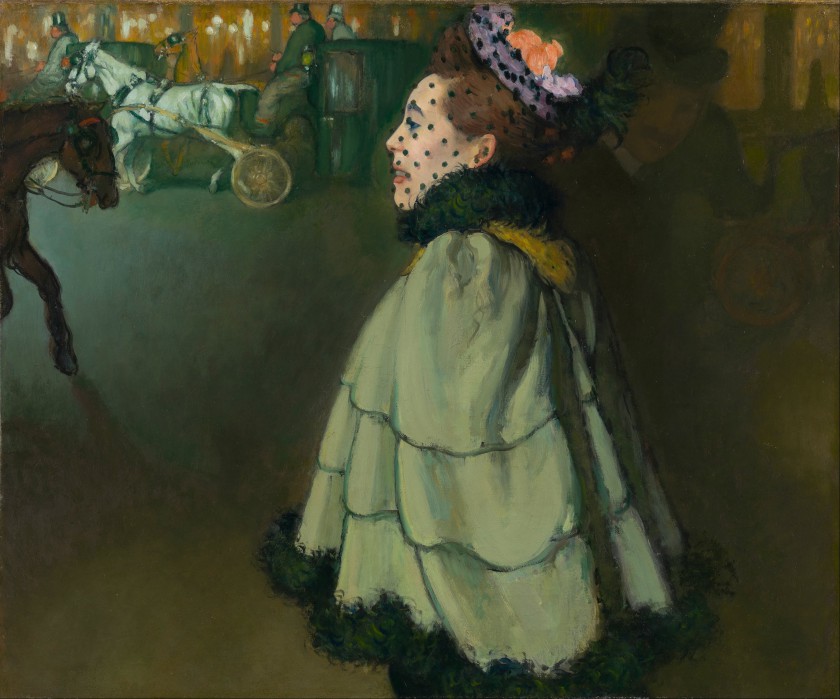
Louis Anquétin, Femme sur les Champs Elysée la nuit, 1889-93 

For all the paintings by French fathers of modernism, there were some interesting photographs and behind closed curtains, some glorious daguerrotypes and early films depicting and advertising sex. These images, like many of the paintings by Musée d’Orsay favorites--Manet, Degas, Forain, Béraud, and Anquetin--were provocative and interesting for many reasons, few of which were raised by the exhibition. In spite of its title and publicity, the exhibition is staged as a history of the rise of prostitution in France.  Thus, paintings and some photographs are used to document the life of prostitutes “in the modern age.” In the couple of rooms that draw attention to the coincidence of technological modernity and prostitution, the paintings are posed as documents of historical events going on outside of painting. Thus, Louis Anquétin’s Femme sur les Champs Elysée la nuit and other paintings in the L’Heure du Gaz room, show that prostitution flourished at night under city street lights. 

Henri de Toulouse-Lautrec - At the Moulin Rouge - Google Art Project.jpg
Henri Toulouse Lautrec, Au Moulin Rouge, 1892-95
Little is said of the complexity of representation found in significant paintings that critique this world. For example, Manet’s Bal masqué à l’Opéra documents the habit of poorer women to find prospective husbands and benefactors at the opera. Manet’s painting is an exquisite representation of class and gender visualized across space, in gesture, costume and in framing, as well as brushtroke and the sweep of the crowd in the composition. All of the replication of the commodification of sex and female sexuality for sale by the complex transformation of Manet’s modernist canvas is lost in an exhibition that prefers to titillate than understand modernist art.

See original image
Louis Béraud, L'Attente, vers 1885
Also troubling about the exhibition is its framing of women as victims of modernity, suffering the social transformations that brought the commodification of sex and men’s desire to exploit women’s bodies for pleasure. Modernity is also about pleasure having an expression or needing to be expressed. What’s missing altogether is any appreciation, let alone, understanding of the different ways that the male artist represented the prostitute. Béraud’s placement of the faceless woman in L’Attente, vers 1885, as an object to be looked at by the spectator as well as the man in the painting is given the exact same status of historical document as Manet’s Irma Brunner, 1880. Manet’s portrait is painted with a face, in profile, given a dignity and an identity equal to that of a noblewoman. And Manet’s empathy for La Prune, 1875 in sumptuous pink, in closeup, bored, beautiful but trapped and framed by the devices around her gives her an identity, a personality and a fate, that is not solely dependent on the men who might be watching her. Looking and who looks at who, or how the woman is positioned within the frame is so different from painting to painting. However, this is completely effaced by an exhibition that is interested in using paintings to tell a story.
See original image
Edouard Manet, La Prune, 1878
Even without going into the theoretical issues of vision and visuality that went hand in hand with prostitution and the transformation to representation in modernity, there are other elements of the paintings that are glossed over. The changing definitions of portraiture that see Toulouse Lautrec’s images of women turned away from him and the viewer, the portraiture of everyday people, how prostitution was also all about performance and parading of sexuality -- going hand in hand with costumes, shopping, the changing identity of men in modern society, questions of spectacle, disconnection, all of which are articulated through looks as well as dress, makeup, lights, performance. These levels of complexity are not foregrounded by the exhibition

Of course, it’s always a treat to see so many great paintings on display in one space. And there are many in this exhibition brought from all over the world. However, in direct proportion to the apparent liberation and equality of women apparently intended by the museum, there is also a persistent oppression and devaluation of women. Of course, we can’t do anything about what painters and photographers in the late-nineteenth century saw on their streets, or how they saw it, but surely we are compelled to educate the next generation of women of the prejudices they face on a daily basis? An exhibition that uses paintings of prostitution to tell a story from the perspective of the men who wrote it--but not always the painters who painted it--does not take responsibility for that education.