Showing posts with label Glass. Show all posts

Sunday, November 26, 2017

Monochrome. Painting in Black and White @ National Gallery, London

Jean-Auguste Dominique Ingres, Odalisque in Grisaille, c. 1824-34
This small exhibition in the National Gallery’s temporary exhibition space is both exquisite and somewhat perplexing. It is a treat to see some of the precious paintings on display, many of which I have not seen in exhibition before. However, there is not much coherence to the works that are displayed in roughly—though not consistently—chronological order.

Image result for stained glass panel with quarries and a female head
Stained Glass Panel with Quarries and a Female Head, c. 1320-24
On entering, we recognize that Monochrome. Painting in Black and White is an exhibition of works that are not all painted, neither are they all black and white, nor are they consistently monochrome. Thus, if the somewhat misleading title is not the point of coherence, what is? Unfortunately, the colour itself does not create strict continuity, because grey comes in so many different shades, tones and hues. In addition to the fact that the works are not all black, white and/or grey, and very few are monochrome, it becomes obvious as we walk around that colour itself is unreliable. Thus, one of the most extraordinary works on display is the Genoa altarcloth, Agony in the Garden, 1538 which is, in fact, oil on blue linen. And the porcelain skin on the back of one of the most famous grey paintings, Ingres’s Odalisque in Grisaille (c. 1824-34), is highlighted in shades of red. Indeed, it’s highly unusual to find paintings that are entirely executed in a grey palette. And of course, this is what makes grey (as opposed to black and white) fascinating: grey is always shifting to the human eye, often because it is mixed with other colours, and even when it is on the scale between black and white, it is never a singular.
 
Josef Albers, Study for Homage to the Square, 1965
Thus, in another painting that is central to the history of grey painting, Josef Albers’s Study for Homage to the Square (1965), the interest of the work is compromised because it sits on a wall by itself. The point of Albers’s colour studies is to highlight the optical effects of the area covered by a colour and its interaction with that surrounding it, next to it, or behind it. That is, we see the individual grey squares as different sizes depending on what is next to them. And when there is only one study as there is here, the comparative effect is lost on the viewer.
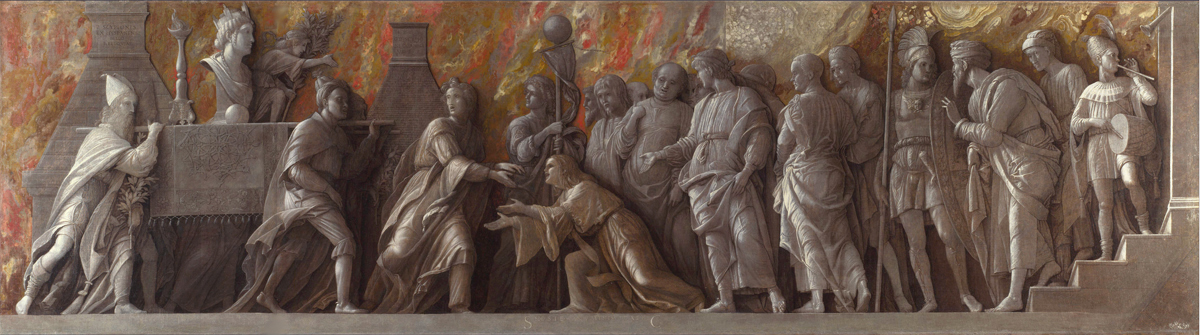
Image result for mantegna the introduction of the cult of cybele in rome
Andrea Mantegna, The Introduction of the Cult of Cybele at Rome, 1505-06

And what of the different media that are displayed?  It’s clear to me why the curators have chosen works in glass, metalpoint, ink, pen and engraving. Because these were the media used for some of the developments in grey, black and white image making from the Renaissance on. However, the rationale for the inclusion of prints is never made clear to the visitor.  Which is not to detract from the fact that there are some marvellous works—including a stained glass panel from 1320. However, together with the diversity and historical reach of the exhibition, these examples muddy rather than clarify the larger perspective.
Frank Stella, Tomlinson Court Park I, 1959
The final room has at its centre Malevich’s Black Square (another of the gallery’s great coups on loan from the Tretyakov Gallery in Moscow). The Black Square was among the paintings that changed the course of Western art history in 1929. Here in the final room, focused on the theme of “Abstraction in Black and White,” opposite Malevich is a minor Jasper Johns painting, and it is surrounded by works as varied as Stella’s Tomlinson Court Park I (1959), two Cy Twomblys, Bridget Riley’s Horizonatal Vibration (1961) and others. It is thus centrally placed, but its influence is lost because it is surrounded by works that are only related by their colour palettes.

Ultimately, while the exhibition is to be applauded for bringing these works together, and for shining the spotlight on black, white, grey, blue and brown, it would have been lovely if it had given a sense of what is so special and intriguing about these colours. More coherence and logic would have gone some way to showing us why we should care about them. 

Friday, December 30, 2016

Kader Attia, Prix Marcel Duchamp 2016 @ Centre Pompidou

Kader Attia, Réfléchir la Mémoire, 2016
The winner of the 2016 Prix Marcel Duchamp, the most prestigious award for a French or living-in-France artist, Kader Attia, is someone to watch. His multi-media installation Reflecting Memory is on display in the newly expanded Gallery 3, together with work by the other three finalists. The French-Algerian Attia's work stands out from the rest for its provocation, empathy and reach between the languages of art, science, history and politics.
Kader Attia, Installation View, Prix Marcel Duchamp 2016

At the centre of the installation is a documentary film, Reflecting on Memory (2016) in which doctors, psychotherapists, a prosthesis engineer, cultural workers, an art historian and a range of other people are interviewed. The interviewees are located across continents, from Lithuania to Paris, to Chicago, each relating their experience and encounter with Phantom Limbs. One health worker tells the story of a patient who complained bitterly of acute pain in his big toe. However, she then asks the off-screen interviewer, what can you say to that when the man's leg has been amputated above the knee? The interviewees discuss the presence and reality of physical sensations that are, in fact, memories of lost limbs. Another therapist tells of a patient who was silent, always. He explains that silence causes anxiety for those who live in its midst, and if the trauma is not worked through and healed, it will be passed on to the next generation: silence means that the children must deal with the "phantom limb," which in this case is a traumatic historical experience they themselves never had.


Kader Attia, Réfléchir la Mémoire, 2016
An African-American professor of theatre from Northwestern University talks of the absence of mourning for slavery in a culture in which slavery still exists. Even if it looks different from pre-Civil War slave labor on cotton farms and Sunday lynchings in town, indeed, even if it is not visible, exploitation and victimization is carried within the contemporary African American body and heart as a memory of their people's treatment by institutions and authorities. All of these different "phantom limbs," serve to create connections between people who might otherwise appear to have nothing in common, people who might not understand the burden of others' trauma. Reflecting on Memory demonstrates that as people we are all in this together and our traumas, whether with individuals or carried by a community, are shared.

Kader Attia, Installation View, Prix Marcel Duchamp 2016

In one of the most powerful interviews, a strikingly beautiful young man talks about his upbringing in France by an Algerian mother. The man tells of his practice as a choir boy, his baptisim, confirmation and so on, as she insisted on his education within the catholic church. For him there was no arabic spoken as a child, clearly as his mother made sure her trauma was not passed onto her son. However, as we know by this point in the film, it's not that simple. As he goes on to explain, the silence of the past must be unearthed and addressed if healing is to happen.
Kader Attia, Réfléchir la Mémoire, 2016

Perhaps the most powerful few minutes of the film come at the end—because the film is shown on a loop, the revelations may come at the beginning—when we learn that a number of the interviewees are in fact missing a limb. Though the discussion throughout has been about the use of mirrors for the rehabilitation of pain caused by a phantom limb, it came as a complete surprise to me that the people appear to have both legs or arms thanks only to the use of mirrors. In the end when the mirror is removed, and the figures are shown with missing limbs, of course, we look at them differently. But not in the same way that we would if we had not just spent the past 30 minutes learning of the stigmatization and pain endured by the phantom limb. The film shows these are brave and extraordinary warriors against so much more than their physical ghosts: their absent limbs come to symbolize the injuries of slavery, genocide, terrorism and the collective and individual injuries that befall us all. Thus Attia's film dismisses all notions of difference between "us" and the abstract "them" when it comes to suffering and loss. And for that reason alone, Reflecting on Memory makes a powerful statement in a contemporary political climate that would have us believe the very opposite.  


Images from Réfléchir la Mémoire courtesy Lehmann Maupin, and Galerie Krinzinger. Photo Credit Kader Attia @Adago, Paris 2016. 
Installation View images courtesy Centre Pompidou

Monday, November 10, 2014

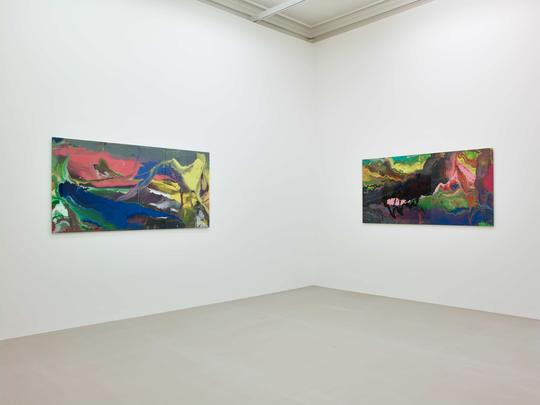
Gerhard Richter in Marian Goodman's Gallery. On Golden Square, London

Strip, 2013
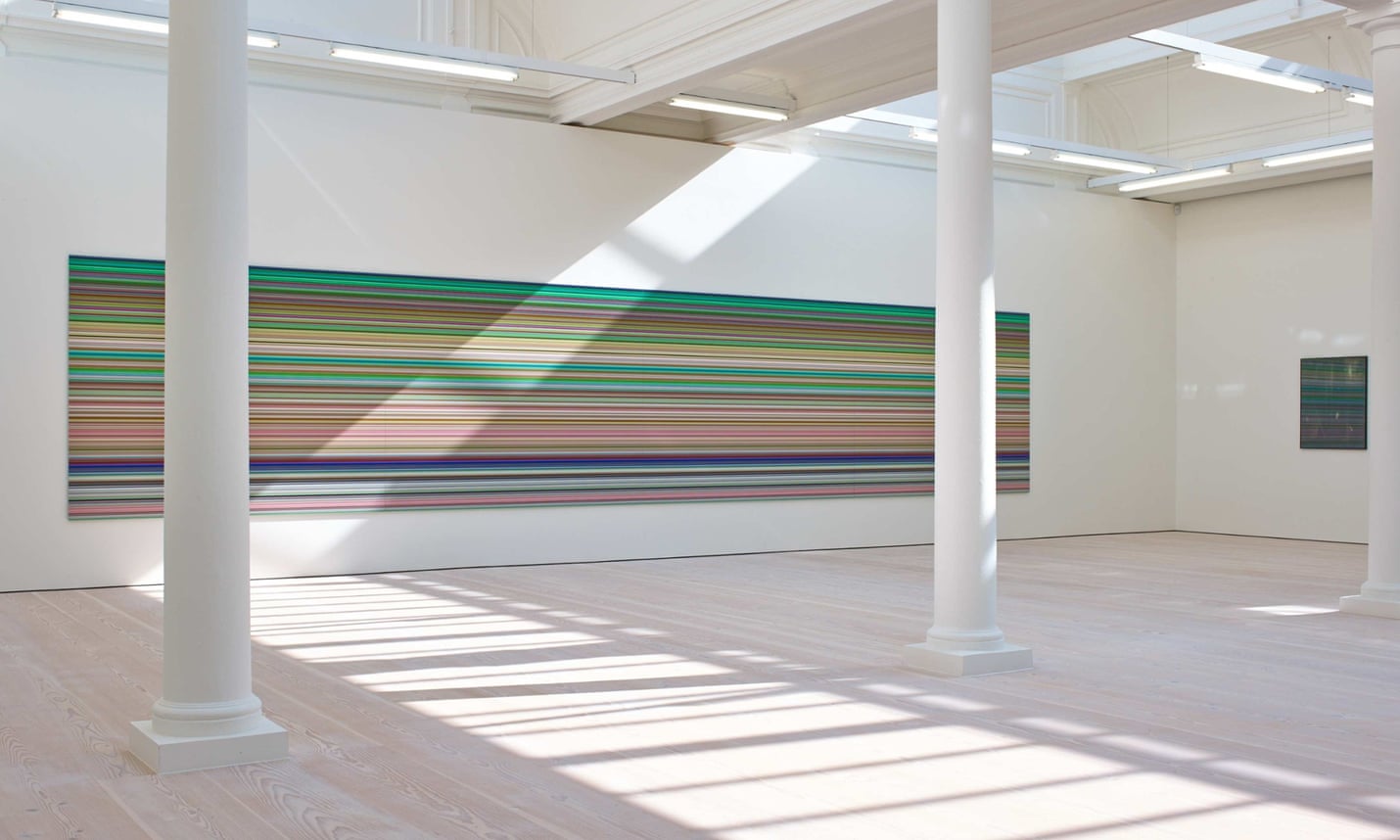
Gerhard Richter, Strip 930-1, 2013

Marian Goodman has finally opened an exhibition space in London. It is stunning. In an old industrial space on Golden Square in Soho, it’s grand, spacious and on the evening I visited, was filled with London’s misty late autumn light. Anyone who thinks they have seen enough Gerhard Richter paintings, will still want to visit gallery’s inaugural exhibition, Gerhard Richter, if for no other reason than to be inside this inspiring new space. And anyone – like me – who thinks they have already seen the Richter works needs to see them here on display at Marian Goodman. Because their inhabitation of the superb new space makes it like seeing them for the first time.
7 Panes of Glass (House of Cards), 2013
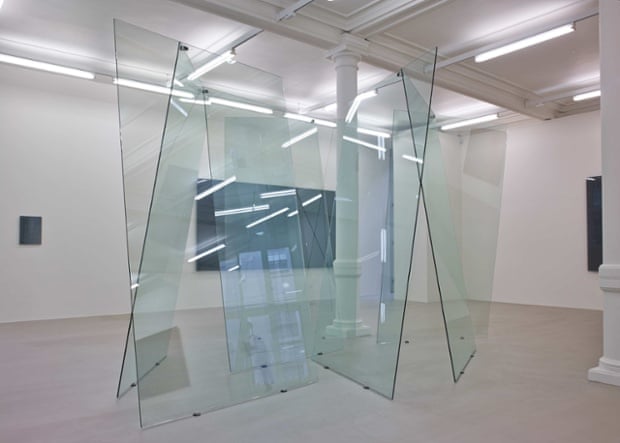
Gerhard Richter, 7 Panes of Glass (House of Cards), 2013
House of Cards is perhaps Richter’s most baroque, and simultaneously, futuristic piece of art. It is filled with distortions, reflections, fragility and a monumentality that dissolves as soon as we are absorbed into the piece through our reflection on the glass faces. In typical Richter contradiction, the glass sheets remind us both of Richard Serra’s precariously placed steel plates and, of Richter’s own accord, the ice flows of Casper David Friedrich’s The Sea of Ice (1823-24). They are both fragile and intransigent, continually shifting and incomprehensible. Filled with the reflection of neon lights, other paintings, and the visitors who try to make sense of the House of Cards, the glass sheets are mesmerizing.

image not avaialable
Gerhard Richter, Doppelgrau, 2014
A series of four Doppelgrau, 2014 works are Richter’s most recent pieces in the exhibition. Paint and glass come to belong together to create diptychs. While Richter has fused paint and glass together for years, Doppelgrau introduce something new to his oeuvre. They go back to grey, an intensity of and serious focus on grey that has not been seen since the Eight Grey were presented at the Deutsche Guggenheim in 2002. And like those works, we question the status of Doppelgrau. Are they sculpture? Paintings? Architectural? Is it important to distinguish the two different greys? Or even, what shade of grey is actually used? And what is the reference to art history? They are diptychs afterall. Unlike painting as we know it, the Doppelgrau works encourage us not to look. We are distracted by the reflection of other paintings, and beyond their existence on the wall of the gallery, there is nothing to look at. I was left with more questions than answers for Doppelgrau.

Installation view Image
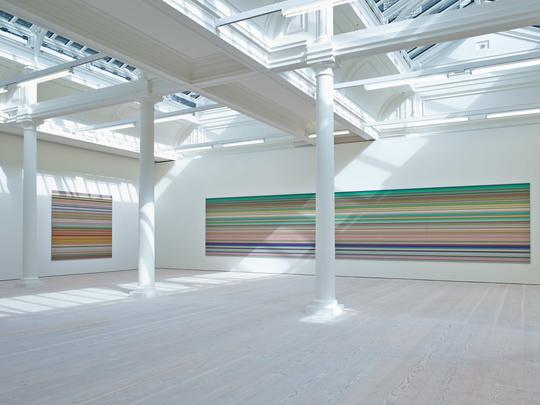
Gerhard Richter, Installation View at Marian Goodman on Golden Square
Upstairs, under the iron and glass windows of the old factory ceiling, a series of Strip paintings from 2012 and 2013 fill the walls. Here, Richter’s painting has become clean, cold, and finite – but then, of course, as usual, these examples are simultaneously, none of these. The lines extend forever off the side of the image. I was enthralled to find – especially with the ten metre long versions – the velocity of the works. Up close, there is nothing to see, nothing to contemplate, and so, I walked the length of the painting, to find it had me racing, moving at a high and intense speed. There was nothing finite or cold about it. I can’t describe the logic behind the speed of physical movement they encourage, even demand. I just noticed that they had this effect. And yet, in the middle of the room, away from their influence, I felt as though I was standing in a cathedral built for the Strip paintings. Light pours through the windows, and without me up close, the paintings are left with each other, creating a perfection that makes them holy. They sit there in this magnificent space, together in complete silence.

Installation view Image
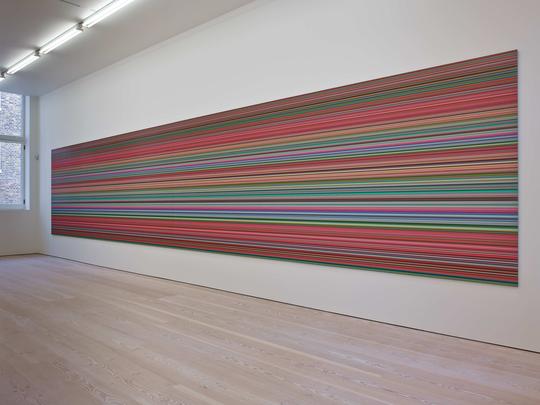
Gerhard Richter, Strip 930-2, 2013
Installation View
The Strip paintings are like landscapes, horizontal, and infused with the familiar Richter elusiveness. I wonder if they are so different from the fifty years of paintings that precede them. They may have lost the luscious, tactile oil paint of the overpainted photographs, but the sensuousness has only been transformed, it is not erased. It is no longer found on the surface, in the paint, but it can be found in the unpredictability of the interaction, between the movement, placement of the viewer and the paintings themselves. As Richter gets older, his work becomes increasingly conceptual. There is nothing to do but walk along the length of the Strip paintings, because they are all but impossible to look at. Their movement, their psychedelic colours hurt the eye with optical illusions. Here the image has all but disappeared. So we have reached this place where not only is there nothing to see, but like the cinema, Richter's image no longer exists an object. Painting has become transparent, translucent and not even a surface. Or at least, when it is a surface, it is simultaneously violated as a surface. 

Installation view Image
Gerhard Richter, Flow 933-4, 2013 and Flow 933-3, 2013
Installation View
The paintings I find least appealing are also those that seem to capture all that Richter's work is about: the Flow paintings are about being in process. In these paintings, the unexpected here arises out of and in the narrative unfolding – Flow captures that invisible moment that can’t be touched. It is the randomness of the moment that Richter decides to stop. And this is the moment that he gives to us in a painting, a moment that is always elusive, always in the process of becoming something that we can never touch, and in his most recent works, can no longer see. 


Thursday, July 25, 2013

Dynamo: Un siècle de lumière et de mouvement dans l’art 1913-2013

Anish Kapoor, Untitled, 2008
Until we reached the films by Viking Eggeling, Walther Ruttmann, and Paul Sharits I couldn’t decide whether the problem with this exhibition was the works on display or the way they were exhibited. But then I saw the likes of Tony Conrad’s Flicker, 1966 — a film I always claim, as Annette Michelson announced to me when I was a student, to be the most brilliant film ever made. The inclusion of a selection of films from the 1920s international avant-garde and 1960s & 70s America convinced me that the works were chosen and curated to create something closer to a fun park than an art exhibition. Dynamo is a typical example of a Paris blockbuster designed to attract the summer crowds to the Grand Palais. Dynamo opens with Anish Kapoor’s Untitled, 2008, three metal concave discs that embrace us with their energy as we step into what feels like a magical space transformed sonically as well as visually and conceptually by the discs. However, the exhibition goes downhill quickly, not through any fault of the art, but a design intended for maximum thrill and minimum provocation.


As we wandered through the spaces my friends and I were treated to a visceral experience in which we were carried away by movement, overcome with nausea, disorientation and constantly followed by the persistence of vision, confronted with optical illusions. The experience with many of the works results in a questioning of our own space, and our own orientation within this space. It was a lot of fun to take photos inside the exhibition, to see how so many of the art works are transformed through the iphone lens. We oohhed and ahhed at Dan Flavin’s light works as they refracted colour through the camera to become their opposite, complementary colour. We were consumed by the mysterious and ethereal light creations of James Turrell, mesmerized by the lights in motion of French artist François Morellet, never being able to fully grasp their rhythms and logics.


Although I knew some of the artists' work, and admired that of others, I found myself moving through the exhibition at a fast pace, looking at the work as though looking in the distorting mirrors in a fun park. Any claims that individual works might be making about modern art had no resonance: the possibilities and productivity of light as a medium, the profundity of light as a tool for the organization and transformation of space, its power over human vision, its agency to deceive, to design, to create and diminish time were discursively concealed or bracketed by this smorgasbord of light and movement art. When I reached the experimental films at the end, I realized how much I was missing a context for the works on display. The European avant-garde and structural American films in their time broke every rule of representation, of cultural expectations, of how we understand ourselves in relationship to the visual art object. And yet, in Dynamo, they were displayed as yet another form of visual eye candy that would entertain the masses at the Grand Palais. And the greatest sin of all? They were shown on small screen monitors in DVD format.  


All in all, Dynamo provided pleasant refuge from the heat of a Paris July afternoon, but did nothing to engage or broaden its audience’s experience of the parameters of modern and contemporary art. It was fun from beginning to end, but in my books, that’s not enough to call an exhibition successful. 

Wednesday, June 26, 2013

Mike Kelley au Centre Pompidou


A Band playing in the Serbian Cultural Centre 
As I sat listening to the mélange of rock and roll being played out in the streets last Friday night for the annual Fête de la Musique, I wondered if my cultural experience for the evening could have been more different. Fête de la Musique is a fun, happy, popular event when amateur bands, performers, choirs and musicians of all kinds set up in whatever space they can find on Paris streets and start playing. In the Marais, the music tends to be rock and roll; so it is loud, not always refined, but in true Paris style, people of all ages come out to join in the fun.

In my favorite space of the Centre Pompidou, the South Galleries that give onto the plaza on one side and the Niki de Saint Phalle sculptured pool on another, I had spent the evening at the Mike Kelley “retrospective” put together to mark his untimely death.

The more I think about Kelley’s work, the clearer and more disturbing it becomes. To the point where, after a few hours, on reflection, I want to say that a lot of the pieces on display at the Pompidou Center are frightening. Whereas, when I was in the exhibition I was more perplexed than emotionally affected by the work. It’s the lingering effect of seemingly benign, or hastily put together conceptual installations, that make this work so powerful. Kelley’s art is an onslaught — of sounds, images of all media, objects, lights — all of which somehow come together into some of the most searing political statements made by contemporary art.
Mike Kelley, Exhibition View @ Centre Pompidou
Perhaps the most disturbing works are those that figure children’s very worn, soft fluffy toys, arranged into perverse, sexually suggestive positions. They are often dismembered, placed on the wall as though they are paintings, on the floor like sculptures, photographed as portraits. A number of the series feature these stuffed toys and other references to childhood  Half a Man, 1987; Ah … Youth, 1991). These are usually discussed by critics as embracing a nostalgia, with a sentimentality of reminiscence. To me, these works are more sinister, and more disturbing than the idea of a lost innocence might suggest. The mere display of these assumedly once loved toys is unsettling, if only in its turning of the private lost world of childhood inside out to become a public performance. Many of the stuffed animals and toys are physically distorted, often suggesting sexual activities. Whether this is ironic, or critical or simply good old fashioned fun, whether the sexual connotations are sublimated or unconscious, the display of very worn children’s toys, having been dismembered, sometimes sewn together with the next one is, for me, incorporating a violation of all that is meaningful in childhood. Similarly, there are gestures towards corruption, pain and a lot of misunderstanding.
 
Mike Kelley and Tony Oursler, The Poetics Project, 1977-1997
One of the most striking and brilliant of the series in this retrospective is that of The Poetics Project which Kelley did together with Tony Oursler, exhibited at Kassel in 1997 for the Documenta X. Oursler’s contributes his familiar video projections in shocking colours over talking heads, and other footage on screens, objects, mirrors, paper cut outs. Together, the artists have designed musical soundtracks that overlay the images. The music is apparently the creation of Kelley and Oursler’s rock band from the late 1970s and 1980s, “The Poetics.” Once again, the experience is one of bombardment with music and image, the perspective and effect changing as the visitor walks around the series.
Mike Kelley, Kandors
I think my favorite pieces were the Kandors series; oversized belljar chambers on LED screens, sculptures, videos that are apparently inspired by Superman’s home kryptonite city. The city itself is miniatiarized, just as Superman believed it to be, and placed inside the bottles, like a precious, carefully crafted object. However, it is not Superman’s lost city that is the delicately crafted art work here, but the huge bell jars that are surely extraordinary glass objects that were so difficult to fabricate because of their scale. The installation is colourful and tongue in cheek, moving from the deeply moving to the light hearted LED screens on which the jars breathe as if the otherworldly realm of Kandor is still alive, laying low as it waits for the future to arrive and set it free.

Mike Kelley, Memory Ware Flat
Kelley’s work is rarely aesthetic, and often I found myself looking dazed at the collages, assemblages, sculptures, videos and so on, trying to work out what was happening in each piece. This said, the two pieces that faced the glass façade that overlooks the fountain were extremely beautiful. Memory Ware Flat, # 18 in which beads, jewellery, watches, buttons are immersed in resin, reuse treasures filled with meaning and memories are framed to create what Kelley called “paintings.” Of course, because it is Kelley, there is also a strong derision of practices of collecting, keeping, and the accompanying nostalgia. In an otherwise very cerebral exhibition, the two Memory Ware Flat pieces were anomalies.