Showing posts with label light art. Show all posts

Thursday, August 8, 2024

Light Installations at Tate Modern

Anthony McCall, Face to Face, 2013

There are some amazing light works currently on display at Tate Modern. I ventured down to the Southbank to see Anthony McCall's Solid Light exhibition and was pleasantly surprised to find other super interesting work in the cavernous ground floor tanks of the Natalie Bell building. 

I have long been a fan of Anthony McCall's Light Describing a Cone (1973) as it was one of the first and purest iterations of light as a medium. In the vein of Laszlo Moholy-Nagy, McCall uses cinema to create light installations. Animated line drawings are projected as a circle in the process of closing, or a shape forming over approximately 30 minutes. A haze machine produces an artificial mist, filling the lines created by the throw of the image, making them look like three-dimensional solid objects. Thus a cone, for example, appears as the film progresses. Added to this is the engagement of the museum visitor who is drawn to interrupt the light projections with fingers, hands, heads, manipulating and transforming solid light sculptures into three dimensional abstractions. 

The uniqueness of the works is their invitation to look from different angles. Visitors can watch the line forming a shape on a scrim or screen opposite the projector, in front of them. Or, they can look into the projector lens to see the line forming on the film strip, and equally, interact with the work as a three-dimensional sculpture. Indeed, the interaction of visitors adds a layer of animation that makes the works performative, not simply art works to look at. On the day I visited Tate Modern, children sat in front of the beam to split it, adults held their spectacles in front of the beam to blur the lines of the shape being projected. Still other people huddled under the tent-like mist, looking as if they were protected from the world. Effectively, once visitors engaged, bringing body and light projection together, the works shifted from art works to be looked at to a playground of light to be revelled in. 

I have to admit, while the interactive aspect was fun to experience, the transfer of McCall's work to digital left the artistic magic a little wanting. A glitch in one projection resulted in a very disappointing broken circle. The absence of the whir of the projector and the immediacy of light projected film — surely a significant element in the original installations — made the exhibition somewhat gimmicky.

Paul Maheke, Levant, 2018

Downstairs, Paul Maheke's Levant was among a series of rooms housing light installations. Maheke's video shows dancer/choreographer Ligia Lewis dressed in black against a black background, her body barely visible. The text accompanying the video mentioned Maheke's inspiration by theorists such as Edouard Glissant and Audre Lorde. I find the notion of the power of invisibility and disappearance to be compelling. It is a visual language which enables black people to evade capture and commodification because they cannot be seen or located. Together with the electronic music of Nkisi (Melika Ngombe Kolongo), Maheke's video of the spectre-like Lewis dancing produces an image of searching and elusiveness. Apparently Maheke filmed Lewis while wearing a headlight and dancing with her. This process is made visible through a shaky and constantly moving image, creating an effect of uncertainty, anxiety, and slipperiness to the figure. 

Felix Gonzales-Torres, Untitled (March 5th) #2, 1991

Also downstairs in the tanks is a very touching work by Felix Gonzales-Torres. His works are always moving because of the connection they have to his deceased boyfriend who is never represented, but always present. In this untitled piece, the inclusion of the lover's date of death in the title, clearly reminds us of his significance. Twin light bulbs illuminate a vault-like space, gently reminding us of the two coming together as one, and yet, the ongoing possibility that one of the lights might go out at any moment. When this happens, the light cast is halved, showing the loss and incompletion of the one without the other. Inside a darkened, vault-like space, the warm light creates an emotional piece thanks to all of its associations. 

Wednesday, March 25, 2020

Christian Boltanski, Life in the Making @ Pompidou

Faire son temps : Christian Boltanski au Centre Pompidou
Christian Boltanski, Depart,  Life in the Making
There will be no surprises in this exhibition for visitors familiar with Christian Boltanski's work. Boltanski is an artist who has been preoccupied with similar issues for fifty years, and he found a language in which to express those ideas very early in his career. Moreover, since the 1990s, the innovation has not always been in the works themselves, but in the way the installations are exhibited. In fact, the most interesting iterations of his work have often been the unique and interesting spaces of exhibition. 
Christian Boltanski exhibition at Paris Centre Pompidou - Pictures ...
Christian Boltanski, Les Regards, 2011
On entering Life in the Making on the top floor of the Centre Pompidou, I felt as though I was entering a mausoleum. The temporary exhibition walls are painted a dark grey, the lighting of Boltanski's black and white images is minimal, if it exists at all, and the mechanically sounding heart beat - no doubt the artist's own - drums through the entire space. To the point where the presence of the thumping heartbeat becomes subliminal, working on a deeper level of consciousness, underlying every step, and no doubt, leading to headaches for some visitors. As we move through the exhibition spaces, the black and white family photographs lining the walls plunge us into the familiar Boltanski world of memory, pathos and hopelessness. Given the sounds and images, I was puzzled by the exhibition's title, Life in the Making. Because nothing here resembles life in the present, in the making, or the pleasure of simply being alive. Rather, in familiar Boltanski fashion, everything points to death.
Image result for christian boltanski faire son temps
Christian Boltanski, Autel Chases, 1987
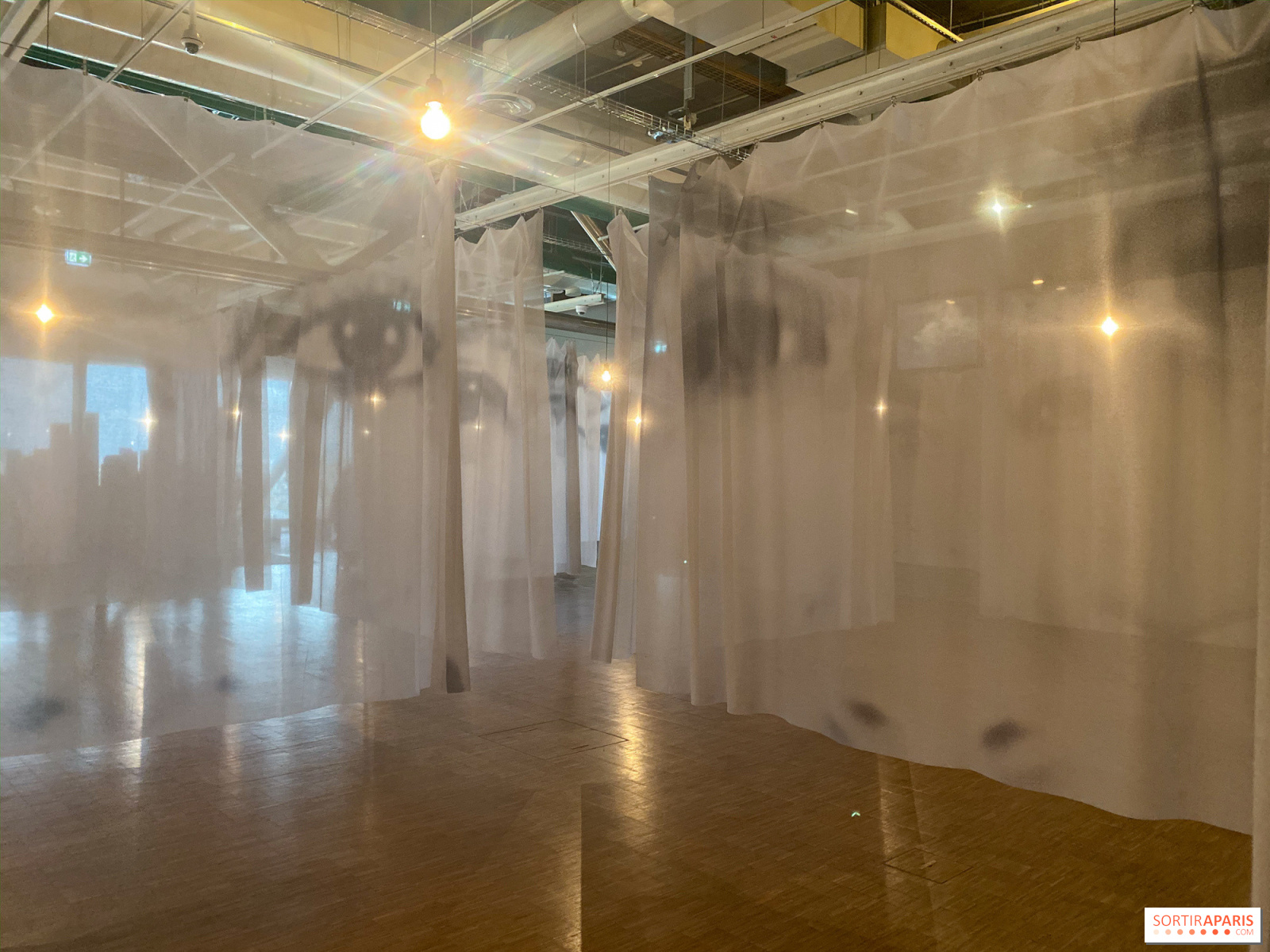
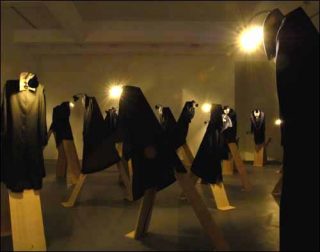
An enormous pile of black clothes, le Terril Grand-Hornu, 2015 resembles the charred remains of the unfortunate people to whom they might once have belonged. A single electrical light bulb hangs above the tip of the pile, barely illuminating the signifiers of death below. It's impossible to see any kind of life after death inside this dark, depressing world. Even when death is far from the work, it's memory haunts our thoughts and imaginations. Thus, for example, in his well known use of images of school children, in a work such as Après in which photographs show anonymous faces of girls smiling as they play in Hamburgerstrasse in Berlin, the blown up, indistinct, anonymous faces printed on very thin, torn veils are haunted by the fact that the girls must be dead. The children may not be  dead, but Boltanski reproduces their portraits in such a way that they remind us of ID photographs of Holocaust victims, or sufferers of other kinds of violence; they are votives encouraging us to mourn.  
Christian Boltanski, Prendre la Parole, 2005

Or in the row upon row of columns made from rusted steel boxes, each with a small photograph on its front, we cannot help but imagine that each box contains the ashes of the person depicted or naming the box. Or perhaps their valuables have been placed in the box, as if in a vault, for safekeeping. Either way, there is no suggestion that anyone is coming back to collect their belongings. 
Christian Boltanski, Les Registres du Grand-Hornu
1997

Boltanski grew up with a father who, as a Russian Jew, had escaped deportation by hiding underneath the floorboards for over a year. The profound effect this had on Boltanski's father is potentially taken up throughout the son's art across decades. The icons and symbols of the death camps are everywhere recognizeable, even if they are not present, in the works: piles of clothes, great numbers of blurred, anonymous faces with blackened-out eyes in photographs printed on flimsy cloths, black mirrors and veils, as well as sound installations that evoke practices of witnessing death and trauma. Of course, the exhibition and the museum are now closed in keeping with the government shutdown. However, should further reiterations of Life in the Making be staged elsewhere, Boltanski's work might just be seen as an omen for the end of the world that appears to be approaching through the silent city streets of our time. 

Saturday, September 15, 2018

Laurent Grasso, OttO @ Galerie Perrotin

Laurent Grasso, OttO, 2018

Laurent Grasso’s OttO is a complex and fascinating exhibition that ticks so many of my personal “not to be missed” boxes. The experimental film that gives its title to the exhibition, OttO was filmed in the Australian outback in the region of Ayers Rock and the Olgas on the territory of the Yuendumu aboriginal community. Grasso sent drones and hyperspectral cameras into the air to video the otherwise invisible energy and activities of the earth and its atmosphere. As an Australian, I grew up knowing all about the Aboriginal Songlines that were brought to international renown by Bruce Chatwin’s 1987 novel with that same title. The Songlines are the dream paths that follow the spirits of the earth that, in turn, give life and meaning to Australia's indigenous cultures. Each of these paths has a song that is the language of the Dreamtime, which, when sung brings the aborigines together with the earth, rocks, and vegetation as they wander nomadically across their ancient land. Grasso’s cameras find their own different paths, but still in the spirit of the Songlines.
Laurent Grasso, OttO, 2018
It’s striking to see the desert through Grasso’s drones, to wonder at the energies that are made visible and to think of the 65,000 years of history that are contained in the lines they trace. And perhaps most profound of all is that while we might have wrought havoc on much of the earth’s atmosphere, polluted the seas and built structures that cover over the tens of thousands of years of history secreted by the land, the Australian desert is largely untouched by human manipulation. It is uninhabitable. Deserts like this area of Northern Australia have the last laugh; together with the sea, they are perhaps the only places left where we can still connect to the prehistoric, to the history of time. Give or take the erosion and other time related changes, the desert is surely one of the last places that looks like it did 65,000 years ago. It is also one of the last places on earth where the spirit of the earth can still enter into our beings.

Laurent Grasso, OttO, 2018
Grasso’s film underlines our diminished importance in the face of this land. The activities of the atmosphere and the land, the weather and the skies are unceasing and frenetic; we see flames bursting out of rock crevices, water veins suddenly appearing, and a vast, incomprehensible salt lake (presumably Swanson Lake) appear in the middle of nowhere. This landscape is a phenomenon that undoes any ideas we might have that we will ever fully understood and conquer this world. It is an infinite mystery.
Laurent Grasso, OttO, 2018
The images recorded through the drone show rocks, red earth, and the wild growth of the desert floor. And then in images from the hyperspectral cameras, we see a world in brilliant, glaring colours, filled with spectres and shadows, the secrets of a magnificent landscape revealed for their vibrant and unceasing energy. In among the shapes in gaudy yellows, purples and reds, we see the form of a man in an Akubra hat. He is apparently Otto Jungarrayi, a Waripiri Elder who guided Grasso across the terrain. Otto's figure is fused together with the land and its energy, making visible his place across generations in the weaving of Songlines in the Dreamtime. The booklet given out at the exhibition tells us that Otto has a counterpart: Winfried Otto Schumann (1888-1974) a German physicist who discovered “the low frequency reflecting in between the earth’s surface and the ionosphere and its wavelength coincided with one over the integer of the circumference of the Earth.” In other words, Otto Schumann made a scientific discovery that would eventually lead to Grasso’s visualization of the invisible mysteries that have given substance and meaning to indigenous Australians for thousands of years.

Laurent Grasso, OttO, 2018
Exhibition Installation
Galerie Perrotin
The remainder of the exhibition includes images and objects that support the theme of making visible the invisible energies that surround us in a world we otherwise think we know and command. The physics, electronics and technology that Grasso uses to make his art are sophisticated, and he includes multiple historical, philosophical and artistic references to elevate his works into conceptual sculptures that, nevertheless, can be aesthetically exquisite. His materials of glass, steel, ether, copper, light, wood, stone and even screens, are sumptuous, and they remind us of the textures and reflections, the unseen turns that we overlook in the objects and images on the paths of our daily lives. Grasso’s work is riveting and not to be missed—even for those who are not tied to the Australian outback as a spiritual home.


All images courtesy Galerie Perrotin

Monday, December 4, 2017

William Forsyth x Ryoji Ikeda @ La Grande Hall, La Villette

Image result for ikeda at la villette
Ryoji Ikeda, Test Pattern. 
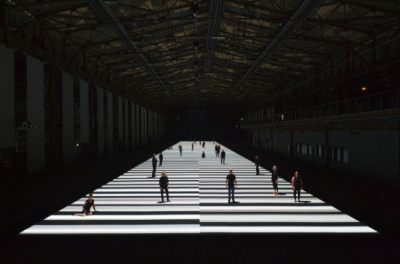
I have seen a number of Ryoji Ikeda’s installations over the years, and in this current one in the Grande Hall at La Villette he reaches a whole new level of creation, affect and meaning. On entering the Grande Hall we hear a strange technically produced sound by which we are pulled into the most spectacular of Paris’s former slaughterhouse spaces enclosed by a glass and cast iron structure. The visuals of the work laid out across the floor of the hall are a highly complex “test pattern” in which Ikeda has translated the everyday images that bombard and surround us into electronic form. The result is a fluctuating series of black and white lines, bands, grids moving unpredictably in a test pattern that is simultaneously hypnotic and slightly disturbing. It is like stepping onto an enormous pulsating barcode. The sound is likewise culled from the everyday and translated into a dramatic technobeat. Together, the sound and image form a complete environment that envelops us, overwhelms us and simultaneously soothes us. To stand in the middle of this highly structured chaos is like being in the middle of an endless ocean of sound and images. Or, as my friend with whom I visited the installation remarked, it’s like being on acid.


My visit to the piece was made even more compelling by a young dancer who improvised a performance over the test pattern. His movements were led by the sound and the light as they swept up and across the floor. Even non-professional dancers will intuitively move to the beat as they walk across and around the environment. Indeed, this physical engagement with the light and sound is imperative because only then can we experience the unpredictability of the music and light patterns. No sooner do we find the beat than it changes. Ikeda’s work is this mix of the most sophisticated mathematical computations, engineering design and an old-fashioned culling from the popular cultural environment. What impressed me most was its appeal to everyone: with the involvement of professional dancers, Sunday strollers, parents and children, old and young alike, this work unlike others of his I have seen was a community event.
 
William Forsythe, Nowhere and Everywhere at the Same Time no. 2
Across the hall is William Forsythe’s Nowhere and Everywhere at the Same Time no. 2. In this piece hundreds of pendula hang suspended from the tracks of an automatic rig at ceiling height. We are invited to enter the space and move among the pendula, but are warned not to touch or disturb them. Until we are inside the forest of pendula we don’t realize that it is actually very difficult to avoid the hanging weights. Because they constantly change speeds and move in different, unpredictable directions. Presumably through a computer designed algorithm, the pendula change the speed and arc of their trajectory according to the shifting speed and direction of the tracks above from which they are suspended. Thus, the experience is unsettling: we begin casually strolling through the pendula, and then, suddenly their speed changes and we have to run, jump, twist and contort our bodies to evade them. This sense of their command over us created a kind of ominous feeling when inside the installation. Watching others from the cast iron balcony above it was possible to see how they evoked anxiety, a heart rush, panic, all in the attempt to avoid touching them. There was literally nowhere to go dor refuge from their predatory movements.

Image result for william forsythe nowhere and everywhere at the same time
Forsythe inside Nowhere and Everywhere at the Same Time no. 2
Brighton Festival

Once again, the inanimate objects dictate (not simply influence) the movement of the human body: we have no choice inside their system that is ungraspable to us. Forsythe as the vanguard choreographer is here committed to exploring the form and limits of human movement. And while it is fascinating to find see our bodies move in ways we do not expect if we follow the dictate of the pendula, it would also be interesting to see Forsythe himself dance inside the installation.  Because it is on tour around Europe and has been to the US, there may still be opportunity to experience this. 

Monday, May 16, 2016

Zentrum für Internationale Lichtkunst, Unna, Germany

Mischa Kuball, Space Speech Speed, 1998/2001
Unna, a sleepy town in North East NRW has one attraction that makes the effort to get there worthwhile: the Centre for International Light Art housed in an old brewery. The exhibition spaces are built into the underground storage, cooling and change rooms, that is, spaces otherwise cloaked in complete darkness. It is, apparently, the only museum of its kind, devoted solely to light installations. This makes it a big drawcard, and though I enjoyed the visit, I was slightly disappointed. More on that later, first, what’s most impressive is the array of international artists’ whose work is exhibited here. There's no Dan Flavin, Bruce Nauman Anthony McCall or Robert Irwin, but many major contemporary international light artists have at least one piece on display in the bowels of the unrenovated Linden Brewery.
Olafur Eliasson, Der Reflektierende Korridor, 2002
Built for the working brewery 120 years ago, no one space is the same as the next, and no space seems to have a natural or logical connection to the next. Accordingly, each art work, exploits this isolation and is contained by its space. Thus, the experience is one of going from room to room, where corridors and transition spaces constitute discrete and often unusual spaces. This is all to say, the experience is not one of wandering through the light installations, but more a series of unrelated immersions in light. Most impressive are those works that engage with the architecture of the building. In one of the most extraordinary works, Olafur Eliasson has us walk across a grated bridge between what at first appears to be a curtain of sparkling light on either side. And then, as we step close to the curtain, our feet get wet. The beads of light are created through spot lights above shining on drops of water as they cascade into the pool beneath the grated bridge. The confusion of what we are seeing, hearing, touching, even smelling, is the most outstanding example of the lesson taught by a number of these sculptural installations. Visual perception is only the first of the multi-dimensions of light art.
Lichtkunst
Keith Sonnier, Tunnel of Tears for Unna, 2002
Some of the works are confronting, again in ways that surprise. Keith Sonnier’s Tunnel of Tears for Unna installed in a storage space, for example, turns the rough hewn walls, lined with pipes, switches, butts and other paraphernalia into red and blue tunnels. Sonnier plays with the familiar visual effects of opposite colours, so when we are in the space bathed in red through murano glass fluorescent tubes, we look back at a white lighted space and it appears green. And then when we move to the blue room beyond the red one, the white becomes yellow. Most surprising of all is the warmth we experience over time standing in the blue light, and then when we move back to the red, it is harsh, cold, alienating. This is the surprise of Sonnier’s tears: blue and red are supposed to create cold and hot respectively, not the other way around. From Sonnier we also learn that light is an emotional experience. The confrontation of the harsh red light is so unexpected. Furthermore, we are reminded through this confrontation that the seeing is just the beginning of our experience of light.

Image result for james turrell third breath unna
James Turrell, Third Space, 2009
Image result for james turrell third breath unna
James Turrell, Third Space, 2009
Light art, like the stuff itself, comes in many different media or types of light. The exhibition includes a lot of neon, as the chosen material of the -post-Nauman generation of light artists, but there is also a very special natural light art work using the sky over Unna by James Turrell. Turrell has made a camera obscura in the only above ground installation. It’s a simple circle cut in the ceiling of a purpose built room (not part of the original brewery) through which day or night light falls onto a circular marble slab inside. Turrell place lenses in the circular opening, and thus, when inside the room, we look down at the sky as it moves across the opening above. Thus, it is not only the image that is inverted through Turrell’s camera obscura but logic too: we look down to see what is above us. In addition, the clouds in the sky seem to race across the opening, a striking antithesis of their apparent stillness when we stand below and look at them above us. Having spent the last two hours in the catacomb-like spaces below ground, immersed in neon and artificially created spaces, coming above ground to be in the midst of Turrell’s creation, I was amazed by the fact that, all along, nature gives us, afterall, the most surprising art work.

Francois Morellet, No End Neon (Pier and Ocean), 2001

There are many other works - by Joseph Kosuth, François Morellet, Christian Boltanski, Rebecca Horn and Mischa Kuball among others. As we go through the spaces, we are given new perspectives on space, on our body, on the relations between art and nature, above and below ground, all of which we experience through our own movement and senses. My one disappointment in the exhibition was that, even through a large number of works intelligently engage the spaces they occupy, none of them engage the history of the production processes or the work and activities that once took place in the Brewery or its spaces. This, in itself, is not a criticism. However, considering the tendency of public artworks, even those in museums, to engage the history of the region’s past in the Ruhrgebiet, it would have been interesting to see light works engage on this level. Energy, water, light are all key to the industrial production that gives the region its identity, and I would have thought it’s acknowledgment would make this museum more than just the only one devoted solely to light art. Otherwise, once down in the storage spaces of the Linden Brewery, we could be anywhere in the world.