Friday, November 28, 2014

Constructing Worlds: Photography and Architecture in the Modern Age @ Barbican


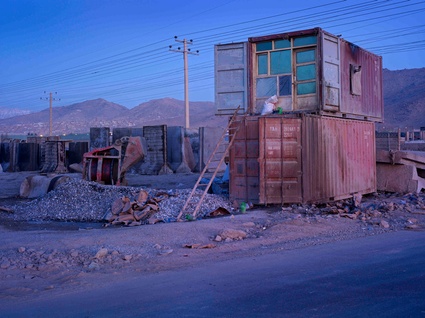
Simon Norfolk, A Home Made of Shipping Containers, Kabul
I had many questions of this vast exhibition of photography. Is it really about the intersection of photography and architecture, or is architecture the thread that loosely holds together a certain history of art photography in the twentieth century? The photographers collected here are among the most celebrated of the last 100 years, and it’s really exciting, if overwhelming, to see all their work together. Strictly speaking, however, a number of the photographs in the exhibition were not about architecture. Works by Berenice Abbot, Walker Evans, and later on, Simon Norfolk and Nadav Kander, among others, are exemplary of the development of photography and its negotiation as representation of space over the past 100 years, but they are not representations of architecture. Space, light, surface, and their intersection with photographic representation are the more likely foci of Constructing Worlds.
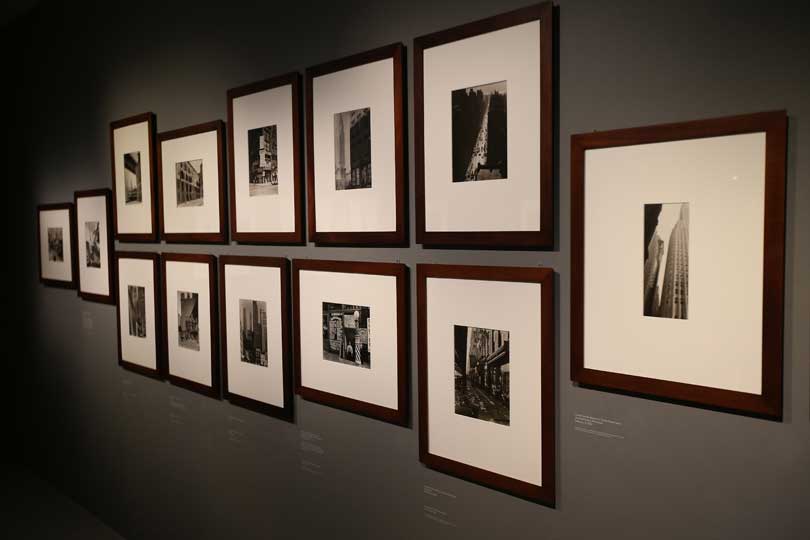
Berenice Abbott's photographs in 'Constructing Worlds'.
Berenice Abbott's photographs in Constructing Worlds
My second question for the curators is the size of the exhibition. As I say, there is no doubt that it is a treat to see all these great photographs in one space, but to be honest, I found it too much. It is impossible to get an overall sense of over 250 photographs by 18 photographers, that span the 20th and 21st centuries, as well as every continent on earth. With this challenge in mind, here are my thoughts.

What stood out for me was my introduction to some photographers I wasn’t previously familiar with and to those by others whose other work I know well. Hiroshi Sugimoto’s blurred and confused spaces and places of erasure are breathtaking. And they become haunting, unforgettable when we learn that they are actually representations of the World Trade Towers in 1997, four years before they were destroyed, it is as though Sugimoto knew the fate of the twin towers. Sugimoto’s long exposure technique has produced a very different, but nevertheless, powerful result in these huge black and white images.   
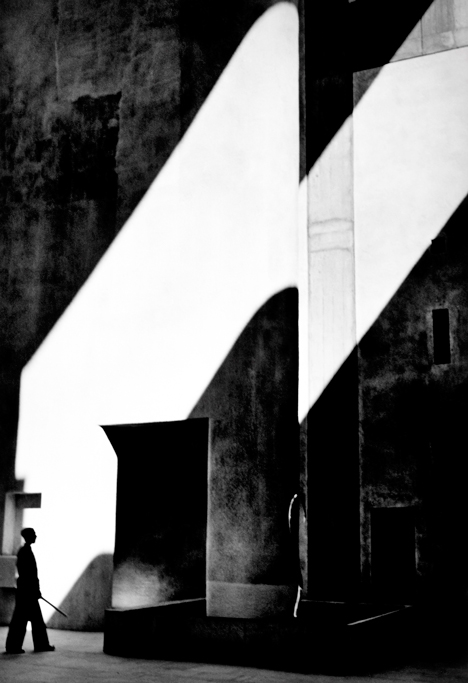
Lucien Hervé, High Court of Justice in Chandigarh, 1955
Upstairs, Lucien Hervé’s photographs of the High Court of Justice in Chandigarh, India 1955 stood out for their abstraction among works that were, for the most part, interested in some form of documentary realism. Hervé’s almost delicate images are both an ode to the medium of photography as no more and no less than images of light. Hervé more than anyone else in the 1950s represented in the exhibition is pushes the image in its relationship with architecture into abstraction through silver gelatin prints. And simultaneously, as he photographs Le Corbusier’s radical building, he finds an architecture as well as a mode of representing it that breaks new ground in the 20th century.

Guy Tillim,  Apartment Building Avenue Kwame Nkrumah Maputo Mozambique, 2008
By the time I reached Guy Tillim’s photographs downstairs, I was convinced that photography is the superior medium; its flexibility, vast possibility and ability represent, reconstruct and document all at the same time. And yet, I was frustrated again because Tillim’s familiar sensuous, but rough and organic surfaces are almost de-politicized when we don’t get any information regarding the production and more importantly, his printing process. Tillim’s technique is everything. To be sure, of course, the images are about the dilapidated, derelict government buildings and luxury hotels, the state of decay of his native post-colonial Africa. But the blunt, hard vision of Africa is brought to life through his use of pigment ink on cotton rag paper to give the buildings a wet texture that is key to their political edge. Along the same lines, nothing is mentioned of Gursky’s digital manipulation of the image in production and post-production to stretch the underground subway station of Sao Paolo, Sé (2002) in his characteristic rendering of an everyday space of capitalism, an isolated superficial structure.
Nadav Kander, Chongqing IV (Sunday Picnic), Chongqing Municipality
2006

Nadav Kander’s photographs of the Yangtze River and the industrial developments that have taken place there are mesmerizing. Their empty, effaced backgrounds, the traces of structures that could be from the past or the future, it’s difficult to say which, are at first glance, almost Romantic. And then up close, the enormity of the structures, their overwhelm of the people takes over, becoming ever more noticeable. In what is unusual for the photographs in this exhibition, people existed in the reconstructed worlds of China, but they are always dwarfed by the development of industry along the Yangtze. And for us, who are so aware of the imperative to take care of our landscape, Kander’s photographs show the violation of a landscape that otherwise has no hope. Thus, after time, the transformation of the river is like a descent into hell shown in Kander’s images.

I also enjoyed seeing Simon Norfolk’s Afghanistan images. His excessive use of filters simultaneously creating a superficial vision of bullet scarred, war torn Afghanistan, as well as exposing how the same spaces are repurposed to functional everyday uses. There is no mercy in this world – sun and light may shine brightly on seductive landscapes, but they are populated by buildings and worlds that have been destroyed. The irony is everywhere in Norfolk’s images.
Luisa Lambri, Darwin D. Martin House (1905)
designed by Frank Lloyd Wright, 2007
 Luisa Lambri’s negative spaces were compelling and lyrical, as she finds what cannot be documented, what is left unspoken for in the built environment. Her prints explore corridors, doorways, thresholds, the caverns and crevices that might otherwise be ignored.  Lambri’s are in the same vein as Hélène Binet’s captivating images of the Libeskind Jewish Museum in Berlin. But where the latter creates dimensionality and volume through filling space with light, Lambri does the opposite, closing down the spatial environment so that only what is otherwise invisible is traced in light. I was interested to see that these two examples of work that no longer expose the structures and surfaces of the architectural, are by women. It’s women who are interested in space, in the unsaid, the invisible.

Hélène Binet, Jewish Museum, Berlin, 1998
And in this, their work strongly resonated with that of Berenice Abbott upstairs. In the 1930s, the student of Man Ray was interested in finding the spaces that are completely taken up by buildings, closing out sky. Abbott’s photographs were about the density and intensity of New York, the city it would become, sculpted through the intensity of the relationship between light and the camera, the chiaroscuro able to be created through the specificity of the photographic medium. 

Friday, November 14, 2014

Pierre Huyghe, In. Border. Deep @ Hauser and Wirth, Saville Row

Installation View of In. Border. Deep @ Hauser and Wirth
The Pierre Huyghe exhibition at Hauser and Wirth’s London galleries, In.Border.Deep, was fascinating. The gallery which feels enormous thanks to very high ceilings was blackened out, and on entering, I was overwhelmed by a sense of foreboding. The sounds of what could have been a broken machine, or a madman intermittently hitting a steel post, infused the air with an ominous mood. As often happens in such exhibitions where there is a saturation of visual, or in this case, the erasure of the visual, and aural stimulation, I didn’t know where to begin. I was also captivated by one of the gallery attendants watering a huge sculpture, or cast, which had grown moss over its body. Standing there, watching her, looking for orientation, I wondered what I had entered.

Pierre Huyghe, La dérasion, 2014
There was something very human about the care being taken to feed the headless statue, in this otherwise cold, dark environment in which intermittent industrial sounds cut through the air. Apparently (and I missed this) the sculpture contains an internal heating system that mirrors the human circulatory system, enabling it to grow moss. Similarly, I read later that the sculpture’s body temperature can be felt by the visitor. I was so taken by the care with which the moss was being nurtured that I didn’t spend much time with the statue itself.

Pierre Huyghe, La déraison, 2014
Pierre Huyghe, Nymphéas Trasnsplant, Live pond ecosystem, 2014
This fascination for living bodies, and creatures pervades the whole exhibition. The living habitats of Monet’s geo-engineered ponds in Giverny from 1893 and the subject matter of his famous Nymphéas paintings, had been transplanted into three fishtanks. Apparently, the lighting system for the tanks was determined by the weather at Giverny in the years when Monet painted the Nymphéas. These pieces represent an extremely complex ecosystem that pushed the tanks into the realm of conceptual art. Because they were covered in switchable glass, the water looked murky, and coloured, as though the grime had built up in the tank over months of not being cleaned, but lived in. It was as though each tank contained a science-fiction experiment gone wrong. And yet, it was quite the opposite: independent living organisms from the past, continually reminding us of the uncertain future arising out of the clash between nature and technology.

Pierre Huyghe, Human Mask, 2014.
Pierre Huyghe, Human Mask, 2014
Behind a partition was another apocalyptic piece: a film titled Human Mask in which a monkey wears a mask and clothes to assume the persona of a young girl working as a waitress in a restaurant. The film opens with footage of a deserted Fukushima in 2011, so from the beginning we know this will not end well.  It’s an experimental film that never lets us look for long at the monkey, but as the monkey starts to show repetitive behaviors, solitary circuits of the enclosed space of the kitchen, serving guests that are not there, picks at her hands, we start to empathize with her. I found myself becoming angry at whoever had put her in this environment. The sound of a tap dripping onto a plastic container is isolated and magnified to sound mechanical. Maggots are found inside the container, and the monkey’s world becomes frightening, enclosed, and we see her as a victim. At one point she sits before a wall with a painted scene, curtained windows behind her which seem to cover an artificial light. Like the fishtanks, the space that should be nourishing (the restaurant) and life-giving reeks of death, disease, apocalypse.

Pierre Huyghe, Human Mask, 2014
 Framed by Huyghe’s clean aesthetic images and sculptures, these creatures inhabit worlds that turn into horror movies. Like the mixing of sounds to make them abstract, the spaces are no more real than those we imagine. He is creating individual works, that straddle interesting fences and break many rules, both those art is expected to follow, and the moral an ethical rules of the world we inhabit. My only disappointment was that I hadn’t seen his exhibition at the Pompidou Centre last winter. 


Images Copyright the artist/Hauser and Wirth

Monday, November 10, 2014

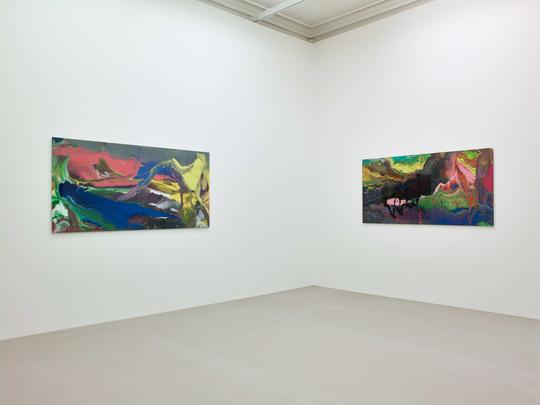
Gerhard Richter in Marian Goodman's Gallery. On Golden Square, London

Strip, 2013
Gerhard Richter, Strip 930-1, 2013

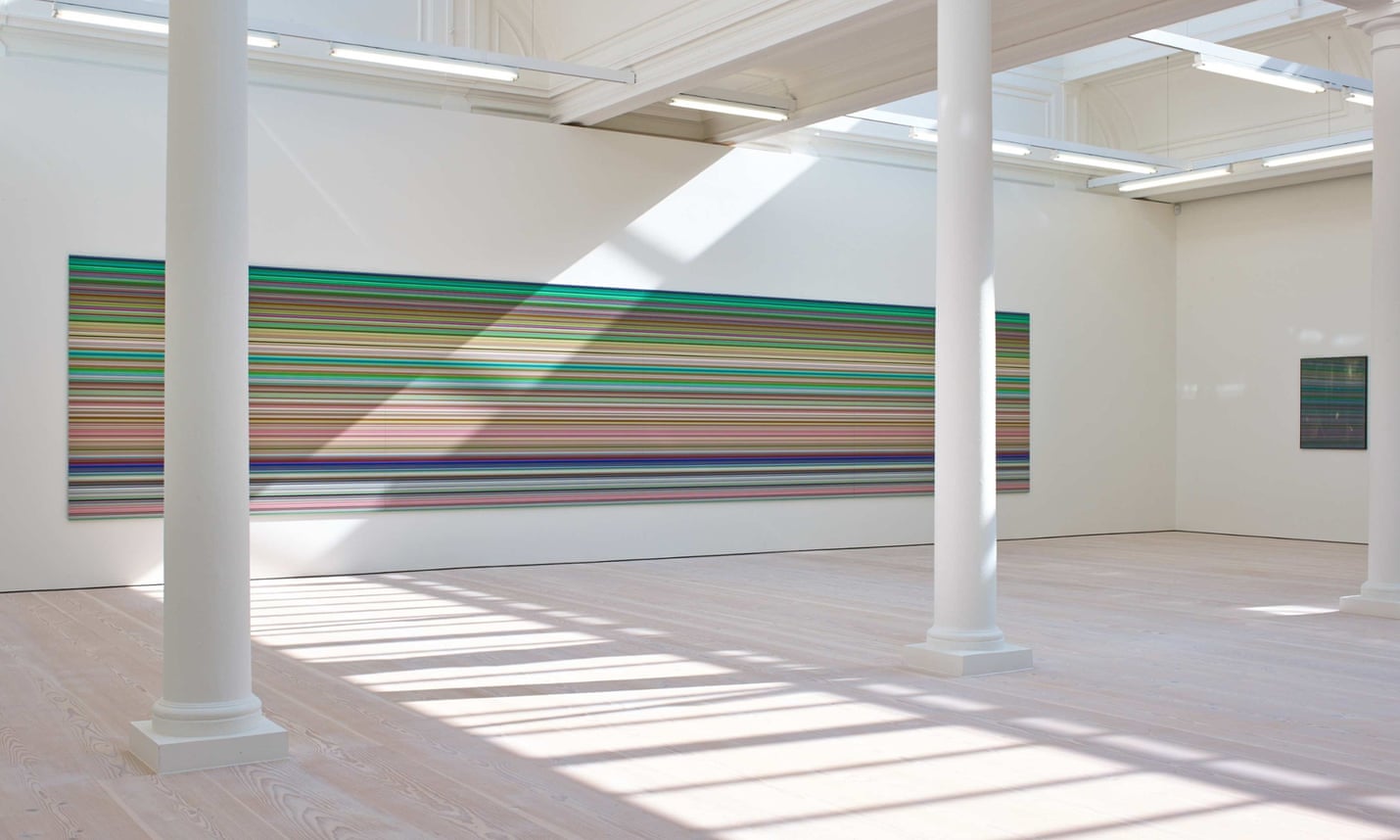
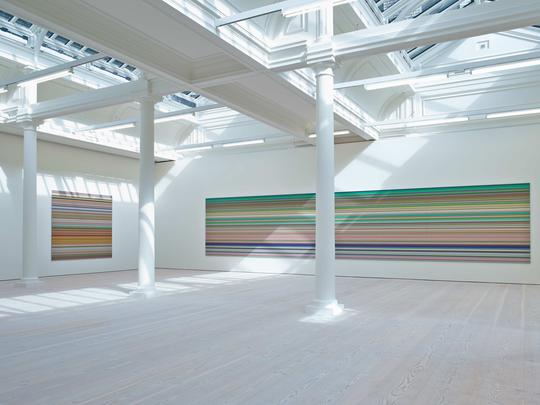
Marian Goodman has finally opened an exhibition space in London. It is stunning. In an old industrial space on Golden Square in Soho, it’s grand, spacious and on the evening I visited, was filled with London’s misty late autumn light. Anyone who thinks they have seen enough Gerhard Richter paintings, will still want to visit gallery’s inaugural exhibition, Gerhard Richter, if for no other reason than to be inside this inspiring new space. And anyone – like me – who thinks they have already seen the Richter works needs to see them here on display at Marian Goodman. Because their inhabitation of the superb new space makes it like seeing them for the first time.
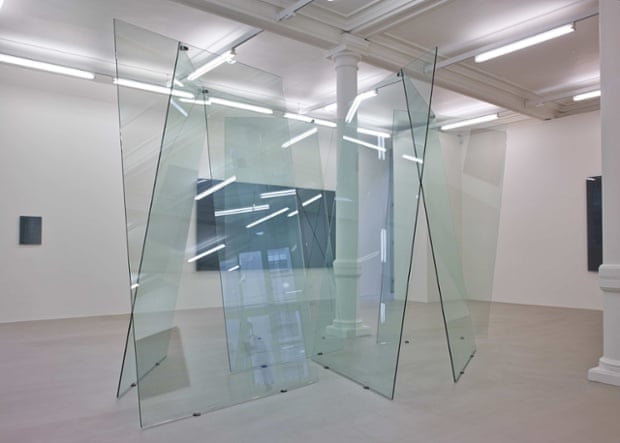
7 Panes of Glass (House of Cards), 2013
Gerhard Richter, 7 Panes of Glass (House of Cards), 2013
House of Cards is perhaps Richter’s most baroque, and simultaneously, futuristic piece of art. It is filled with distortions, reflections, fragility and a monumentality that dissolves as soon as we are absorbed into the piece through our reflection on the glass faces. In typical Richter contradiction, the glass sheets remind us both of Richard Serra’s precariously placed steel plates and, of Richter’s own accord, the ice flows of Casper David Friedrich’s The Sea of Ice (1823-24). They are both fragile and intransigent, continually shifting and incomprehensible. Filled with the reflection of neon lights, other paintings, and the visitors who try to make sense of the House of Cards, the glass sheets are mesmerizing.

image not avaialable
Gerhard Richter, Doppelgrau, 2014
A series of four Doppelgrau, 2014 works are Richter’s most recent pieces in the exhibition. Paint and glass come to belong together to create diptychs. While Richter has fused paint and glass together for years, Doppelgrau introduce something new to his oeuvre. They go back to grey, an intensity of and serious focus on grey that has not been seen since the Eight Grey were presented at the Deutsche Guggenheim in 2002. And like those works, we question the status of Doppelgrau. Are they sculpture? Paintings? Architectural? Is it important to distinguish the two different greys? Or even, what shade of grey is actually used? And what is the reference to art history? They are diptychs afterall. Unlike painting as we know it, the Doppelgrau works encourage us not to look. We are distracted by the reflection of other paintings, and beyond their existence on the wall of the gallery, there is nothing to look at. I was left with more questions than answers for Doppelgrau.

Installation view Image
Gerhard Richter, Installation View at Marian Goodman on Golden Square
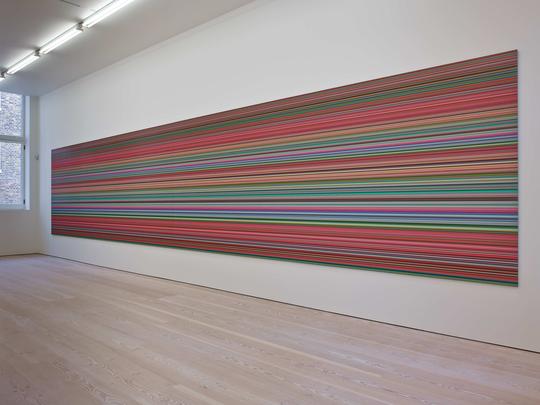
Upstairs, under the iron and glass windows of the old factory ceiling, a series of Strip paintings from 2012 and 2013 fill the walls. Here, Richter’s painting has become clean, cold, and finite – but then, of course, as usual, these examples are simultaneously, none of these. The lines extend forever off the side of the image. I was enthralled to find – especially with the ten metre long versions – the velocity of the works. Up close, there is nothing to see, nothing to contemplate, and so, I walked the length of the painting, to find it had me racing, moving at a high and intense speed. There was nothing finite or cold about it. I can’t describe the logic behind the speed of physical movement they encourage, even demand. I just noticed that they had this effect. And yet, in the middle of the room, away from their influence, I felt as though I was standing in a cathedral built for the Strip paintings. Light pours through the windows, and without me up close, the paintings are left with each other, creating a perfection that makes them holy. They sit there in this magnificent space, together in complete silence.

Installation view Image
Gerhard Richter, Strip 930-2, 2013
Installation View
The Strip paintings are like landscapes, horizontal, and infused with the familiar Richter elusiveness. I wonder if they are so different from the fifty years of paintings that precede them. They may have lost the luscious, tactile oil paint of the overpainted photographs, but the sensuousness has only been transformed, it is not erased. It is no longer found on the surface, in the paint, but it can be found in the unpredictability of the interaction, between the movement, placement of the viewer and the paintings themselves. As Richter gets older, his work becomes increasingly conceptual. There is nothing to do but walk along the length of the Strip paintings, because they are all but impossible to look at. Their movement, their psychedelic colours hurt the eye with optical illusions. Here the image has all but disappeared. So we have reached this place where not only is there nothing to see, but like the cinema, Richter's image no longer exists an object. Painting has become transparent, translucent and not even a surface. Or at least, when it is a surface, it is simultaneously violated as a surface. 

Installation view Image
Gerhard Richter, Flow 933-4, 2013 and Flow 933-3, 2013
Installation View
The paintings I find least appealing are also those that seem to capture all that Richter's work is about: the Flow paintings are about being in process. In these paintings, the unexpected here arises out of and in the narrative unfolding – Flow captures that invisible moment that can’t be touched. It is the randomness of the moment that Richter decides to stop. And this is the moment that he gives to us in a painting, a moment that is always elusive, always in the process of becoming something that we can never touch, and in his most recent works, can no longer see.